
AstroChart
What is AstroChart?
AstroChart is a free astrocartography calculator designed to help people explore how different places around the world may relate to their birth chart. Instead of treating a birth chart as something that stays on a page, the platform places planetary lines on an interactive world map, making it easier to explore locations connected with themes such as career, relationships, personal growth, home, and change.
The experience starts with a few basic details: birth date, exact birth time, and birthplace. From there, the system creates a personalized map showing the planetary lines associated with the individual's chart. It is particularly useful for people thinking about relocation, planning meaningful travel, comparing cities, or simply curious about why certain places feel unusually significant.
One of the strongest aspects of the service is its accessibility. The core astrocartography map is available without a subscription, while additional reports and ongoing features are available for users who want deeper analysis.
Key Features
- Free interactive astrocartography maps based on birth information.
- All 10 major planetary lines, from the Sun through Pluto.
- Four major angles: MC, IC, ASC, and DSC.
- Personalized birth chart calculations and interpretations.
- Interactive world map for exploring different locations.
- Location-based interpretations covering career, relationships, home, identity, growth, and other life themes.
- Additional astrology tools including birth charts, relocation charts, synastry, solar returns, transit charts, and an ephemeris.
- City comparison and decision-oriented reports for users who need help evaluating specific locations.
User Interface
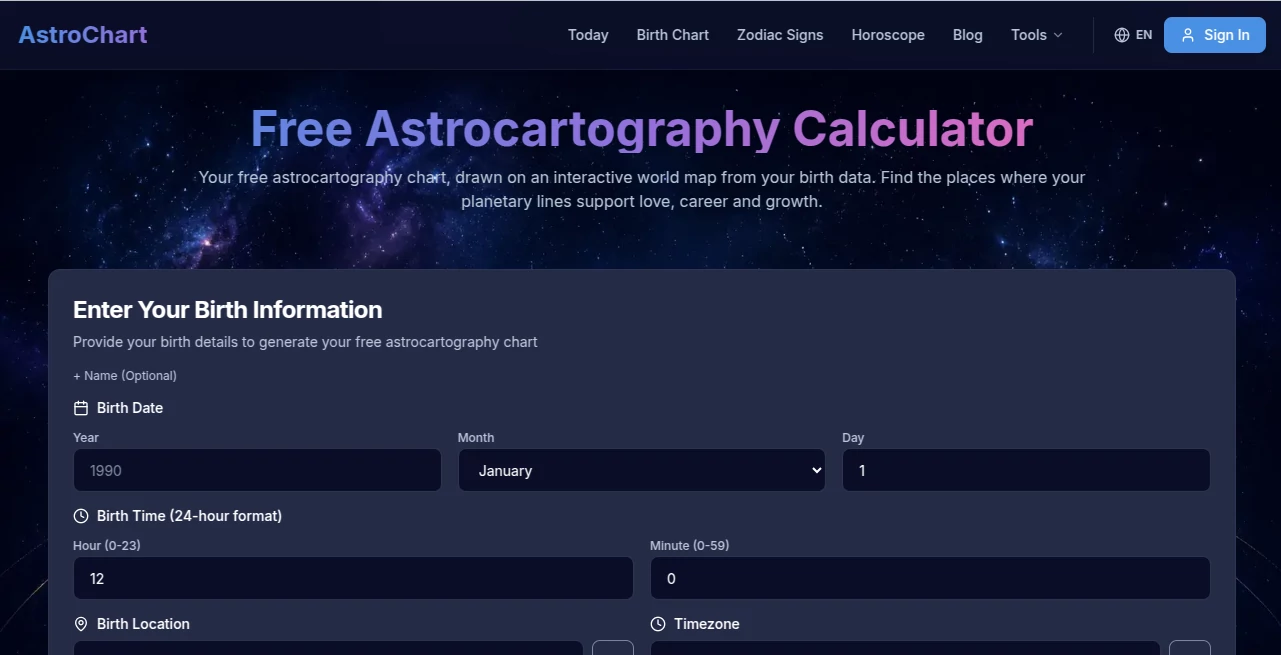
The interface is built around a simple idea: enter your birth information and explore the resulting map. The birth-data form is straightforward, with fields for date, time, location, timezone, and optional name. Cities can be selected directly, while coordinates can also be entered manually when a location cannot be found.
The interactive map is particularly helpful because astrocartography can otherwise feel complicated when presented only as a list of planetary positions. Being able to see the lines across a world map gives users a much more intuitive way to investigate cities and regions that interest them.
The platform is also designed to work across desktop and mobile devices, so users can explore their chart without needing specialist astrology software.
Accuracy & Performance
The calculation system is one of the more technically interesting parts of the platform. It uses Swiss Ephemeris with DE431 planetary data and calculates the locations where planets were rising, setting, culminating, or at the IC at the moment of birth.
Historical timezone information, including daylight-saving changes applicable to the birthplace and date, is taken into account when converting birth information to Universal Time. This matters because even relatively small errors in birth-time handling can change the resulting astrocartography lines.
The site states that calculations are completed in under a second. More importantly, the free map includes all ten planetary lines rather than limiting the free experience to a small preview.
Capabilities
The platform goes beyond a basic map generator. Users can investigate the meanings associated with Sun, Moon, Mercury, Venus, Mars, Jupiter, Saturn, Uranus, Neptune, and Pluto lines, while also considering whether a line falls on the MC, IC, ASC, or DSC angle.
For example, MC lines are associated with career and public visibility, IC lines with home and family, ASC lines with identity and self-expression, and DSC lines with partnerships and relationships. This structure makes it possible to look at the same planet from different perspectives rather than treating every planetary line as having the same meaning.
The wider collection of tools also covers birth charts, relocation charts, relationship compatibility, solar returns, transits, rising signs, Moon signs, and other astrology-related calculations. For users who want to move from a broad world-map view into a more specific analysis, these additional tools provide a natural next step.
Security & Privacy
Birth date, birth time, and birthplace can be sensitive personal information, so privacy is an important consideration when using any astrology calculator. The platform states that birth information is processed in real time and is not permanently stored.
The service also explains that privacy is one of its core values. Users should still review the current privacy policy before entering personal information, particularly when using any online service that processes location and birth data.
Use Cases
There are several practical ways people can use an astrocartography map. Someone considering an international move might compare several cities and look at which planetary lines pass nearby. A traveler could investigate a destination before booking a trip. Someone interested in relationships might pay particular attention to Venus or Moon lines and their relationship-oriented angles.
Career-focused users can explore locations associated with Sun, Jupiter, or Saturn on the MC, while someone looking for a period of reinvention might investigate Uranus-related locations. The value is less about receiving a single predetermined answer and more about creating another perspective when comparing places.
The decision report is especially useful for a concrete choice. It can compare up to three cities against a particular goal and provides a verdict alongside 90-day timing windows. The report is available as a web report and PDF, making it suitable for users who want something they can revisit later.
Pros and Cons
Pros
- Free access to a complete astrocartography map.
- All 10 planetary lines are included in the free experience.
- Uses Swiss Ephemeris and DE431 planetary data.
- Interactive world-map visualization makes complex information easier to explore.
- Includes several related astrology tools in one platform.
- Birth information is stated to be processed in real time rather than permanently stored.
- Offers both a one-time decision report and a subscription option.
Cons
- Astrocartography is based on astrological traditions and should not be treated as scientific evidence.
- Understanding planetary lines and their four angles can take some time for beginners.
- Some advanced features require a paid plan.
- The usefulness of the interpretations depends heavily on how comfortable a user is with astrological concepts.
Pricing Plans
The core experience is unusually accessible because the free plan costs $0 and provides an astrocartography map containing the lines for all 10 planets, along with a birth chart and core interpretations. The free plan also allows up to three saved charts, relocations, and synastry charts.
For users facing one specific location decision, the Decision Report costs $39 as a one-time payment. It compares up to three cities for a selected goal, provides a verdict and 90-day timing windows, and includes a web report and PDF. One month of the Weekly Sky Report is also included.
The Pro plan costs $15 per month and is aimed at users who want ongoing analysis. It adds daily readings, weekly personalized sky reports, active planetary-line information, chart-based questions, city rankings and comparisons, unlimited saved charts, additional chart types, PDF reports, an ad-free experience, and priority support. An annual option is also offered with a stated 33% saving.
How to Use the Tool
- Enter your birth date, exact birth time, and birth location.
- Confirm the timezone and location information shown by the calculator.
- Generate your personalized astrocartography map.
- Explore the planetary lines crossing different regions and cities.
- Identify the planet and angle associated with each line.
- Look at locations that match your particular goal, such as career, relationships, home, travel, or personal growth.
- Compare several potential destinations rather than relying on a single line.
- Use a relocation chart or decision report when you want a deeper look at a specific city.
Comparison with Similar Tools
Many astrology websites offer birth charts or basic astrocartography maps, but the experience here is more focused on connecting astrological information with geography. The interactive world map makes it easier to move from an abstract planetary interpretation to an actual location.
Another advantage is the combination of accessibility and technical detail. Users can access a complete free map while the underlying calculations use Swiss Ephemeris data. At the same time, people who want more than a map can move into relocation charts, synastry, transit analysis, city comparisons, and decision reports.
For someone who simply wants a quick horoscope, this type of platform may be more detailed than necessary. For someone specifically interested in the relationship between astrology and place, however, the combination of mapping, calculations, interpretations, and location-based tools makes it a particularly useful option.
Conclusion
Astrocartography becomes much easier to explore when planetary information is placed directly on a world map, and this platform does a good job of turning a traditionally complicated subject into something approachable. The free map is the biggest attraction, especially because it includes all ten planetary lines instead of hiding the main calculation behind a subscription.
The combination of interactive maps, detailed interpretations, professional-grade astronomical data, and additional location-focused astrology tools gives users plenty to explore. The paid options are also sensibly divided between people making one specific location decision and those who want ongoing tracking.
As with any astrology service, the results are best viewed as a framework for reflection rather than a substitute for evidence-based decisions. Used in that spirit, an astrocartography map can be an interesting way to compare places, discover new questions, and look at familiar locations from a different perspective.
Frequently Asked Questions (FAQ)
What is astrocartography?
Astrocartography is an astrological technique that projects planetary positions from a person's birth chart onto a world map. The resulting lines are traditionally interpreted as areas where particular planetary themes may become more noticeable.
Is the astrocartography calculator free?
Yes. The free plan provides an interactive astrocartography map with all 10 planetary lines, along with a birth chart and core interpretations. Additional features are available through paid options.
How many planets are included?
The free map includes 10 major planetary lines, covering the Sun, Moon, Mercury, Venus, Mars, Jupiter, Saturn, Uranus, Neptune, and Pluto.
Why is the exact birth time important?
Astrocartography depends on the precise position of planets relative to the four major angles of the chart. A change in birth time can therefore alter the position of the resulting lines, which is why providing the most accurate birth time available is recommended.
Can I use astrocartography to choose where to live?
You can use an astrocartography map as one perspective when comparing possible locations. The platform itself recommends considering practical factors such as cost of living, visas, language, relationships, and other real-world considerations alongside astrology.
Does the service permanently store birth information?
The service states that birth information is processed in real time and is not permanently stored. Users should review the current privacy information for the latest details before submitting personal data.
Can I compare different cities?
Yes. The platform provides tools for comparing locations, including a paid Decision Report that can compare up to three cities against a specific goal and provide 90-day timing windows.
Is astrocartography scientifically proven?
No. Astrocartography is part of astrology and should be understood as a traditional or reflective practice rather than a scientifically validated method for predicting outcomes. It should not replace professional medical, legal, financial, or other evidence-based advice.
Are there other astrology tools available?
Yes. The platform also provides birth charts, synastry charts, relocation charts, solar returns, transit charts, ephemeris information, compatibility checks, rising sign calculations, and Moon sign calculations.
AI Life Assistant , AI Fun Tools , AI Religion , Other .
These classifications represent its core capabilities and areas of application. For related tools, explore the linked categories above.

AstroChart Alternatives Product

Kirkify

mainaro

Pontefuerte …

MEANINGS

KronoPrompt

MixBooze

Dewy Chat

SwapAnything

Yes No Oracle