
Atlas Verified
What is Atlas Verified?
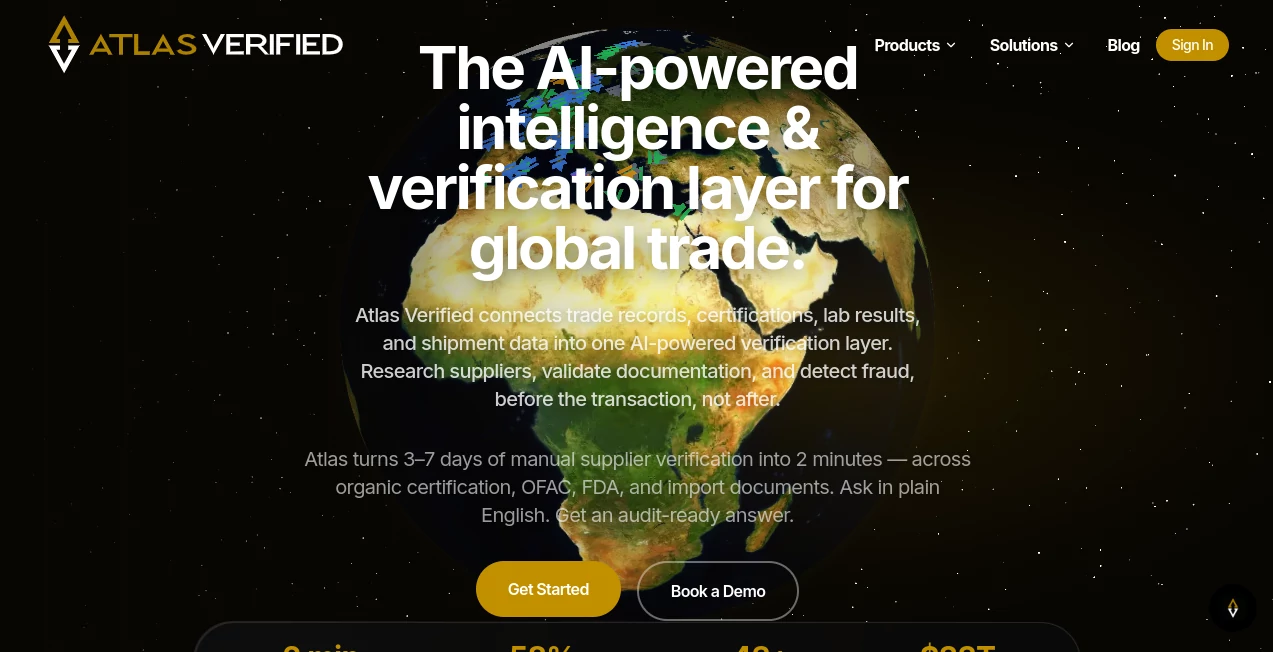
Global trade depends on information that is often scattered across certificates, shipment records, government databases, laboratory reports, and spreadsheets. Checking all of those sources manually can take days, especially when a supplier needs to be verified before a purchase or shipment moves forward.
Atlas Verified brings these tasks into a single AI-powered intelligence layer built specifically for global agricultural trade. The platform connects supplier records, certifications, trade data, shipment information, and documents so businesses can investigate suppliers, validate documentation, identify potential risks, and maintain an evidence trail for their decisions.
One of its most useful advantages is speed. The company says its system can reduce supplier verification work that traditionally takes 3–7 days to roughly two minutes. Instead of simply producing a conversational answer, it cross-checks information against sources such as USDA records, OFAC sanctions data, FDA import alerts, and other trade and certification databases.
Key Features
- AI-powered supplier verification and due diligence
- Automated certification and document authentication
- Shipment and vessel tracking
- Chain-of-custody monitoring
- Compliance and sanctions screening
- AI-generated intelligence reports
- Four specialized monitoring agents
- Natural-language access to trade intelligence
- OCR and structured document extraction
- Reusable supplier verification badges and trust scores
- MCP connectivity for AI assistants and enterprise workflows
User Interface
The interface is designed around the way procurement, compliance, and trading teams actually work. Instead of forcing users to jump between certification databases, shipment systems, spreadsheets, and document folders, the platform brings supplier, shipment, document, and intelligence information into one workspace.
The conversational interface is particularly practical. A user can ask a question about a supplier or shipment in plain English and receive an answer tied to the available evidence. For example, a compliance professional could investigate whether a supplier is ready for onboarding, while a logistics team could ask about the status of a shipment or missing documents.
The dashboard also separates ongoing monitoring into dedicated areas for intelligence, suppliers, shipments, and inventory. That makes the product feel less like a generic chatbot and more like an operational system built for trade teams.
Accuracy & Performance
Accuracy is central to the platform's purpose because trade verification is not an area where an unsupported AI response is particularly useful. The system is designed to cross-reference information against authoritative and specialized sources rather than relying solely on a language model's stored knowledge.
The platform reports verification workflows involving up to 79 automated checks, covering areas such as organic certification, sanctions screening, FDA import alerts, company registration, laboratory accreditation, and document consistency. Its broader data layer includes more than 150 data sources, giving users a wider evidence base for supplier and shipment research.
Document processing is another important part of the workflow. Bills of lading, certificates, laboratory documents, and other trade records can be analyzed and cross-checked rather than simply summarized. This distinction can be valuable when a small discrepancy matters more than the overall meaning of a document.
Capabilities
The platform goes beyond one-time supplier checks. Four specialized AI agents can continuously monitor different parts of a trading operation. The Intelligence Agent watches for certification changes and supplier opportunities, the Supplier Agent monitors verification gaps, the Shipment Agent tracks routes and vessel movements, and the Inventory Agent watches commodity lots, aging, and market pricing.
Its research capabilities also extend into global trade intelligence. Users can work with bill-of-lading information, vessel and aircraft positions, port activity, sanctions information, tariff data, certification records, and commodity-related information. This makes the system particularly relevant to companies that need to combine compliance research with practical trading decisions.
AI-generated reports provide another useful layer. Reports can cover suppliers, trade routes, commodities, and market conditions, with source attribution designed to make the resulting information easier to review internally or use in due-diligence records.
Security & Privacy
For organizations handling supplier documents and compliance records, controlled access and traceability matter as much as AI functionality. The platform provides enterprise-oriented access paths, including SSO-compatible deployment options and administrator-controlled connector rollout.
Its MCP integration is also designed to expose the platform's verification tools and supplier intelligence to compatible AI clients and internal agents. This can allow organizations to incorporate trade intelligence into existing workflows rather than forcing every team to work in a separate application.
Because compliance decisions can require evidence later, the emphasis on sourced answers and exportable audit-ready records is particularly valuable. Teams can maintain a documented trail instead of depending on an informal conversation or manually assembled collection of PDFs.
Use Cases
Supplier due diligence: Procurement teams can investigate new suppliers before entering a commercial relationship, checking certifications, sanctions information, company records, and supporting documentation.
Organic and agricultural trade: Importers, exporters, commodity traders, feed manufacturers, and brands can validate organic credentials and connect certification information with shipments and suppliers.
Compliance monitoring: Teams can continuously watch for changes in certification status, import alerts, sanctions information, or other events that could affect an existing supplier relationship.
Shipment verification: Logistics and trading teams can combine bill-of-lading information with vessel positions, ports, routes, and shipment documents to build a clearer picture of where goods are moving.
Document analysis: Instead of manually reviewing every certificate, laboratory report, or bill of lading, users can upload documents and allow the system to extract information and cross-check it against other records.
Market and trade research: Analysts can investigate suppliers, commodity flows, trade routes, and market conditions using information drawn from multiple specialized data sources.
Pros and Cons
Pros
- Purpose-built for global agricultural and supply-chain verification
- Combines supplier, document, shipment, and compliance intelligence
- Uses authoritative and specialized data sources
- Supports continuous monitoring through dedicated AI agents
- Provides cited and auditable verification results
- Supports document extraction and cross-checking
- Offers AI-generated reports with source attribution
- MCP integration can connect trade intelligence with existing AI workflows
Cons
- The platform is specialized rather than intended for general-purpose AI use
- Advanced plans may be more suitable for organizations with substantial trade operations
- AI credit usage is an additional consideration when evaluating ongoing costs
- Businesses outside supply chain, agriculture, procurement, or compliance may not need its full feature set
Pricing Plans
The available plans are designed around different levels of verification and intelligence requirements.
Pro – $20/month: Includes an FSVP-aligned supplier verification form, company identity confirmation, compliance reporting, facility details, document and trade-history uploads, buyer sharing, and a supplier verification score.
Intelligence – $200/month: Adds an interactive dashboard with four AI agent areas, AI chat, supplier management, private suppliers, 24/7 cloud agents, AI reports, shipment data, document scanning, digital signatures, and a document repository. The listed plan includes monthly AI credits.
Max – $500/month: Adds AI Cloud Employees for automated workflows, priority AI processing, advanced analytics, custom reports, team collaboration, MCP access, bulk document processing, and custom agent configurations. A 5% discount on AI credit usage is included.
AI Employees – Custom: Organizations requiring managed agentic workflows can work with a custom plan that includes dedicated AI Cloud Employee configurations, onboarding, large-scale document and data ingestion, custom integrations, custom LLM connections, consulting, and priority support.
AI credits reset each billing cycle and do not roll over. Additional pay-as-you-go credits are available after the included allocation has been used.
How to Use It
Start by creating an organization and adding the suppliers, documents, or trade information you need to investigate. For supplier due diligence, provide the relevant company and certification details, then allow the verification workflow to cross-check available records.
Documents such as certificates, laboratory reports, and bills of lading can be uploaded for extraction and analysis. The system can then compare the information against relevant databases and highlight inconsistencies or missing evidence.
For ongoing operations, configure the appropriate AI agents and monitoring schedules. This is where the platform becomes particularly useful: instead of repeating the same checks every morning, teams can have automated monitoring surface changes and anomalies as they occur.
Users can also ask questions in natural language, investigate shipments, generate intelligence reports, and export verification results when documentation is needed for internal review or audits.
Comparison with Similar Tools
General-purpose AI assistants are useful for research, writing, brainstorming, and summarizing documents, but they are not designed to perform specialized trade verification against live certification, sanctions, shipment, and compliance records.
Traditional trade-data platforms, meanwhile, can provide valuable information about imports, exports, vessels, or companies, but they may not combine that information with document authentication, supplier verification, continuous compliance monitoring, and AI-driven analysis in one workflow.
The main distinction here is the combination of evidence sources and operational automation. A procurement professional is not simply asking an AI to explain whether a supplier looks legitimate. The goal is to produce a documented assessment based on multiple records, identify warnings, and keep monitoring that relationship after onboarding.
Conclusion
For businesses operating in global agricultural trade, supplier verification can quickly become a bottleneck when information is spread across certificates, spreadsheets, government databases, shipping records, and email attachments. Bringing those pieces together can make the difference between a slow manual review and a repeatable due-diligence process.
This platform stands out because it treats AI as an intelligence and verification layer rather than simply a conversational interface. Its combination of automated checks, document analysis, trade data, shipment monitoring, specialized agents, and audit-ready reporting gives procurement and compliance teams a more structured way to investigate risk.
For organizations where supplier trust, regulatory compliance, and shipment visibility directly affect the bottom line, that focus makes it a particularly compelling addition to the modern trade technology stack.
Frequently Asked Questions (FAQ)
What is this platform designed for?
It is designed primarily for global agricultural trade, supplier verification, compliance, documentation, shipment monitoring, and trade intelligence.
Can it verify suppliers?
Yes. Supplier workflows can check areas such as organic certifications, sanctions, company registration, laboratory accreditation, and supporting trade documentation.
Can it analyze trade documents?
Yes. The platform supports document extraction and cross-checking for documents such as certificates, laboratory reports, and bills of lading.
Does it track shipments?
Yes. Shipment intelligence includes bill-of-lading information, vessel tracking, route analysis, port information, and other movement data.
Can it monitor suppliers continuously?
Yes. Its specialized AI agents can monitor supplier compliance, certification changes, shipment activity, and other operational signals on a scheduled basis.
Does it provide AI-generated reports?
Yes. Intelligence reports can cover suppliers, trade routes, commodities, and market conditions and include source attribution for the underlying information.
Is there a low-cost plan?
Yes. The Pro plan is listed at $20 per month and focuses on supplier verification and compliance fundamentals. More advanced intelligence and automation features are available on higher plans.
Who can benefit most from it?
Importers, exporters, commodity traders, brokers, procurement teams, certifiers, feed manufacturers, retailers, brands, and compliance professionals are among the strongest potential users.
Can it work with other AI applications?
Yes. MCP connectivity is available on the higher-tier offering, allowing its intelligence and verification capabilities to be connected with compatible AI clients and agent workflows.
AI Workflow Management , AI Knowledge Management , AI Research Tool , AI Consulting Assistant .
These classifications represent its core capabilities and areas of application. For related tools, explore the linked categories above.
Atlas Verified details
Website unavailable — View Alternatives
Pricing
- Freemium
Apps
- Web App
Categories

Atlas Verified Alternatives Product

ttanonviewer

Odysseus AI

Referent
AlphaTax

Sourcetable

Rank++

Rabbitholes …

Elicit

Sorank