
Avatar SDK
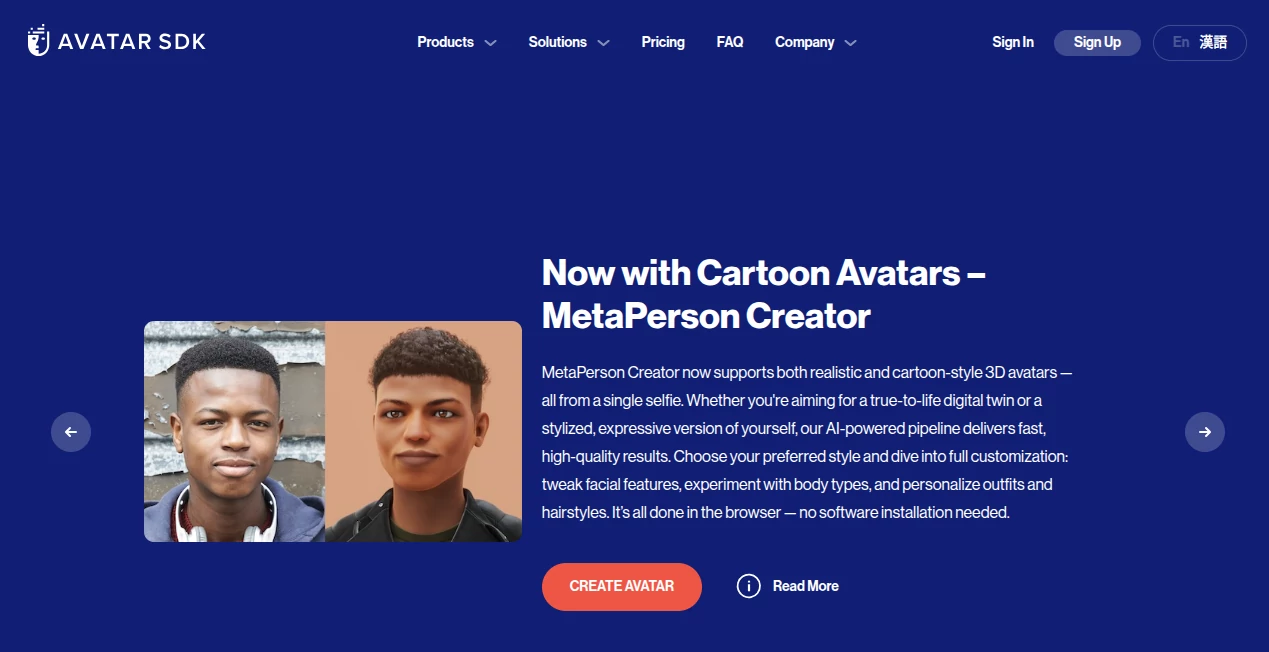
What is Avatar SDK?
Creating lifelike digital humans has traditionally required skilled artists, expensive equipment, and hours of manual work. This platform changes that process by transforming a single selfie into a recognizable, rigged 3D avatar that is ready for games, virtual worlds, mobile applications, and immersive experiences. It combines advanced computer vision with deep learning to deliver avatars that preserve facial identity while remaining optimized for real-time rendering.
Whether you are building a multiplayer game, a metaverse experience, a virtual meeting platform, or an interactive application, the technology offers a streamlined workflow that dramatically reduces production time. Developers can integrate avatar generation directly into their products through APIs, SDKs, and ready-to-use creator components, allowing users to personalize their digital identities in just a few moments.
One of the biggest advantages is its flexibility. The generated avatars support both realistic and stylized appearances, making them suitable for entertainment, education, healthcare, e-commerce, virtual events, and many other industries where personalized digital characters improve user engagement.
Key Features
User Interface
The platform provides a clean and developer-friendly experience. End users simply upload a front-facing photo, while developers can integrate the avatar creator into websites, mobile applications, Unity, Unreal Engine, or custom software through available SDKs and APIs. The workflow is straightforward and minimizes the learning curve.
Accuracy & Performance
The recognition quality is impressive, producing avatars that closely resemble the original person from a single selfie. Generated models include facial blendshapes, skeletal rigs, and optimized geometry suitable for animation. Cloud processing enables fast generation, while enterprise deployments can also utilize local infrastructure for large-scale production.
Capabilities
- Create recognizable avatars from a single photograph.
- Generate full-body or head-only characters.
- Support both realistic and cartoon styles.
- Produce animation-ready avatars with facial blendshapes.
- Export models in GLB, glTF, and FBX formats.
- Compatible with Unity, Unreal Engine, Blender, and web applications.
- REST API for large-scale automated avatar generation.
- Embeddable avatar creator for web and mobile products.
- Support for customization including hairstyles, outfits, and body options.
- Suitable for cloud deployment or enterprise on-premise environments.
Security & Privacy
Privacy is an important consideration for organizations handling user images. Enterprise customers can deploy avatar generation within their own infrastructure, reducing data exposure while maintaining full control over internal workflows. Flexible data retention policies further support organizations with strict compliance requirements.
Use Cases
- Character creation for video games.
- Metaverse and virtual world platforms.
- Virtual reality and augmented reality experiences.
- Digital identity systems.
- Virtual meeting applications.
- Educational simulations.
- Healthcare visualization.
- E-commerce virtual assistants.
- Interactive entertainment.
- Custom avatar generation for mobile applications.
Pros and Cons
Pros
- Produces highly recognizable 3D avatars from only one selfie.
- Professional-quality rigging for animation.
- Supports both realistic and stylized characters.
- Developer-friendly REST API and SDK integrations.
- Multiple export formats for popular 3D engines.
- Suitable for enterprise-scale deployments.
- Flexible cloud and local deployment options.
Cons
- Advanced API features are primarily available through enterprise plans.
- Requires a quality front-facing photo for optimal results.
- Animation systems such as lip-sync require third-party integrations.
Pricing Plans
A free trial is available for evaluation. Professional subscriptions are designed for commercial integrations and include monthly avatar generation quotas. Enterprise plans provide custom pricing with additional capabilities such as REST API access for full-body avatars, on-premise deployment, custom infrastructure, and dedicated support for large organizations.
How to Use Avatar SDK
Start by creating an account and accessing the dashboard. Upload a clear front-facing selfie or connect the REST API to your application. Select the preferred avatar style and generation options, then allow the platform to process the image. Once completed, download the generated model in the desired format or automatically integrate it into your application through available SDKs. Developers can further customize hairstyles, outfits, body proportions, and animations depending on project requirements.
Comparison with Similar Tools
Unlike many avatar generators that focus only on visual appearance, this solution delivers production-ready assets suitable for real-time applications. The generated avatars include skeletal rigs, facial blendshapes, and standard export formats that fit directly into professional development pipelines. The availability of cloud APIs, SDKs, and enterprise deployment options also makes it particularly attractive for businesses building scalable avatar-based products instead of standalone avatar images.
Conclusion
For developers and companies looking to introduce personalized digital humans into their products, this platform offers an excellent combination of realism, speed, scalability, and flexibility. From a single selfie, users receive animation-ready avatars that integrate seamlessly into modern game engines and immersive applications. The extensive developer ecosystem, enterprise deployment options, and support for multiple avatar styles make it one of the strongest choices for organizations investing in digital identity and interactive 3D experiences.
Frequently Asked Questions (FAQ)
Can avatars be created from just one photo?
Yes. A single front-facing selfie is sufficient to generate a recognizable 3D avatar.
Which file formats are supported?
Models can be exported in GLB, glTF, and FBX formats for compatibility with major 3D software and game engines.
Can developers integrate it into their own applications?
Yes. Integration is available through REST APIs, SDKs, and embeddable avatar creator components.
Does it support realistic and cartoon avatars?
Yes. Both realistic and stylized avatar generation pipelines are available depending on project needs.
Is enterprise deployment available?
Yes. Organizations can deploy the technology on their own infrastructure and customize data retention and workflow options.
AI 3D Model Generator , AI Avatar Generator , AI Image to 3D Model , AI Developer Tools .
These classifications represent its core capabilities and areas of application. For related tools, explore the linked categories above.

Avatar SDK Alternatives Product
volume shader
Project Genie

ChatFlowchart
Image to STL
FurWall

CtrlOps

StylinAI

Vidmix
Layven