

















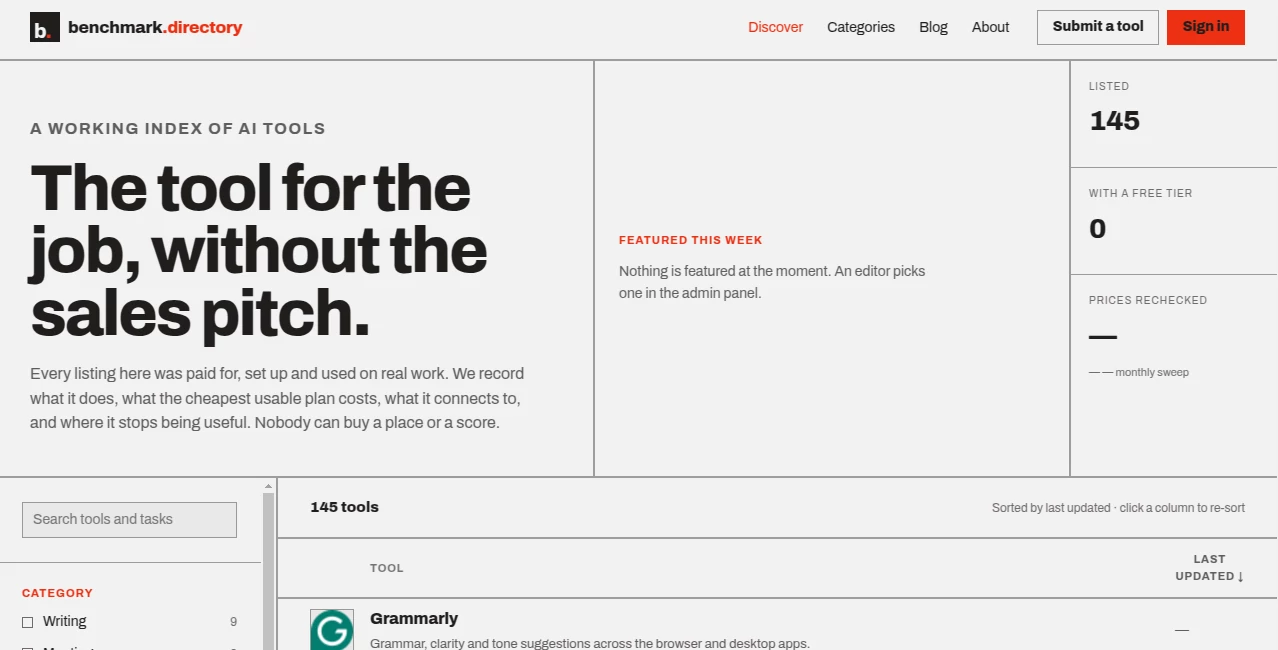
What is benchmark.directory?
Choosing an AI tool is often harder than actually using one. Pricing pages can hide important limits, free plans may be far less useful than they first appear, and marketing descriptions rarely explain where a product stops being useful. benchmark.directory takes a more practical approach by creating an independent working index of AI tools based on hands-on use rather than vendor claims.
Each listed product is paid for, set up, and used on real work before earning a place in the directory. The result is a resource designed for people who want to compare software based on practical details such as pricing, integrations, usage limits, data policies, and actual performance.
Key Features
- Independent AI tool listings based on practical evaluation.
- Information about the cheapest usable plan rather than simply the cheapest advertised plan.
- Details about what free tiers actually allow.
- Integration information based on real connections and testing.
- Data policy checks, including whether user work is used to train models by default.
- Practical limits discovered during hands-on use.
- Editor scoring based on setup, output quality, price to value, and support.
- Categories organized around real jobs and workflows, including writing, code, meetings, research, marketing, automation, design, finance, education, video, and more.
User Interface
The interface is intentionally straightforward. Visitors can search for tools and tasks, browse practical categories, and use pricing filters to narrow down the available options. Instead of forcing users through complicated comparison screens, the directory puts discovery at the center of the experience.
The category structure is particularly useful when you know what you need to accomplish but do not yet know which product to choose. A person looking for help with research, writing, project work, or customer insight can start from the job itself rather than trying to understand the technical differences between dozens of AI products.
Accuracy & Performance
The strongest part of the service is its emphasis on firsthand testing. Products are not simply copied from vendor descriptions. The editorial process involves setting up and using tools on real work for at least a week before a tested listing receives an editor score.
The directory currently records 145 listed tools and 640 hours of testing. Its editors examine practical factors such as setup, output quality, price to value, and support. Pricing and other listing information are also intended to be checked regularly, giving users a more realistic picture of what they can expect after signing up.
Capabilities
The directory covers a broad range of practical software categories. Current sections include Writing, Meetings, Code, Support, Data, Automation, Design, Research, Sales, Finance, Marketing, People Ops, Legal Ops, Audio, Video, Project Work, Security, Education, Translation, and Customer Insight.
This makes it more than a simple collection of AI product names. A user can investigate a particular workflow, compare products according to pricing or availability of a free tier, and examine practical information that is often difficult to find in ordinary software directories.
Security & Privacy
Data handling is treated as part of the evaluation rather than an afterthought. Listings record whether a product's default policy allows user work to be used for model training. The editorial team also states that tools which will not clearly explain what happens to user data can be rejected.
This is valuable for businesses and professionals who need to consider privacy before introducing an AI service into a real workflow. Instead of assuming that every product handles information in the same way, users are given a specific data-policy point to investigate before making a decision.
Use Cases
The directory is useful for anyone comparing AI software for a specific job. A startup founder can research tools for marketing or sales, a developer can explore coding and automation products, and a researcher can compare services designed around research and data workflows.
It is also useful during software procurement. Rather than choosing a product because its landing page looks convincing, users can look at the usable pricing level, integrations, limits, and data practices before spending time on implementation.
For example, someone building a small workflow might first filter tools by whether they offer a free tier, then compare the remaining options based on the practical work they support. That simple process can eliminate a surprising amount of trial-and-error.
Pros and Cons
- Pros: Hands-on evaluation, practical pricing information, tested integrations, data-policy details, workflow-focused categories, transparent editorial approach, and no paid placement or paid scoring.
- Pros: The directory records limitations discovered through real use, which can be more useful than a long list of advertised features.
- Cons: The directory is still relatively small compared with large software databases, with 145 tools currently listed.
- Cons: Not every listing necessarily has an editor score yet, since newly submitted products can appear before the editorial testing stage is completed.
Pricing Plans
There is no paid listing tier for tool makers. A listing is published at no cost once the required badge appears on the maker's own website. The project is funded by readers rather than sponsored placements or affiliate ordering, and vendors cannot pay to influence their position or score.
For visitors, the main value comes from having access to the directory and its editorial information without relying on a pay-to-rank system. This model helps keep the comparison process focused on usefulness instead of advertising budgets.
How to Use benchmark.directory
Start by searching for the type of tool or task you want to solve. You can also browse the available categories to discover products for a particular workflow. Pricing filters can help narrow the selection when budget is an important factor.
Once you find a relevant listing, review the available information about its capabilities, usable pricing level, integrations, data policy, and practical limitations. If the product has been tested by the editorial team, its score can provide another point of comparison.
The best approach is to use the directory as a research layer before committing to a new AI product. It can help you create a shortlist first, then visit the individual products for deeper evaluation or signup.
Comparison with Similar Tools
Traditional AI directories often focus on collecting as many products as possible, while software marketplaces may place considerable emphasis on vendor descriptions, ratings, or commercial relationships. This directory takes a narrower editorial approach.
Its main difference is the decision to document practical details that are easy to overlook. The cheapest advertised plan is not necessarily the cheapest usable plan, a listed integration does not always mean it works smoothly, and a generous-looking free tier may have meaningful restrictions. By testing these areas directly, the directory aims to make software discovery more grounded in actual use.
The no-pay-for-placement policy is another meaningful distinction. Vendors cannot purchase a position or alter an editor score, which gives users a stronger reason to treat the information as an independent starting point rather than another promotional catalog.
Conclusion
For anyone tired of comparing AI products through polished marketing pages alone, this directory offers a more practical way to research software. Its focus on real usage, usable pricing, integrations, data policies, and limitations gives users information they can actually use when deciding what to try next.
The project is still growing, but its editorial philosophy is already clear: evaluate tools through real work, record what happens, and keep commercial influence away from rankings and scores. That makes it a particularly useful destination for professionals, teams, and builders who want to make more informed choices in an increasingly crowded AI software market.
Frequently Asked Questions (FAQ)
What is benchmark.directory?
It is an independent directory for discovering and comparing AI tools according to practical jobs, pricing, limits, integrations, and data policies.
How are tools evaluated?
Tools are paid for, set up, and used on real work. Products that receive editorial testing are used for at least a week and evaluated on areas including setup, output quality, price to value, and support.
Can companies pay to get a better position?
No. The directory states that vendors cannot buy placement or influence an editor score. Sponsored placement and affiliate ordering are not part of its model.
Are listings free for tool makers?
Yes. A maker can receive a free listing after placing the required badge on its own website. There is no paid listing tier.
Does every listed tool have an editor score?
No. A product can be listed before editorial testing takes place. In that situation, the absence of a score does not mean the product received a poor rating; it means the evaluation has not yet been completed.
What information can I find in a listing?
Listings can include what the product does, its cheapest usable plan, actual free-tier limits, tested integrations, data-training policy, practical limitations, editor score, and information about when it was last tested.
Who can benefit from using the directory?
It is useful for individuals, developers, researchers, startups, businesses, and teams that need to compare AI software before adding it to a real workflow.
Why is hands-on testing important?
A product can look impressive on a pricing or feature page while behaving differently in everyday use. Hands-on testing helps reveal setup difficulties, usage limits, integration issues, output quality, and other details that are difficult to judge from marketing material alone.