
Boardy
What is Boardy?
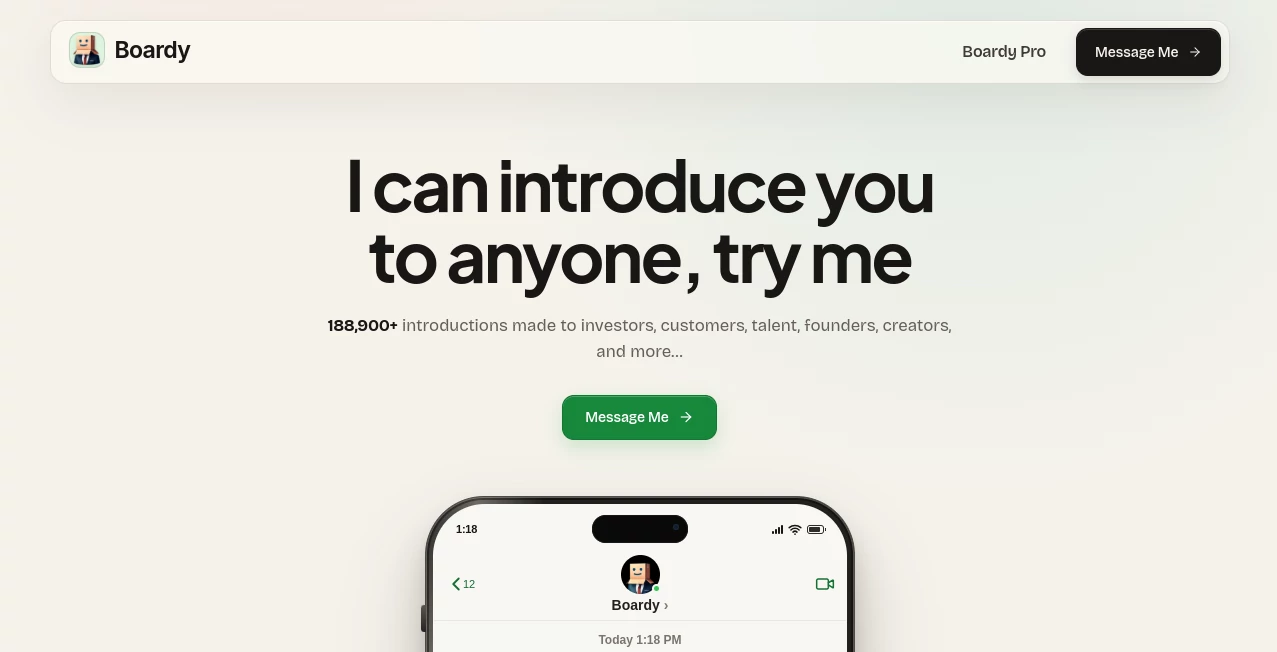
Boardy is an AI-powered social connector built around a simple idea: finding the right person can be more valuable than finding more information. Instead of leaving users to search through endless profiles, directories, or networking platforms, it helps identify people who may genuinely be relevant to a specific goal and facilitates a warm introduction.
The experience is particularly interesting for founders, investors, sales professionals, recruiters, creators, and anyone whose work depends heavily on relationships. You can explain who you want to meet, what you are working on, or what outcome you are trying to achieve, and the system uses that context to look for a potentially useful connection.
What makes the concept stand out is that the process does not necessarily stop when two people are matched. Once both sides agree, the service can help introduce them, coordinate availability, and arrange the meeting. Its website reports more than 189,000 introductions and more than 217,000 people spoken with, showing that the platform has already developed a substantial network.
Key Features
- AI-powered introductions: Instead of simply presenting search results, the system looks for people who may actually be relevant to the outcome you described.
- Context-based matching: Users can explain who they want to meet, why they want the connection, and what would make the conversation useful.
- Warm introductions: The platform focuses on meaningful introductions rather than sending users lists of cold contacts.
- Calendar coordination: After an introduction is accepted, calendar availability can be used to help find a suitable meeting time.
- Email follow-up: The service can be included in an email conversation to help coordinate scheduling and keep the thread moving.
- Meeting participation: It can be brought into Google Meet, Zoom, or Microsoft Teams meetings to provide assistance during conversations.
- Multi-channel communication: Users can interact through channels such as LinkedIn, email, WhatsApp, SMS, and phone calls, depending on the available connection method.
- Large relationship network: The platform says it has spoken with hundreds of thousands of people and facilitated introductions involving investors, customers, founders, talent, and creators.
User Interface
The interface is intentionally centered around conversation rather than a complicated dashboard. Instead of forcing users through a long series of filters, the experience starts with a straightforward request: explain who you want to meet or what you are trying to accomplish.
This conversational approach makes the product feel closer to asking a well-connected person for an introduction than using a conventional networking database. The website also demonstrates scheduling and follow-up scenarios directly, which makes it relatively easy to understand how the service fits into an existing workflow.
Accuracy & Performance
Matching quality is one of the most important parts of this type of service. The system says it considers what people have actually told it rather than relying solely on information contained in public profiles. It can also ask follow-up questions when a request lacks enough context.
The reported network statistics are notable. The website currently shows more than 189,000 introductions, more than 217,000 people spoken with, and an average time to match of around 17 hours. These numbers suggest that the service is designed for active networking rather than occasional profile discovery.
Of course, no matching system can guarantee that every introduction will become a useful relationship. The quality of the request, the available network, timing, and willingness of both people to engage can all affect the final result.
Capabilities
The strongest capability is its ability to handle several steps of the networking process rather than simply suggesting a contact. A user can describe a desired outcome, receive a potential match, and then let the system facilitate the introduction.
Scheduling is another useful part of the workflow. After both people opt in, calendar information can help identify available times and place the meeting on the participants' schedules. This can remove the familiar back-and-forth exchange of messages that often follows a successful introduction.
The meeting functionality adds another layer. The service can join supported online meetings, listen when appropriate, respond when brought into the conversation, and carry relevant decisions into follow-up interactions. For busy professionals, that broader workflow can be more useful than a simple networking recommendation.
Security & Privacy
Because the service deals with personal and professional relationships, privacy is an important consideration. Its terms explain that profile information from public LinkedIn profiles can be used to facilitate introductions. The service also distinguishes information shared through communication channels, such as email addresses in open email threads and phone numbers in open WhatsApp threads.
Introductions are designed around consent. According to the service terms, an introduction is intended to occur after the relevant parties opt in. Users should still review the current privacy policy and terms before connecting accounts or communication channels, particularly when calendar, messaging, or contact information is involved.
The service is currently described as free to use, although users may still be responsible for charges imposed by their mobile carrier or other communication provider. The terms also state that users will be notified in advance if service fees are introduced in the future.
Use Cases
Founders and entrepreneurs: Finding investors, potential customers, advisors, partners, or experienced operators can be difficult through cold outreach. A context-driven introduction can make the first conversation considerably easier.
Sales and business development: Instead of searching for another generic lead list, a professional can describe the type of customer or relationship they need and use the network to look for a relevant connection.
Recruiting: Hiring early employees often depends on personal recommendations. The platform can be useful when a founder or hiring manager is looking for a particular type of talent.
Investors: Investors and venture professionals can benefit from meeting founders, operators, specialists, and other people who fit a particular investment or industry thesis.
Creators and media professionals: Podcast hosts, content creators, and community builders can use relationship-based introductions to discover guests, collaborators, customers, and other relevant people.
Professional networking: Anyone who feels that conventional networking platforms generate too many profiles and too little context may find the conversational approach more natural.
Pros and Cons
- Pros: Focuses on meaningful introductions rather than cold contact lists.
- Pros: Uses conversational context to understand what kind of connection a user actually needs.
- Pros: Can help with introductions, scheduling, email follow-up, and meetings.
- Pros: Supports multiple communication channels.
- Pros: Has already facilitated a large number of introductions according to its published statistics.
- Pros: The core service is currently free to use.
- Cons: The quality of results depends on the available network and the quality of the request.
- Cons: Users who prefer complete control over every networking step may find automated introductions less suitable.
- Cons: Connecting communication or calendar services requires users to consider the privacy implications carefully.
- Cons: A successful introduction does not guarantee a successful business relationship, hire, investment, or deal.
Pricing Plans
The service is currently free to use, according to its published terms. There is also a Pro offering presented on the website that focuses on priority introductions, deeper context, and a faster path to relevant people. Access to the Pro experience involves connecting a calendar.
The website does not present a conventional list of fixed monthly prices for the Pro experience in the information currently available. Users interested in the upgraded functionality should therefore check the latest offer directly through the service rather than relying on outdated third-party pricing information.
How to Use It
- 1. Describe your goal: Explain who you want to meet, what you are building, or what outcome you are trying to achieve.
- 2. Add useful context: Be specific about the type of person, industry, experience, location, or relationship that would make the introduction valuable.
- 3. Answer follow-up questions: If more information is needed, provide additional context so the matching process has a clearer picture of your objective.
- 4. Review the potential connection: The system looks for a person who appears relevant and aims to establish whether the introduction makes sense for both sides.
- 5. Accept the introduction: When both parties opt in, the warm introduction can move forward.
- 6. Coordinate the meeting: With calendar access enabled, available times can be identified and the meeting can be scheduled.
- 7. Continue the relationship: Email and meeting functionality can help keep the conversation organized after the initial introduction.
Comparison with Similar Tools
Traditional professional networking platforms are usually built around profiles, searches, filters, and direct messages. They are excellent when you already know who you want to find, but they can become less helpful when the real question is, “Who should I actually meet?”
Lead databases take a different approach by giving users large amounts of contact information. That can be useful for outbound sales, but a contact record does not necessarily provide the trust or context of a warm introduction.
Human networking communities and referral groups can provide stronger relationships, but they often depend on the time and availability of other members. An AI-driven connector attempts to combine some of that relationship-focused approach with the speed and scale of software.
The biggest distinction is therefore the workflow. Instead of stopping at discovery, the service tries to move from understanding a goal to matching, introduction, scheduling, and follow-up. For users whose work depends on relationships, that can be a meaningful advantage.
Conclusion
Boardy presents a refreshing alternative to the usual approach to professional networking. Rather than asking users to spend hours searching through profiles or sending cold messages, it starts with the more useful question of who they actually need to meet and why.
The combination of contextual matching, warm introductions, calendar coordination, email assistance, and meeting participation makes it more than a simple people-search tool. Its published introduction and network figures also indicate that the concept is being used at meaningful scale.
It will not replace genuine relationship-building, and no algorithm can guarantee that every connection will be valuable. Still, for founders, investors, sales teams, recruiters, creators, and professionals who believe the right introduction can change an outcome, this is an especially interesting way to approach networking.
Frequently Asked Questions (FAQ)
What is this AI tool designed to do?
It is designed to help people find relevant human connections and facilitate introductions based on what they want to accomplish, rather than simply searching through a directory of profiles.
Is it free to use?
The service is currently described as free to use in its published terms. Additional Pro functionality is available, with the website highlighting priority introductions, deeper context, and faster access to relevant connections.
Who can benefit from it?
Founders, investors, sales professionals, recruiters, creators, consultants, and other professionals who depend on relationships can potentially benefit from the service.
Can it schedule meetings?
Yes. After both parties opt in, the service can coordinate calendars and schedule meetings. Calendar connection is also part of the Pro workflow.
Which meeting platforms are supported?
The website states that it can be brought into Google Meet, Zoom, and Microsoft Teams meetings.
Can it help after an introduction?
Yes. The service is designed to continue helping with follow-up, including email coordination, scheduling, and participation in supported meetings.
Does it guarantee a useful introduction?
No. Matching depends on the information provided, the available network, timing, and whether the other person is a suitable and willing connection. A strong request can improve the chances of receiving a relevant introduction, but no outcome is guaranteed.
What information can be used for introductions?
The published terms state that public LinkedIn profile information can be used to facilitate introductions. Information shared through open communication channels may also be used to enable communication, so users should review the current privacy terms before connecting accounts or services.
How is this different from a traditional networking platform?
Traditional platforms generally ask users to search for people themselves. This approach starts with the desired outcome and attempts to identify a person who may be a good match, followed by an introduction and optional scheduling support.
AI Lead Generation , AI Sales Assistant , AI Team Collaboration , AI CRM Assistant .
These classifications represent its core capabilities and areas of application. For related tools, explore the linked categories above.

Boardy Alternatives Product

Beat API

Lessie AI

Duct Tape 3

Sourcetable

Sales Prospe…

AILeadz.io

Helploom

LeadCanvas
TranAI