
















What is Bold Pilot?
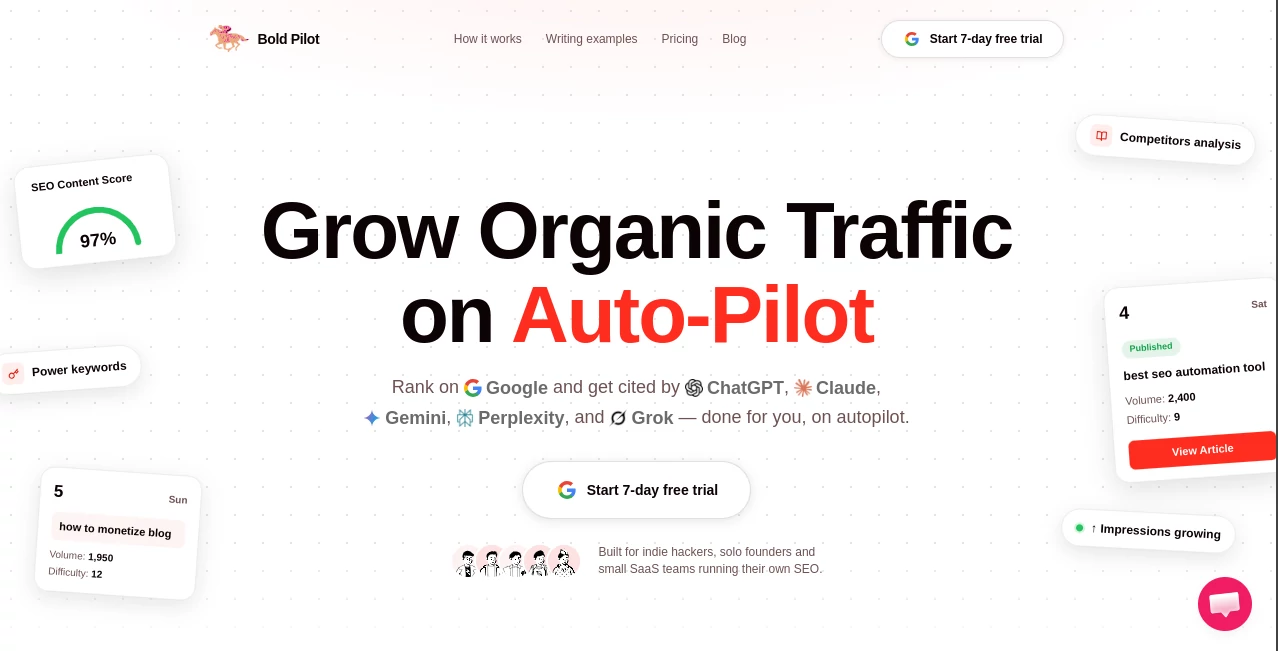
Bold Pilot is an AI-powered SEO and content marketing platform built for indie hackers, solo founders, and small SaaS teams that want to grow organic traffic without spending hours moving between keyword research tools, writing assistants, analytics dashboards, and publishing platforms.
The idea is straightforward: connect a website and Google Search Console, let the platform analyze the niche and search landscape, and then turn realistic keyword opportunities into a repeatable content plan. Instead of simply generating articles on demand, it brings research, planning, writing, optimization, internal linking, and publishing into one workflow.
That makes it particularly interesting for website owners who already know the value of SEO but do not have the time or budget to manage a full content operation. Its focus on practical, winnable keywords is also a welcome change from blindly chasing search terms with high volume.
Key Features
- Keyword research with opportunity and winnability scoring
- AI-generated SEO articles based on selected keyword opportunities
- Automated content planning with a 30-day strategy
- Content optimization and SEO scoring
- Automatic internal linking between published articles
- Google Search Console integration
- Automatic article scheduling and publishing
- Support for multiple websites from one dashboard
- Publishing integrations for WordPress, Ghost, Webflow, Shopify, Notion, Wix, and custom webhooks
- Cross-posting capabilities for platforms such as DEV.to and Hashnode
- MCP and API access for connecting the workflow with AI development environments
- Matching YouTube videos and visual assets included with generated articles
User Interface
The interface is organized around the actual SEO workflow rather than treating each task as a separate application. After connecting a website and Search Console account, users can see keyword opportunities, planned topics, drafts, scheduled articles, and published content in a central workspace.
The calendar-style planning view is especially useful for people who prefer having a clear publishing rhythm. A keyword can move from research to planning, drafting, scheduling, and publication without requiring constant manual coordination.
Accuracy & Performance
One of the more practical aspects of the platform is its approach to keyword selection. Candidate keywords are checked against live search results, and the system considers whether a website of a particular size can realistically compete rather than simply prioritizing search volume.
The platform also displays metrics such as search volume, keyword difficulty, relevance, and opportunity. This gives users more context before committing an article to the calendar.
Generated articles can receive an SEO content score before publication, helping users identify whether a draft is ready to go live. The site showcases examples of content scoring as high as 97%, although individual results will naturally depend on the keyword, niche, and website.
Capabilities
The strongest capability is the complete SEO content pipeline. Users can start with keyword discovery, create a strategic content calendar, generate long-form articles, add internal links, and publish them to their preferred CMS.
The system can produce articles of more than 3,000 words, and the workflow is designed to publish content automatically on a recurring basis. The Autopilot plan currently advertises up to 90 articles per month, three connected websites, automated keyword research, website scans, and several publishing destinations.
There is also an optional agent-oriented workflow through MCP. This allows compatible AI assistants and development environments to interact with the platform for tasks such as finding keywords, drafting content, scheduling articles, and publishing content.
Security & Privacy
Because the service connects to websites and Google Search Console, users should pay attention to the permissions they grant and the publishing destinations they connect. The platform uses an API-key-based MCP connection for supported AI clients, which gives users a defined way to authenticate external integrations.
For businesses handling sensitive website information, it is sensible to review the service's current privacy and terms documentation before connecting production systems. As with any automated publishing platform, account credentials, API keys, and CMS permissions should be managed carefully.
Use Cases
This platform fits especially well with small websites that need consistent SEO content but do not want to build a large marketing team.
- Indie SaaS founders: Build a steady stream of search-focused content without personally researching every topic.
- Blog owners: Discover lower-competition topics and turn them into an ongoing publishing schedule.
- Small marketing teams: Reduce the amount of manual work involved in research, writing, optimization, and publishing.
- SEO-focused businesses: Combine Search Console data with keyword research and content production in one workflow.
- Multi-site operators: Manage up to three websites from the same subscription.
- Content agencies: Automate repetitive parts of article production and CMS publishing.
- Founders using AI coding tools: Use MCP connectivity to bring SEO operations into compatible AI assistants and development environments.
Pros and Cons
- Pros: Combines keyword research, content planning, article generation, optimization, internal linking, and publishing.
- Pros: Live search-result analysis makes keyword selection more practical than relying on search volume alone.
- Pros: Supports several popular CMS and publishing platforms.
- Pros: Multi-site support is useful for founders managing more than one project.
- Pros: MCP and API access provide additional flexibility for advanced workflows.
- Cons: Automated SEO content still needs editorial review, particularly for businesses where accuracy and brand voice are important.
- Cons: The service is primarily aimed at users who already have a website and an ongoing SEO strategy.
- Cons: A high volume of automated publishing is not a substitute for strong original expertise or useful content.
Pricing Plans
The main Autopilot plan is listed at $49 per month and comes with a 7-day free trial. The advertised package includes up to 90 articles per month, more than 3,000 words per article, automated keyword research, three website connections, website scans, automatic publishing, internal linking, and integrations with services including WordPress, Ghost, Shopify, Notion, Webflow, and Wix.
The subscription is billed monthly after the trial, and users can cancel at any time. For a small SaaS business or independent website owner, the pricing is positioned as an alternative to maintaining several separate SEO and content subscriptions.
How to Use the Platform
- Start the 7-day free trial and create an account.
- Connect the website you want to grow.
- Connect Google Search Console so the system can work with your site's search data.
- Let the platform analyze your niche, competitors, audience, and available keyword opportunities.
- Review the proposed keywords and the associated opportunity or difficulty information.
- Build a content calendar around keywords that your website can realistically target.
- Allow the system to generate SEO-focused articles from the selected plan.
- Review the content and SEO score before publication when editorial control is required.
- Connect your preferred CMS or publishing destination.
- Schedule or automatically publish the finished articles and monitor the results through your SEO workflow.
Comparison with Similar Tools
Many SEO products specialize in one part of the process. Traditional SEO suites tend to focus heavily on research and competitive analysis, while AI writing applications often concentrate mainly on generating text. This platform takes a different route by combining both sides with automated publishing.
Its strongest distinction is the workflow between keyword opportunity and published content. Rather than asking users to find a keyword in one service, write an article in another, optimize it somewhere else, and then upload it manually, the platform attempts to connect those steps into one system.
It is therefore most appealing to users who value automation and consistency. Someone who only needs occasional keyword research may find a dedicated SEO research product more appropriate, while a website publishing content every week can benefit much more from having the entire process connected.
Conclusion
For small teams and independent founders, SEO often becomes a time problem before it becomes a strategy problem. There may be plenty of good ideas, but finding the right keywords, creating articles, adding internal links, publishing them, and repeating the process every week takes real effort.
This platform tackles that operational burden with a single automated workflow. Its combination of keyword opportunity analysis, content planning, AI article generation, optimization, internal linking, and CMS publishing makes it more than a simple writing assistant.
The biggest value comes from consistency. If your website has a clear niche and you are serious about building organic traffic over time, having a system that can continually identify realistic topics and move them toward publication can make SEO considerably easier to manage.
Frequently Asked Questions (FAQ)
What is this platform used for?
It is designed to automate SEO and content marketing workflows, including keyword research, content planning, article generation, optimization, internal linking, scheduling, and publishing.
Does it connect to Google Search Console?
Yes. Google Search Console integration is part of the platform's workflow and is used alongside website and search data to help create more relevant content plans.
Can it publish articles automatically?
Yes. It supports automated publishing through integrations with platforms such as WordPress, Ghost, Webflow, Shopify, Notion, Wix, and custom webhooks.
How many websites can I manage?
The Autopilot plan advertises support for up to three websites from one dashboard.
Does it support keyword research?
Yes. Keyword research is a central part of the service. Candidate keywords are evaluated against live search results and ranked according to factors such as relevance and how realistically a website can compete.
Can I use it with AI assistants?
Yes. MCP access allows compatible AI clients and development tools to interact with the SEO workflow, including keyword discovery, article drafting, scheduling, and publishing.
Is there a free trial?
Yes. The Autopilot plan includes a 7-day free trial before the regular monthly subscription begins.
Does automated content still need human review?
It is recommended. Automated content can save substantial production time, but human review remains valuable for factual accuracy, brand voice, original insights, and content that needs expert judgment.