


















Cortex
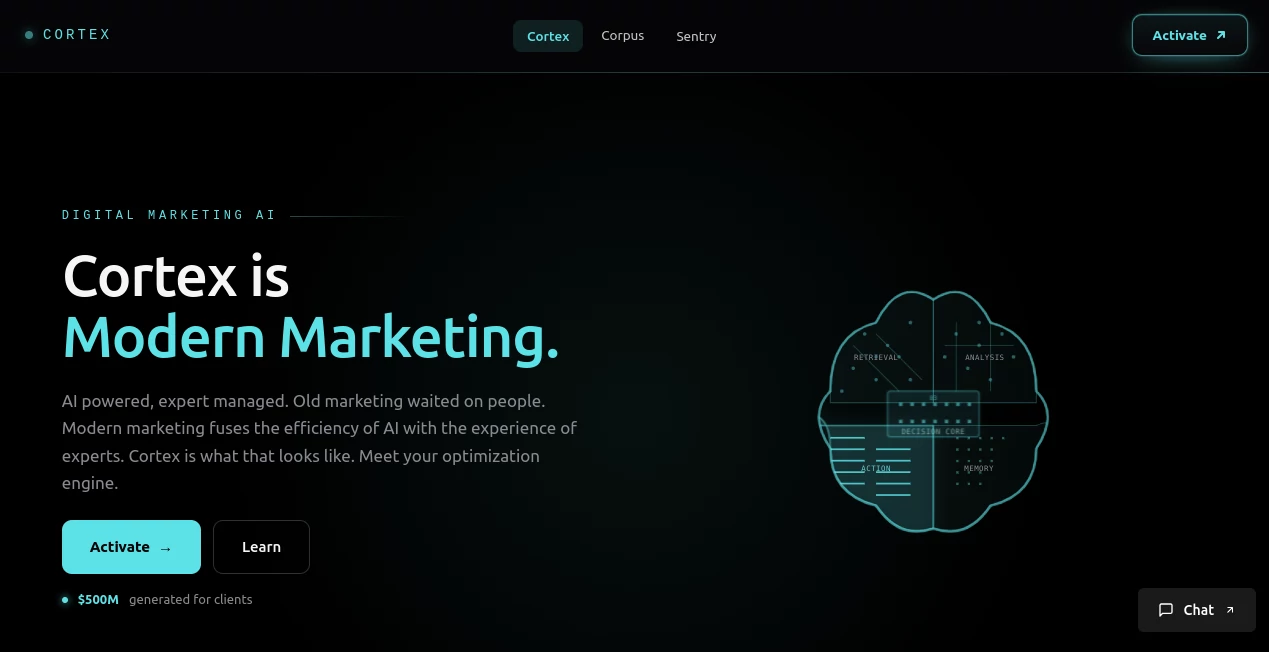
What is Cortex?
Cortex is an AI-powered digital marketing optimization engine designed for teams that want to manage search, paid acquisition, conversion optimization, and emerging AI search visibility from a single system. Instead of treating SEO, GEO, CRO, and PPC as disconnected activities, it brings them together and continuously evaluates marketing performance against documented platform practices.
The platform combines automated monitoring with expert oversight. Its system watches for changes and opportunities across relevant marketing channels, then turns those signals into practical recommendations built around a simple Action, Reason, and Impact framework. The company says its technology has supported more than $500 million in client-generated results, making it particularly interesting for businesses already investing seriously in digital acquisition.
Key Features
- Continuous monitoring of important marketing and visibility signals.
- Support for SEO, Generative Engine Optimization, CRO, and PPC.
- AI-assisted recommendations backed by documented sources.
- Monitoring across search engines, advertising networks, ecommerce platforms, analytics tools, and AI search channels.
- Automated optimization workflows combined with expert review for high-impact decisions.
- Outcome measurement that compares expected results with actual performance.
- A large knowledge corpus containing platform documentation and marketing references.
- Persistent institutional memory that retains previous decisions, patterns, and learnings.
User Interface
The interface is built around monitoring, decisions, and actions rather than simply presenting another collection of marketing charts. Users can inspect signals detected by the system, review recommendations, examine the reasoning behind them, and see the sources supporting a particular decision.
The Sentry concept is especially useful for marketers managing several channels at once. Instead of manually checking every technical SEO issue, advertising setting, or AI search signal, the platform organizes these areas into continuously monitored checkpoints. This approach makes the workspace feel closer to an operational marketing control center than a conventional reporting dashboard.
Accuracy & Performance
One of the strongest aspects of the platform is its emphasis on source-backed reasoning. Recommendations are generated after retrieving information from a large collection of primary-source documentation rather than relying solely on generic model knowledge.
The system describes a retrieval process combining keyword and semantic search with reranking before relevant passages reach the model. Its published infrastructure reports more than 172,000 documents and approximately 1.73 million indexed passages across 81 sources, while the retrieval layer is designed to operate in under 100 milliseconds in the displayed system measurements.
This does not mean every recommendation should be accepted without review. Marketing platforms change frequently, and the service itself describes its outputs as decision support for experienced marketers. Still, tying recommendations to identifiable sources gives users a much clearer basis for evaluating an AI-generated marketing decision.
Capabilities
The system covers four major areas: SEO for traditional search visibility, GEO for visibility across AI-powered search experiences, CRO for improving conversion performance, and PPC for paid acquisition.
Its reach extends beyond search engines. The platform lists support for advertising environments such as Google Ads, Microsoft Ads, Amazon Ads, Meta, TikTok, LinkedIn, Pinterest, and Reddit, alongside AI channels including ChatGPT, Gemini, Claude, and Perplexity. It also references ecommerce and analytics ecosystems such as Shopify, WooCommerce, GA4, Search Console, Merchant Center, HubSpot, and other marketing infrastructure.
For technical marketers, the monitoring layer is particularly detailed. Examples include robots.txt configuration, canonicalization, sitemap freshness, Core Web Vitals, structured data, AI crawler accessibility, advertising data sufficiency, landing-page experience, and AI-search citation visibility.
Security & Privacy
Security matters considerably for a system that can work with marketing accounts and business data. The service provides dedicated legal and security documentation covering customer data, privacy, subprocessors, acceptable use, and AI bot policies.
The platform also uses authenticated application sessions and security controls around its application infrastructure. Businesses considering the service should review the provider's current privacy, security, and data-processing documentation before connecting production accounts, especially when sensitive advertising or customer information is involved.
Use Cases
One practical use case is managing SEO for a growing website without forcing the marketing team to manually inspect dozens of technical signals every day. The system can continuously evaluate areas such as crawlability, indexing, performance, schema, and search visibility.
Another useful scenario is paid advertising management. A team running campaigns across multiple networks can use automated monitoring to identify issues involving budgets, bidding readiness, conversion signals, campaign quality, and other account-level factors.
It is also well suited to organizations interested in AI search visibility. As users increasingly discover businesses through AI-powered interfaces, traditional SEO reporting alone may not provide enough information. Monitoring AI crawlers, citations, structured information, and generative search signals can help teams understand this newer layer of discovery.
For agencies, the centralized approach can be even more valuable. Instead of maintaining separate workflows for SEO, advertising, CRO, and AI search, teams can bring several disciplines into one operating environment while retaining expert approval for important changes.
Pros and Cons
- Pros: Combines SEO, GEO, CRO, and PPC in one system.
- Pros: Recommendations are designed to include source-backed reasoning.
- Pros: Continuous monitoring reduces the need for repetitive manual checks.
- Pros: Covers a broad collection of advertising, search, ecommerce, analytics, and AI platforms.
- Pros: Measures optimization outcomes rather than stopping at recommendations.
- Cons: The breadth of the platform may be more than a small business needs.
- Cons: AI-generated recommendations still require professional judgment before important changes are deployed.
- Cons: Teams looking for a simple standalone SEO tool may find the broader marketing system more complex than necessary.
Pricing Plans
The public product page does not present a conventional list of fixed pricing tiers. Access is centered around activation and business engagement, so organizations interested in using the full platform should check the current commercial terms directly with the provider.
This model appears more suitable for marketing teams, agencies, and businesses with meaningful acquisition activity than for casual users looking for a free keyword research utility. Because pricing and packaging can change, prospective customers should confirm the latest plan structure, included platforms, usage limits, and account requirements before subscribing.
How to Use Cortex
Start by activating an account and connecting the marketing environments that you want to monitor. Depending on your goals, this can include advertising accounts, analytics platforms, ecommerce systems, search properties, or other supported channels.
Once the relevant data is available, the monitoring layer evaluates signals against documented best practices. When an issue or opportunity passes the platform's evaluation criteria, it can become an optimization action.
Review the proposed action, the reasoning behind it, and the expected impact. One of the useful details is that recommendations are designed to show the supporting sources, allowing a marketer to investigate the underlying evidence instead of treating the AI response as a black box.
After an optimization is approved and implemented, performance can be measured against the expected outcome. Over time, those results contribute to a growing body of account-specific learning.
Comparison with Similar Tools
Traditional SEO platforms are often excellent at reporting rankings, backlinks, technical errors, and keyword opportunities, while advertising platforms naturally focus on campaign performance. The main difference here is the attempt to connect these traditionally separate disciplines.
Compared with a basic AI marketing assistant, this approach is also more operational. Instead of simply asking an AI model to suggest an SEO title or advertising idea, the system is designed to inspect real marketing signals, retrieve relevant documentation, explain its reasoning, and move toward an actionable optimization.
The broader scope is its biggest distinction. Businesses primarily interested in keyword research may not need such an extensive system, but organizations managing SEO, paid media, conversion optimization, ecommerce, and AI search simultaneously may appreciate having those functions connected.
Conclusion
Cortex takes an ambitious approach to digital marketing by combining AI-driven analysis, continuous monitoring, documented knowledge, and human oversight. Its strongest idea is not simply using AI to produce marketing advice, but creating a system that connects signals to evidence, decisions, and measurable outcomes.
The extensive coverage of search engines, advertising networks, ecommerce platforms, analytics systems, and AI search channels makes it particularly appealing to sophisticated marketing teams. The emphasis on cited reasoning is another welcome touch, especially in an industry where generic AI recommendations can easily sound convincing without being properly supported.
For companies looking beyond isolated SEO or advertising utilities and wanting a more unified marketing optimization environment, this is a platform worth investigating.
Frequently Asked Questions (FAQ)
What is Cortex used for?
It is designed for digital marketing optimization across SEO, Generative Engine Optimization, conversion optimization, and paid advertising.
Can it help with AI search visibility?
Yes. The platform includes GEO capabilities focused on visibility across AI-powered channels and monitors signals related to AI crawlers, citations, structured information, and generative search.
Does it support paid advertising?
Yes. Its published platform coverage includes major advertising environments such as Google Ads, Microsoft Ads, Amazon Ads, Meta, TikTok, LinkedIn, Pinterest, and Reddit.
Does it replace a marketing team?
No. The system is designed to automate monitoring and accelerate decisions while retaining expert oversight for important actions. Its own documentation describes the output as decision support for experienced marketers.
Are recommendations backed by sources?
Yes. The platform emphasizes source-cited reasoning and states that recommendations are grounded in a large corpus of primary-source documentation from search, advertising, ecommerce, analytics, and AI platforms.
Is there a public free plan?
The public product page does not currently show a conventional free pricing tier or a standard fixed-price plan list. Prospective users should check the current activation and commercial options directly with the provider.
Who can benefit most from this platform?
It is best suited to marketing teams, agencies, ecommerce businesses, and organizations managing multiple acquisition channels that want continuous monitoring and a more unified approach to optimization.
What makes its approach different?
The combination of continuous signal monitoring, source-backed reasoning, optimization workflows, and measured outcomes is the main differentiator. Instead of treating AI as a standalone content generator, the platform uses it as part of a broader marketing decision system.
AI SEO Assistant , AI Digital Marketing Generator , AI Analytics Assistant , AI Advertising Assistant .
These classifications represent its core capabilities and areas of application. For related tools, explore the linked categories above.

Cortex Alternatives Product

Surmado

Arobis AI Vi…

Wild and Fre…

IntoTheBlock

Yorph AI

PurityRadar

ClearWork

Read

Candidate Sc…
