

















ChirpyPet
What is ChirpyPet?
Taking care of a pet often means searching for answers at exactly the moment you need them. Is a certain symptom serious? What is a breed usually like? What should you know before bringing a particular dog or cat home? ChirpyPet brings these everyday questions together in one practical pet knowledge platform.
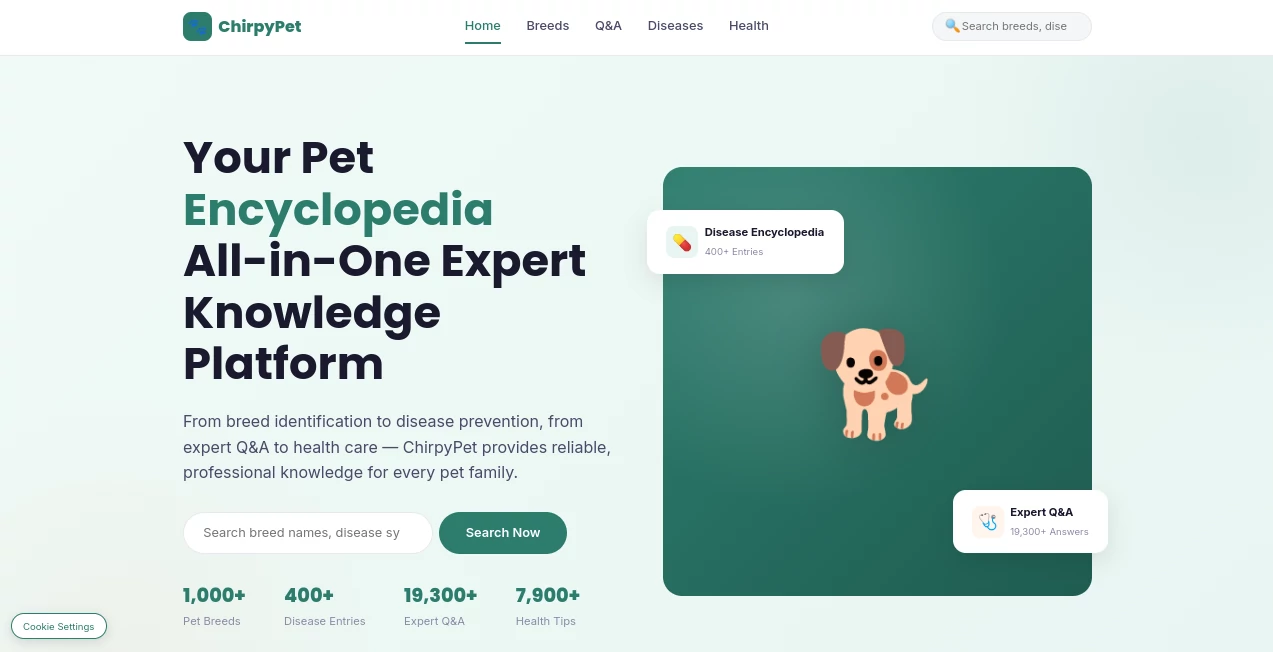
The website covers a broad range of pet-care topics, from breed information and disease references to professional-style Q&A and everyday health guidance. Its homepage currently highlights more than 1,000 pet breeds, 400 disease entries, 19,300 expert Q&A answers, and 7,900 health tips, giving pet owners plenty of material to explore.
What makes the platform particularly useful is its straightforward approach. Instead of forcing visitors to browse through unrelated articles, it provides search tools for looking up breeds, diseases, symptoms, and health concerns. For a pet owner trying to make sense of an unfamiliar issue, that simple organization can save quite a bit of time.
Key Features
- Large collection of dog and cat breed guides
- Dedicated disease encyclopedia covering hundreds of entries
- Extensive pet-care question and answer knowledge base
- Health articles covering daily care and nutrition
- Search functionality for breeds, diseases, symptoms, and health topics
- Information covering dogs, cats, small pets, aquatic animals, and reptiles
- Breed profiles with temperament, care, and health considerations
- Reference material focused on prevention and everyday pet health
User Interface
The interface is designed around discovery rather than complicated controls. A prominent search field lets visitors enter a breed name, disease, symptom, or health issue and start exploring immediately. Main sections for breeds, Q&A, diseases, and health are also clearly separated, making the site easy to navigate even for someone visiting for the first time.
The layout works especially well for quick research. You can move from a breed guide to health information or from a question to a related disease entry without having to learn a complicated system. The emphasis is on getting useful information in front of the reader quickly.
Accuracy & Performance
The platform positions its content as reliable, professional pet-care knowledge and organizes information into dedicated reference areas. Its disease section, for example, is structured around specific conditions and includes descriptions, symptoms, affected systems, and treatment-related information.
For everyday research, the large searchable collection is a strong advantage. A pet owner can begin with a simple question and then explore related material instead of repeatedly searching the wider web. That said, online pet information should be treated as a reference rather than a replacement for veterinary diagnosis or professional care, particularly when an animal has severe, sudden, or worsening symptoms.
Capabilities
The platform goes beyond a simple collection of articles. Its breed library helps users learn about different dogs and cats, including characteristics, temperament, care requirements, and health considerations. The disease encyclopedia provides another layer of reference material for understanding common and less familiar conditions.
The Q&A section is particularly interesting for practical questions. It covers situations pet owners may encounter at home, while the health section adds longer-form material about subjects such as nutrition, daily care, and disease prevention. Together, these sections make the service useful for both quick answers and deeper reading.
Security & Privacy
The website provides a dedicated privacy policy and displays cookie controls for necessary, analytics, and marketing cookies. Visitors can accept all cookies, reject non-essential cookies, or customize their preferences.
As with any online health reference, users should avoid treating general information as personalized veterinary advice. Personal medical details about an animal should also be shared carefully when using online services.
Use Cases
- Choosing a pet: Explore breed characteristics, temperament, care needs, and health considerations before making a decision.
- Understanding symptoms: Search for health concerns and learn about possible conditions that may be associated with particular symptoms.
- Breed research: Compare different dog and cat breeds and discover information about their backgrounds and typical characteristics.
- Everyday pet care: Read practical guidance covering nutrition, daily routines, prevention, and general wellbeing.
- Pet health research: Use the disease encyclopedia as a starting point when learning about an unfamiliar condition.
- Quick questions: Browse the Q&A knowledge base when looking for practical answers to common pet-owner concerns.
- Learning about less common pets: The platform also organizes information into small pets, aquatic animals, and reptiles.
Pros and Cons
Pros
- Large amount of pet-related reference material
- Breed, disease, Q&A, and health information in one place
- Simple search experience
- Useful organization by topic and animal type
- Suitable for both quick searches and longer research
- Covers more than just dogs and cats
Cons
- Online reference material cannot replace an examination by a veterinarian
- The amount of information can feel extensive for visitors looking for one very specific answer
- Not every pet-health situation can be addressed through general educational content
Pricing Plans
No paid subscription or premium pricing structure is prominently presented on the homepage. The main knowledge sections, including breed guides, Q&A, disease references, and health content, are presented as accessible informational resources.
For users comparing pet-care resources, this makes the platform appealing as a reference destination without requiring a complicated onboarding or purchasing process.
How to Use It
- Open the website and choose the type of information you need.
- Use the search box to enter a breed, disease, symptom, or health concern.
- Open a relevant breed guide, disease entry, Q&A result, or health article.
- Read the information and follow related topics when you need more context.
- For serious or uncertain health problems, use the information as background research and consult a qualified veterinarian.
Comparison with Similar Tools
Many pet websites focus on one area, such as breed identification, veterinary articles, or general pet blogs. This platform takes a broader approach by putting several types of reference material under one roof.
Its combination of breed profiles, a disease encyclopedia, a large Q&A collection, and health articles makes it more useful for users who do not yet know exactly what information they need. Someone researching a Labrador, for example, can move from breed characteristics into health considerations, while another visitor can start with a symptom and continue into disease-related information.
The biggest distinction is therefore breadth rather than a single specialized feature. It works best as a central research hub for pet owners who want to explore several related questions in one session.
Conclusion
ChirpyPet is a promising resource for pet owners who prefer having breed information, health references, disease knowledge, and practical Q&A in one place. Its large collection gives the site plenty of depth, while the simple search and section-based navigation keep the experience approachable.
Whether someone is preparing to welcome a new pet, researching a breed, learning about a health condition, or simply trying to become a more informed owner, the platform offers a useful starting point. Its greatest strength is the sheer range of information available across different areas of pet care.
It is best viewed as an educational reference alongside professional veterinary care, rather than as a substitute for diagnosis or treatment. Used that way, it can become a handy resource to return to whenever a new pet-care question comes up.
Frequently Asked Questions (FAQ)
What can I research on this platform?
You can research pet breeds, diseases, symptoms, health topics, daily care, nutrition, and questions commonly asked by pet owners.
How many pet breeds are covered?
The homepage currently states that the platform contains information on more than 1,000 pet breeds.
Does it provide disease information?
Yes. Its disease encyclopedia currently contains more than 400 disease entries covering dog and cat health topics.
Can I use it for veterinary diagnosis?
The information is best used for educational research. A veterinarian should be consulted for diagnosis, treatment decisions, emergencies, or symptoms that are severe or getting worse.
What types of animals are covered?
The site organizes breed information around dogs, cats, small pets, aquatic animals, and reptiles, while its health resources focus heavily on companion animals.