
















AI Humanizer Benchmark
Verified Blue CheckMark
Verified Blue CheckMark products are featured above free or unverified listings.
This badge indicates authenticity and builds trust, giving your product higher visibility across the platform.
Upgrade to get verified
Verified Blue CheckMark products are featured above free or unverified listings. This badge indicates authenticity and builds trust, giving your product higher visibility across the platform.
Upgrade to get verified
What is AI Humanizer Benchmark?
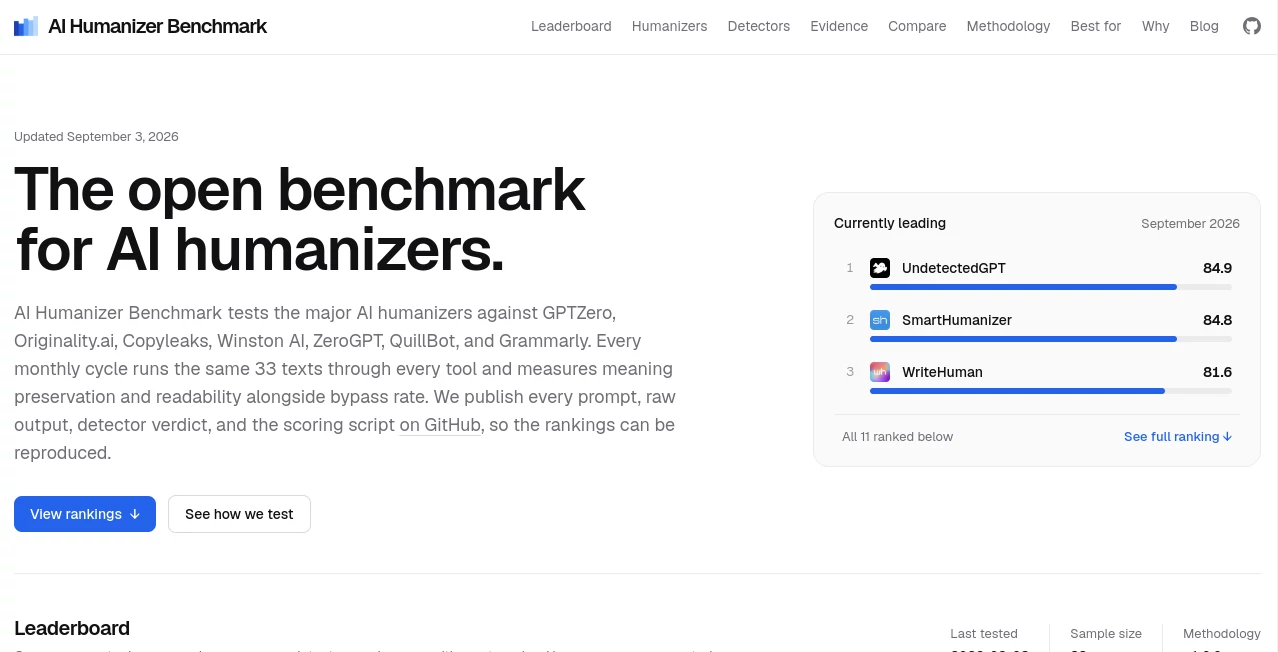
AI Humanizer Benchmark is a public, independently auditable platform that helps writers, students, marketers, and researchers understand how AI humanizers perform in real testing conditions. Instead of relying on vendor claims or promotional comparisons, the platform evaluates humanizers using identical texts, multiple AI detectors, and a published scoring system.
For anyone comparing AI humanization tools, this approach offers something particularly useful: measurable evidence. The September 2026 cycle tests 11 humanizers using 33 texts across seven writing categories, allowing visitors to explore how different tools balance detector bypass, meaning preservation, and writing quality.
Key Features
User Interface
The website is designed around a straightforward research experience. Visitors can explore the overall leaderboard, review individual humanizer results, examine detector-specific rankings, and browse published testing data. The structured presentation makes it easier to compare tools without navigating through lengthy promotional claims.
Each humanizer has a dedicated results page containing performance metrics and access information where available. Users can also explore the methodology and raw data to understand how the reported figures were produced.
Accuracy & Performance
The benchmark evaluates humanizers using a consistent testing process. Every tool processes the same 33 texts on its default settings and base plan, reflecting the experience an ordinary user is more likely to receive rather than a specially optimized demonstration.
Outputs are evaluated against seven commercial AI detectors: GPTZero, Originality.ai, Copyleaks, Winston AI, ZeroGPT, QuillBot, and Grammarly. The platform also considers meaning preservation, readability, and consistency across different writing categories.
Its overall scoring formula assigns 42% to detector bypass, 32% to meaning preservation, 16% to readability, and 10% to consistency. Penalties may be applied when a tool significantly changes the meaning, returns essentially unchanged text, refuses to process content, or introduces substantial length changes.
Capabilities
- Monthly AI humanizer leaderboard: Compare participating tools using a consistent scoring formula.
- Detector-specific rankings: Explore performance against individual AI detection systems.
- Writing category analysis: Review results across academic essays, application essays, blog posts, business emails, marketing copy, discussion posts, and news articles.
- Meaning and readability evaluation: Look beyond detector results to understand whether rewritten text remains useful and readable.
- Public raw test data: Examine source texts, humanizer outputs, and detector verdicts from published cycles.
- Reproducible scoring: Access the published scoring code and data repository to independently review the calculations.
- Historical cycle tracking: Follow benchmark results over time as humanizers and detection systems change.
- Vendor disputes: Submit a challenge when a published result appears incorrect, with a documented review process.
Security & Privacy
The platform publishes benchmark data and methodology for transparency, rather than presenting itself as an AI text rewriting service. Its terms explain that the website is an information resource and does not provide an AI humanization service.
Because the benchmark publishes source texts, generated outputs, and detector results, researchers should review the published data and licensing terms before reusing or redistributing information. The cycle data is available under CC BY 4.0, while the scoring code is released under the MIT license.
The operator also discloses its connection to the team behind UndetectedGPT, a humanizer included in the leaderboard. This disclosure is important for readers assessing the benchmark's independence. The platform states that the same testing pipeline, scoring rules, and penalties apply to every participating tool, and that the raw evidence is publicly available for review.
Use Cases
Students and academic writers: Students can explore how humanizers perform on application essays and academic writing. The meaning-preservation measurement is especially relevant when rewriting text without losing the original argument or essential information. Benchmark results should be treated as research information, not as a guarantee of acceptance by an educational institution's AI policies.
SEO professionals and content teams: Marketers and publishers can compare humanization performance across blog posts, marketing copy, and business emails. Looking at readability and meaning alongside detector results helps content teams consider whether a rewrite remains suitable for publication.
AI tool researchers: Researchers can inspect the published test records, compare detector outcomes, and reproduce the scoring process. This makes the platform useful for studying the strengths and limitations of AI humanizers and detection systems.
AI humanizer developers: Developers can submit their products for consideration in future monthly cycles and use the published methodology to understand the evaluation criteria. The dispute process provides a channel for raising questions about specific results.
Buyers comparing AI tools: People considering a paid humanizer can use the leaderboard as one source of evidence before making a purchase. Reviewing individual detector results, output quality, and access details provides more context than relying on a single advertised bypass percentage.
Pros and Cons
Pros
- Uses a consistent testing procedure across participating humanizers.
- Publishes raw benchmark data and scoring code for independent review.
- Evaluates meaning preservation and readability alongside detector bypass.
- Includes multiple AI detectors and writing categories.
- Provides monthly cycles that can help track changes over time.
- Discloses the operator's relationship with a humanizer included in the benchmark.
- Does not function as an affiliate-based humanizer recommendation service according to its published information.
Cons
- The benchmark covers a defined group of humanizers, so not every available product is necessarily included.
- Results reflect the selected texts, detector versions, settings, and methodology used in each cycle.
- Passing an AI detector does not prove that text was written by a human or guarantee acceptance by a school, publisher, or employer.
- Public benchmark rankings cannot fully represent every user's writing requirements or preferred workflow.
- The operator's connection to a participating humanizer remains a consideration for readers evaluating independence, even with the disclosed safeguards.
Pricing Plans
AI Humanizer Benchmark is presented as a public information and research resource rather than a paid AI humanization product. Its website provides access to the leaderboard, methodology, and published benchmark information without presenting a subscription plan for using a rewriting service.
The platform also states that vendors do not pay for placement or ranking positions. Its purpose is to publish measured results, not to sell access to a humanization tool.
Users interested in the exact access conditions, data licensing, or future participation should review the website's published terms and benchmark documentation.
How to Use This Benchmark
- Step 1: Explore the leaderboard. Begin with the overall results to see the humanizers included in the latest testing cycle.
- Step 2: Review the scoring formula. Understand how detector bypass, meaning preservation, readability, and consistency contribute to the overall score.
- Step 3: Compare individual results. Open a humanizer's results page to examine its detector performance and available access information.
- Step 4: Check writing categories. Consider whether the results are relevant to your intended use, such as essays, emails, marketing copy, or blog content.
- Step 5: Inspect the evidence. Browse the published raw data to understand the inputs, outputs, and detector verdicts behind the measurements.
- Step 6: Make an informed comparison. Consider writing quality and meaning preservation instead of relying only on a detector bypass percentage.
Comparison with Similar Tools
AI humanizer directories and comparison websites often focus on vendor descriptions, advertised bypass rates, or editorial recommendations. This benchmark takes a different approach by applying a shared testing procedure and publishing the underlying evidence.
Unlike a conventional humanizer, it does not rewrite text for users. Instead, it evaluates humanization products and presents their measured performance in a comparable format.
Its methodology also differs from a single-detector test. The benchmark uses seven commercial detectors and includes additional measurements for meaning preservation and readability. This provides a broader view of output quality, although the results remain dependent on the chosen test design and the capabilities of the detectors involved.
For a meaningful comparison, visitors should examine the individual results, methodology version, sample size, and testing date rather than assuming that a single overall score represents every possible writing situation.
Conclusion
AI Humanizer Benchmark offers a practical way to research the performance of AI humanizers through repeatable testing and publicly available evidence. Its combination of detector results, meaning analysis, readability evaluation, and open scoring methodology makes it useful for people who want more information before selecting a humanization tool.
The platform's monthly testing model is particularly valuable in a market where product performance can change as humanizers and AI detectors are updated. By publishing its methodology and raw records, it gives readers the opportunity to investigate the numbers instead of simply accepting promotional claims.
Whether you are researching AI writing tools, evaluating content workflows, or developing a humanizer, the benchmark provides a structured starting point for understanding the trade-offs between detector performance and writing quality.
Frequently Asked Questions (FAQ)
What is an AI humanizer benchmark?
An AI humanizer benchmark is a testing system that evaluates tools designed to rewrite AI-generated text. It measures outcomes such as detector bypass, meaning preservation, and readability to provide a structured comparison between products.
How often are the rankings updated?
The benchmark operates on a monthly testing cycle. Each cycle uses newly generated texts, allowing visitors to track performance as humanizers and AI detection systems change. The September 2026 cycle was tested on September 3, 2026.
Which AI detectors are included?
The benchmark's September 2026 panel includes GPTZero, Originality.ai, Copyleaks, Winston AI, ZeroGPT, QuillBot, and Grammarly. Detector coverage and methodology may change in future cycles.
Does the benchmark offer an AI rewriting service?
No. The website describes itself as an information resource and benchmark for commercial AI humanizers. It does not provide an AI humanization service.
Can I verify the published results?
Yes. The platform publishes its raw test data and scoring code in a public repository. Readers can inspect the underlying inputs, outputs, and detector verdicts, and use the published scoring process to reproduce the leaderboard calculations.
Does a high bypass score guarantee human-written results?
No. A detector bypass score represents performance within the tested conditions. It does not establish that text was written by a person, guarantee that another detector will classify it as human-written, or ensure compliance with an institution's writing policies.
Can humanizer developers submit their tools?
Yes. The website provides a process for submitting a humanizer for consideration in a future testing cycle. Participating tools are evaluated under the published methodology.
How should I interpret the overall score?
The overall score combines detector bypass, meaning preservation, readability, and consistency, with penalties for certain quality failures. It should be interpreted alongside the individual metrics and the methodology used for that cycle.
Is the benchmark independent?
The platform discloses that it is operated by the team behind UndetectedGPT, which is included in its leaderboard. It describes safeguards such as a shared testing pipeline, public scoring code, cryptographically committed test sets, and published raw data. Readers should consider both the disclosure and the available evidence when evaluating the benchmark.
Who can benefit from using the benchmark?
Students, content writers, marketers, researchers, developers, and people comparing AI humanizers can use the benchmark to explore measured performance and understand the limitations of different rewriting tools.