
Cloudernative
What is Cloudernative?
Finding the right AI model can be surprisingly difficult. There are thousands of models available, each with different strengths, input requirements, output formats, performance characteristics, and use cases. CloudNative makes that search much easier by bringing a large collection of AI models into one searchable place.
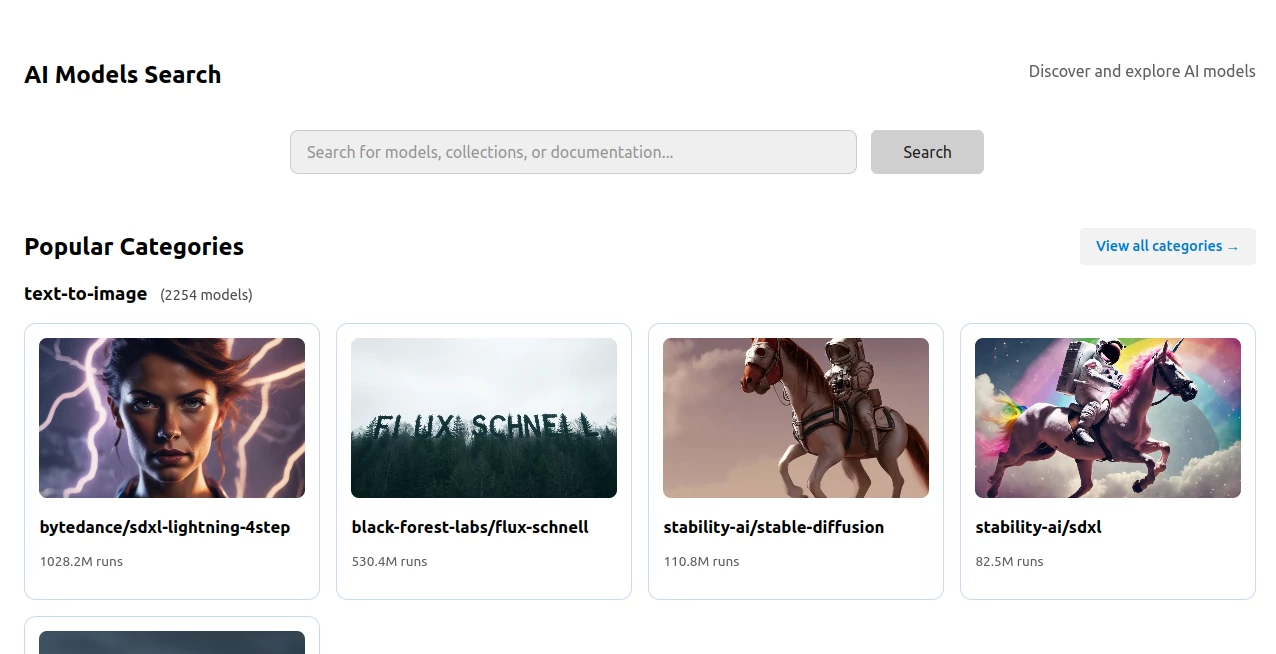
The platform is designed for people who want to explore what modern AI models can actually do rather than simply browse a list of popular AI tools. Visitors can search for models, collections, or documentation and then explore models by practical categories such as text-to-image, image-to-image, LoRA, and image inpainting.
For developers, researchers, and technical users, this approach is particularly useful. A model page can provide information about its purpose, example inputs and outputs, supported parameters, performance measurements, and version details. That makes it easier to compare options before deciding which model is worth testing.
Key Features
- AI model search: Search across a broad collection of models using keywords and categories.
- Model discovery: Explore popular models and discover alternatives based on specific AI capabilities.
- Detailed model pages: Individual pages can include descriptions, examples, parameters, output schemas, and version information.
- Performance information: Selected models display prediction time, total runtime, and usage statistics.
- Model categorization: Models are organized around practical capabilities such as text-to-image, image-to-image, LoRA, and image inpainting.
- Developer guides: The platform includes guides covering areas such as depth estimation, image upscaling, speech-to-text, text embeddings, virtual try-on, and face restoration.
User Interface
The interface keeps the main purpose of the platform clear: search, explore, and inspect AI models. The homepage places model discovery at the center, with a prominent search field for models, collections, and documentation.
Popular categories are presented directly on the page, making it possible to start browsing without knowing the exact name of a model. This is a useful touch for users who know what they want to accomplish but are not yet familiar with the available model names.
Accuracy & Performance
One of the stronger aspects of the platform is the amount of technical information available on individual model pages. Depending on the model, users can see prediction time, total execution time, number of runs, supported inputs, parameters, and output information.
For example, model listings can show real execution statistics alongside practical details about how a model accepts prompts, images, duration settings, aspect ratios, or other parameters. This gives developers more context than a simple marketing description.
Performance should still be evaluated according to the specific model and workload. A model designed for high-quality video generation may naturally require more processing time than a lightweight image or computer-vision model.
Capabilities
The platform covers a wide range of modern AI capabilities. Image generation and transformation are well represented, with categories for text-to-image and image-to-image workflows as well as specialized areas such as inpainting and LoRA.
Video generation is also represented through models capable of text-to-video and image-to-video generation. Other model pages demonstrate capabilities involving image segmentation, depth estimation, image editing, character consistency, and related computer-vision tasks.
This breadth makes the platform useful not only for experimenting with generative AI, but also for finding models that can be incorporated into more specialized technical workflows.
Security & Privacy
Users should treat individual models according to their own data-handling requirements. The platform primarily serves as a discovery and information layer for AI models, so privacy considerations can vary depending on the model, execution environment, and service used to run it.
For sensitive business information, private documents, personal images, or confidential source material, it is sensible to review the relevant model and execution provider documentation before submitting real data.
Use Cases
AI development: Developers can use the search functionality to find models that fit a particular application instead of manually searching through numerous repositories and model pages.
Generative image projects: Designers and developers can explore text-to-image, image-to-image, inpainting, and related models when building creative workflows.
Video generation: Teams experimenting with AI video can compare models supporting text-to-video or image-to-video generation and inspect their available parameters.
Computer vision: Researchers can explore models for tasks such as segmentation, depth estimation, image restoration, and other visual analysis workflows.
AI research: Researchers can use model statistics, version details, examples, and technical parameters as a starting point when comparing different approaches.
API development: Developers can also use the available technical guides to understand how particular AI capabilities can be integrated into applications.
Pros and Cons
- Pros: Large model collection, practical model categories, detailed technical information, performance statistics, example inputs and outputs, developer-focused documentation, and easy model discovery.
- Cons: The amount of technical information may feel overwhelming to beginners, and choosing the best model still requires understanding the requirements of a particular project.
Pricing Plans
The platform is primarily positioned as a model discovery and exploration resource. The publicly visible website focuses on searching and browsing AI models, rather than presenting a conventional subscription-based AI application with multiple consumer pricing tiers.
Individual models may have their own execution requirements or costs depending on how they are run and which underlying infrastructure is used. Users planning production workloads should therefore check the specific model and execution provider before estimating their final expenses.
How to Use It
- Start by entering the name of a model, capability, collection, or documentation topic into the search interface.
- Browse the available categories if you are not sure which model you need.
- Open an individual model page to review its description, examples, supported parameters, and technical details.
- Check performance information and usage statistics where available.
- Compare several models based on their capabilities and input requirements.
- Choose the model that best matches your application, then follow the relevant execution or API documentation.
Comparison with Similar Tools
Traditional AI tool directories usually focus on finished applications that people can use directly. This platform takes a more technical approach by concentrating on the underlying AI models themselves.
That distinction matters. A business owner searching for an AI writing application may prefer a conventional software directory, while a developer looking for a specific image-generation, video-generation, computer-vision, or embedding model can benefit much more from a model-focused search engine.
The inclusion of execution statistics, model parameters, example inputs, output schemas, and version information also makes the platform more useful for technical comparison than a simple catalog containing only tool names and descriptions.
Conclusion
For anyone working with modern AI models, discovering the right model can be just as important as choosing the right application. CloudNative provides a focused environment for that discovery process, combining searchable model listings with technical information that helps users understand what each model can actually do.
Its strongest advantage is the combination of breadth and technical depth. Instead of stopping at a short description, users can often inspect examples, parameters, performance data, usage numbers, and version details before moving forward.
Whether you are researching new generative models, building an AI-powered application, testing computer-vision technology, or simply keeping up with the rapidly changing model ecosystem, this platform offers a practical starting point for finding and evaluating the technology behind today's AI applications.
Frequently Asked Questions (FAQ)
What is this platform used for?
It is used to search for, discover, and explore AI models across different capabilities, with technical information available for individual models.
Can developers use it to find AI models?
Yes. Developers can search models by capability and inspect technical details such as inputs, parameters, outputs, versions, and performance information where provided.
What types of AI models can be found?
The catalog includes models for areas such as text-to-image, image-to-image, LoRA, image inpainting, video generation, image editing, segmentation, depth estimation, and other AI workloads.
Does it provide information about model performance?
Many model pages provide performance measurements such as prediction time, total runtime, and usage statistics. The exact information varies from one model to another.
Is it useful for AI research?
Yes. The combination of searchable models, categories, examples, technical parameters, and version information can make it a useful starting point for AI research and experimentation.
Can beginners use it?
Beginners can browse the categories and popular models, although some of the technical information is more useful to developers and experienced AI users.
Does the platform include developer resources?
Yes. It provides guides covering several practical AI capabilities, including image upscaling, speech-to-text, text embeddings, depth estimation, virtual try-on, and face restoration.
AI Research Tool , Large Language Models (LLMs) , AI Developer Tools , AI Search Engine .
These classifications represent its core capabilities and areas of application. For related tools, explore the linked categories above.

Cloudernative Alternatives Product

MacroMicro

Toonifyit

NetlifyAPP

Sourcetable

EstatePass

Preuve AI

Where Is Thi…

Where Is Thi…

Yorph AI