
CodeMouse
What is CodeMouse?
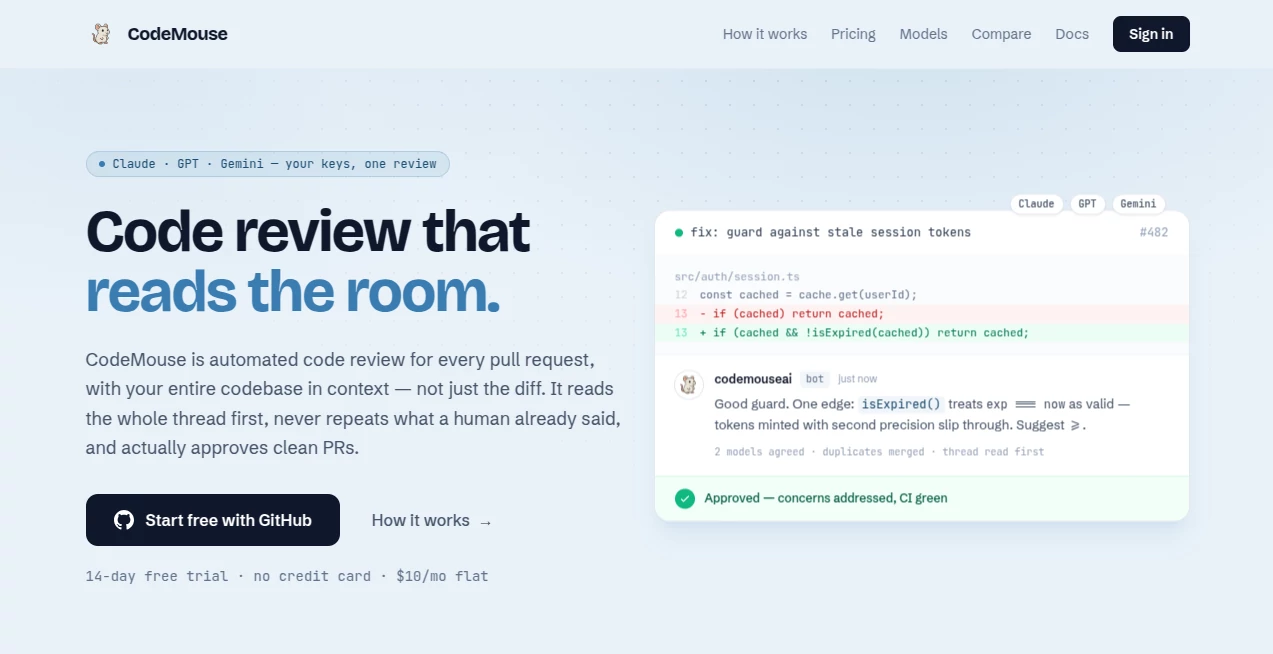
Modern software teams move quickly, but every pull request deserves careful attention before it reaches production. This AI-powered review platform helps developers catch bugs, improve code quality, and streamline collaboration without slowing down the development process. Instead of reviewing only the changed lines, it understands the broader project structure, making suggestions that are relevant to the entire repository rather than isolated code snippets.
One of its biggest strengths is the ability to avoid unnecessary noise. Before posting feedback, it reads existing pull request discussions and skips issues that have already been identified by teammates or previous reviews. This creates cleaner conversations and allows developers to focus on solving real problems instead of sorting through duplicate comments.
The platform integrates directly with GitHub and works automatically whenever a pull request is opened. Developers can connect their preferred AI providers, including Claude, GPT, and Gemini, allowing multiple models to review the same code simultaneously while merging duplicate findings into a single, organized review. The result feels surprisingly natural, almost like having several experienced engineers reviewing every change together.
Key Features
- Automatic GitHub pull request reviews.
- Repository-wide context instead of diff-only analysis.
- Supports multiple AI providers working in parallel.
- Consolidated review with duplicate findings removed.
- Inline review comments directly inside GitHub.
- Automatically approves clean pull requests when appropriate.
- Bring-your-own API key model for greater control.
- Fast setup with no CI pipelines or configuration files.
- Unlimited repositories and team members under a flat subscription.
- Supports popular programming languages including Python, TypeScript, Java, Go, and Rust.
User Interface
The interface is intentionally simple and developer-friendly. Installation requires only connecting a GitHub account, selecting repositories, and adding AI provider keys. Reviews appear directly inside GitHub pull requests, so developers never have to switch between multiple dashboards. Every suggestion is attached to the exact line of code where attention is needed, making reviews feel familiar and easy to follow.
Accuracy & Performance
Instead of relying only on code differences, the review engine analyzes the broader project structure, giving it additional context for more meaningful recommendations. Using multiple AI models together improves confidence in the reported issues while reducing false positives through intelligent merging of overlapping findings. Reviews are generated automatically shortly after a pull request is opened, helping teams maintain a fast development workflow.
Capabilities
The platform identifies potential bugs, edge cases, security concerns, naming inconsistencies, performance improvements, and maintainability issues. It also understands existing pull request conversations, follows up after developers push fixes, and recognizes when a pull request has satisfied all previous concerns. This creates an experience that feels closer to an experienced engineering teammate than a traditional static analyzer.
Security & Privacy
Security has been designed with developers in mind. Users provide their own AI provider keys, giving them direct control over API usage and costs. Repository data is processed only for reviews, source code is not permanently stored, and API keys are encrypted at rest using modern encryption standards. Temporary repository access helps minimize unnecessary data retention while maintaining accurate reviews.
Use Cases
- Automating code reviews for software development teams.
- Improving pull request quality before human review.
- Finding edge cases and hidden bugs early.
- Supporting open-source maintainers with consistent reviews.
- Helping startups maintain code quality with smaller engineering teams.
- Reducing repetitive review comments across large projects.
- Reviewing code across multiple programming languages.
Pros and Cons
Pros
- Very fast GitHub integration.
- Repository-aware code analysis.
- Supports multiple leading AI models.
- Duplicate review comments are automatically removed.
- Affordable flat pricing for entire teams.
- No complex CI configuration required.
Cons
- Requires users to provide their own AI API keys.
- Designed primarily for GitHub workflows.
- AI suggestions should still be validated by human reviewers.
Pricing Plans
The service offers a 14-day free trial without requiring a credit card. After the trial, it is available for a flat monthly subscription of $10 regardless of team size. AI provider usage is billed separately through the user's own API accounts, typically costing only a small amount per review depending on repository size and the selected model.
How to Use CodeMouse
- Install the GitHub application.
- Choose the repositories you want to review.
- Connect one or more supported AI provider API keys.
- Open a new pull request.
- Review the generated inline feedback.
- Apply suggested improvements and update the pull request.
- Receive approval automatically when the review is clean.
Comparison with Similar Tools
Unlike many AI review solutions that focus only on changed files, this platform analyzes the surrounding codebase for additional context. Its ability to combine feedback from multiple AI providers into one consolidated review also helps eliminate repetitive comments. The flat monthly pricing is particularly attractive for growing engineering teams compared to services that charge per developer seat.
Conclusion
For development teams looking to improve pull request quality without adding friction to their workflow, this solution delivers an excellent balance of automation, intelligence, and developer experience. Its contextual understanding, multi-model review process, and thoughtful handling of duplicate feedback make every review more valuable. Whether used by startups or established engineering teams, it helps developers spend less time on repetitive review tasks and more time building reliable software.
Frequently Asked Questions (FAQ)
Does it work with private repositories?
Yes. Private GitHub repositories are fully supported.
Which AI models can be connected?
Developers can connect Claude, GPT, Gemini, or multiple providers simultaneously.
Does it permanently store source code?
No. Repository data is processed temporarily during reviews and is not permanently stored.
Can it replace human code reviews?
No. It is designed to complement human reviewers by identifying mechanical issues and allowing engineers to focus on architecture and design decisions.
Is it suitable for large development teams?
Yes. Unlimited repositories and team members are included under a single flat subscription, making it scalable for growing organizations.
AI Testing & QA , AI Code Assistant , AI Developer Tools , AI DevOps Assistant .
These classifications represent its core capabilities and areas of application. For related tools, explore the linked categories above.

CodeMouse Alternatives Product

TutuoAI
Kimi K2.5

PatentFig AI

Velokey

ClawBridge

Defapi

Vibe Coding …

Project Mela

Blackbox AI