
Collects
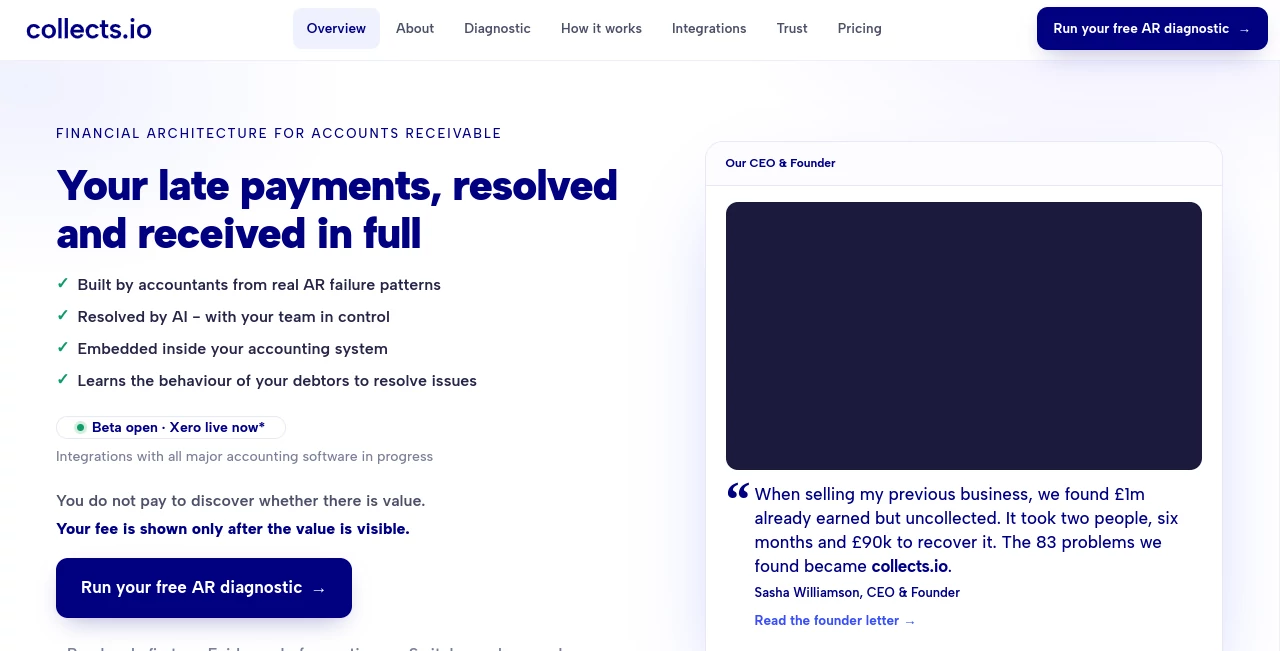
What is Collects?
Late payments are rarely caused by one simple problem. A missing purchase order, an incorrect contact, a delayed approval, an unresolved dispute, or a weak follow-up process can keep an otherwise healthy invoice unpaid for weeks. For finance teams, that creates more than an administrative headache. It affects cash flow, forecasting, working capital, and the time employees spend chasing customers.
collects.io takes a different approach to accounts receivable management. Instead of focusing only on sending payment reminders, it is designed to identify the underlying reasons invoices are delayed and help finance teams resolve those issues before they turn into another manual chasing task.
The platform was built by accountants and accounts receivable specialists around real AR failure patterns. Its diagnostic currently maps 83 known failure patterns and 488 resolution actions, giving businesses a structured way to examine where cash is getting stuck. The system is designed to work alongside finance teams rather than removing them from the decision-making process.
One of the most useful aspects is the read-only approach at the beginning. Businesses can connect their accounting data, review the findings, understand the potential cash and workload impact, and decide whether they want to activate further automation. That makes the platform particularly interesting for companies that want AI-assisted collections without immediately handing over control of customer interactions.
Key Features
- Accounts receivable diagnostic based on 83 mapped failure patterns
- 488 mapped resolution actions covering common collection problems
- Read-only analysis of 12 months of ledger history
- Identification of overdue cash and ageing risk
- Prioritisation of invoices according to payment risk and cash impact
- AI-assisted follow-ups and information requests
- Support for resolving missing information and payment blockers
- Human approval and manual override controls
- Audit trails for actions and debtor activity
- Safety controls including opt-outs and blackout periods
- Xero integration currently available
- Value-based pricing following the initial diagnostic
User Interface
The interface is built around the information a finance professional actually needs to see. Rather than presenting AI activity as a black box, the platform focuses on receivables, ageing, overdue cash, risk, manual workload, and potential recovery opportunities.
The diagnostic view can show how much money is sitting in different ageing bands and highlight areas that deserve attention. From there, the workflow moves toward identifying the reason behind a delayed payment and determining the appropriate next action.
This approach should feel familiar to an accounts receivable team. The technology sits behind the workflow, while the interface keeps the financial outcome at the centre.
Accuracy & Performance
The platform's approach to accuracy is particularly relevant for financial workflows. Rather than allowing an AI model to act freely, the system uses accuracy gates, approval controls, exception handling, and human oversight before live debtor actions are enabled.
Its diagnostic evaluates receivables against a structured collection framework containing 83 failure patterns. These include missing purchase orders, incorrect contact information, disputes, approval delays, insufficient evidence, and broken follow-up processes.
The figures presented on the website, such as potential DSO improvement and estimated recovered cash, are modelled indicators rather than published customer results. That distinction is important when evaluating the product. The value comes from using the diagnostic to understand a company's own receivables rather than assuming every business will achieve the same outcome.
Capabilities
The core capability goes beyond automated reminders. The system can identify what is blocking payment, rank invoices according to risk and financial impact, and recommend or trigger the next appropriate action within approved rules.
Depending on the workflow, this can include following up with customers, requesting missing information, gathering evidence, escalating disputes, and learning which approaches work for particular debtors. This gives finance teams a way to move from reactive chasing toward a more structured resolution process.
Another notable capability is its ability to begin with historical ledger data. A 12-month read-only connection allows a business to understand its receivables position before enabling live actions. That makes the initial diagnostic useful even for teams that are still deciding how much automation they actually want.
Security & Privacy
Financial data requires a cautious approach to automation, and the platform places considerable emphasis on governance. The initial connection is read-only, and live debtor activity is not enabled until the appropriate controls are approved.
Human approval, per-step overrides, do-not-disturb rules, blackout periods, customer opt-outs, and audit trails are built into the operating model. Actions are designed to remain traceable, with reversible workflows and human intervention available when an unusual situation requires judgment.
The company states that it is working toward ISO 27001, ISO 9001, and ISO 42001 certification principles, while Xero partner certification is also in progress. These are certification roadmaps rather than completed certifications, so businesses with strict compliance requirements should review the latest status before deployment.
Use Cases
Reducing overdue invoices: Finance teams can identify which invoices are creating the greatest cash-flow pressure and focus attention where it matters most.
Finding the reason behind delayed payments: Instead of repeatedly sending reminders, teams can investigate issues such as missing POs, disputes, approval delays, or incorrect customer information.
Reducing manual debtor chasing: Businesses spending hours every month on repetitive collection tasks can use governed AI workflows to handle suitable follow-ups while retaining human control.
Improving cash forecasting: A clearer view of ageing, payment risk, and overdue balances can give finance professionals better information for working-capital planning.
Scaling AR operations: Growing companies can create more consistent collection processes without relying entirely on spreadsheets, individual memory, and repetitive manual emails.
Protecting customer relationships: Collection activity can be governed by customer-specific information, communication rules, timing preferences, and human approval rather than using the same automated message for everyone.
Pros and Cons
- Pros: Focuses on the causes of late payments rather than reminders alone.
- Pros: Read-only diagnostic allows businesses to evaluate their AR position before activating automation.
- Pros: Strong emphasis on human approval, safety rules, and auditability.
- Pros: Uses a detailed framework of AR failure patterns and resolution actions.
- Pros: Xero integration is already available.
- Pros: Pricing is presented after the business can see the diagnostic value.
- Cons: The wider accounting and ERP integration roadmap is still being developed.
- Cons: Pricing is not publicly displayed as a fixed subscription.
- Cons: Some performance figures are modelled estimates rather than independently published customer results.
- Cons: Businesses using accounting systems other than Xero may need to wait for planned integrations.
Pricing Plans
The pricing model is based on the value identified during the accounts receivable diagnostic rather than a standard public subscription price. Businesses can begin with a free diagnostic using a read-only Xero connection and review the trapped cash, payment risk, DSO opportunity, manual workload, and potential recovery value before seeing their fee.
The company is currently operating a beta program. The website states that the beta is open until September 1, 2026, with some beta clients eligible for their first two months free. Availability is limited and may close earlier.
This pricing approach is appealing for businesses that want to understand the potential return before committing to an AR automation platform. The exact fee depends on the diagnostic findings and the chosen activation scope.
How to Use It
Getting started is designed to be straightforward. First, connect a Xero account in read-only mode. The system then works through the available 12-month ledger history and evaluates receivables against its mapped AR failure patterns.
Next, review the diagnostic. This stage highlights overdue balances, ageing risk, manual collection workload, potential trapped cash, and areas where payment delays may be occurring.
Once the business understands the findings and reviews the proposed pricing, it can choose how much automation to activate. Teams can begin in an observe-only or assisted mode before moving toward live AR resolution.
This staged process is useful for finance departments that want to test the technology gradually. Instead of changing the entire collections operation overnight, they can start with visibility, assess the recommendations, and increase automation as confidence grows.
Comparison with Similar Tools
Traditional accounts receivable software often concentrates on invoice tracking, payment reminders, ageing reports, and collection workflows. Those features remain useful, but they do not necessarily explain why an invoice is stuck.
This platform takes a more diagnostic approach. Its workflow is built around finding the operational failure behind a delayed payment, prioritising the financial impact, and selecting an appropriate resolution action.
It also differs from generic automation platforms because financial controls are part of the workflow. Human approval, exception handling, audit trails, customer-specific rules, and controlled activation are designed to remain central to the process.
For a company that only needs basic automated reminders, a simpler collections application may be sufficient. For finance teams dealing with recurring payment blockers, substantial overdue balances, or a large manual chasing workload, a diagnostic and resolution-focused approach can offer considerably more depth.
Conclusion
Late payments can quietly become one of the most expensive inefficiencies inside a growing business. The difficult part is often not sending another reminder; it is understanding what is preventing the customer from paying in the first place.
This platform addresses that problem with a combination of AR diagnostics, AI-assisted resolution, accounting data analysis, and human-controlled workflows. Its 83 mapped failure patterns and 488 resolution actions give the product a more specialised foundation than a generic AI automation tool, while the read-only starting point makes it easier for finance teams to investigate potential value before enabling live activity.
The current Xero integration and beta pricing make it particularly worth considering for businesses already using Xero and looking to improve their receivables process. Its broader integration roadmap is still developing, but the underlying idea is compelling: use AI not simply to chase invoices, but to understand and resolve the problems that cause invoices to remain unpaid.
Frequently Asked Questions (FAQ)
What problem does this tool solve?
It helps businesses identify and resolve the operational problems that cause accounts receivable payments to become delayed, while also helping finance teams prioritise the cash that needs attention.
Does it work with Xero?
Yes. Xero is currently the live accounting integration. The connection initially works in read-only mode and can access customers, invoices, payments, and credit notes for the AR diagnostic.
Does it automatically contact customers?
AI-assisted debtor actions can be activated within approved rules, but the system is designed around human approval, safety controls, exceptions, and manual overrides rather than unrestricted automation.
Can I test it before paying?
Yes. The current offering includes a free AR diagnostic with a read-only connection. The pricing is shown after the diagnostic has identified the potential value and workload opportunity.
Is the pricing publicly fixed?
No. Pricing is determined after the diagnostic and is presented in relation to the value identified for the business. During the current beta, some clients may also receive their first two months free.
AI Workflow Management , AI Accounting Assistant , AI Customer Service Assistant , Business .
These classifications represent its core capabilities and areas of application. For related tools, explore the linked categories above.

Collects Alternatives Product

TranAI

LeadCanvas

BetterAntisp…

Chatzy AI

FiveMinChat

TutuoAI

vivgrid

Beat API

4ga Boards