


















Context.dev
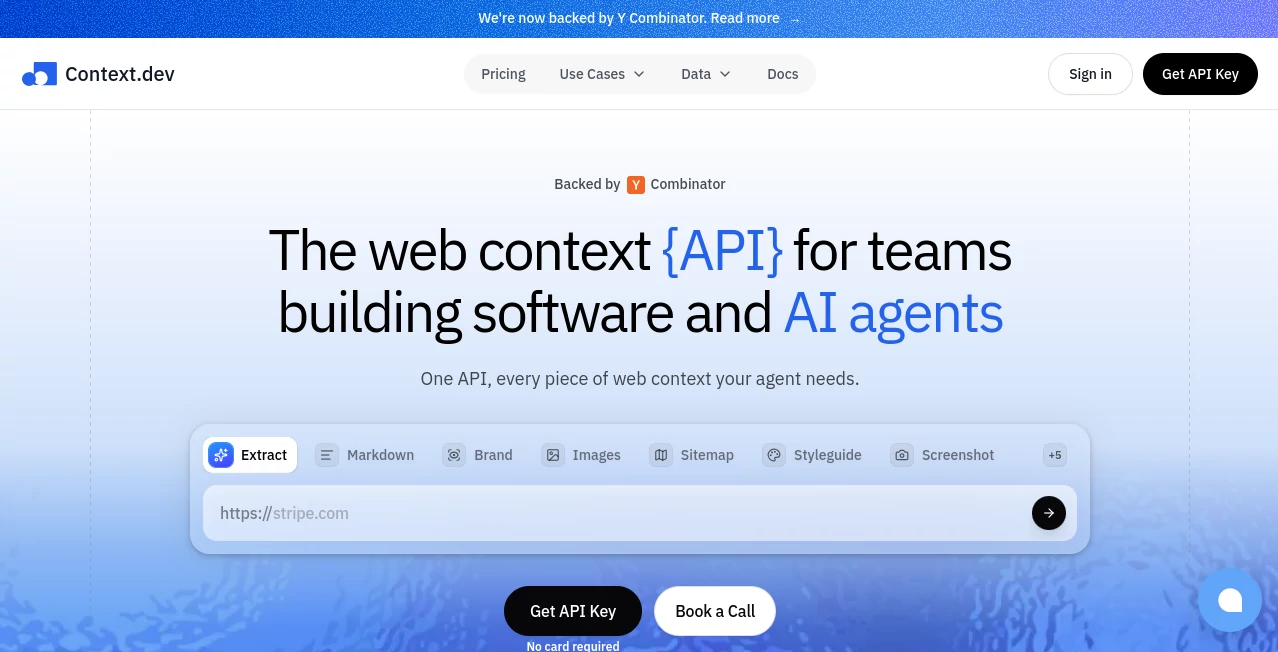
What is Context.dev?
Building modern AI products often fails not because of the model, but because of the messy way context is handled. This platform quietly solves that gap by helping developers structure, manage, and optimize the information that goes into AI systems. The result is cleaner outputs, fewer hallucinations, and a smoother development workflow.
Instead of treating context as an afterthought, it turns it into a controllable layer that improves how applications think and respond in real time.
Key Features
User Interface
The interface is minimal and developer-focused. It avoids distractions and puts emphasis on clarity, making it easy to experiment with different context setups without friction.
Accuracy & Performance
By organizing context more intelligently, responses from AI systems become noticeably more stable and relevant. It reduces unnecessary noise and helps models stay aligned with user intent.
Capabilities
- Context structuring for LLM-based applications
- Support for dynamic information injection
- Improved prompt orchestration
- Integration-friendly design for developer workflows
Security & Privacy
The platform is designed with a developer-first mindset, meaning sensitive data handling and controlled context exposure are prioritized to reduce risks in production environments.
Use Cases
It is especially useful for teams building AI assistants, SaaS tools with embedded LLMs, or any product where responses depend heavily on structured knowledge. Developers use it to reduce hallucinations, improve consistency, and maintain better control over outputs.
Pros and Cons
Pros
- Improves AI response consistency
- Helps organize complex prompt systems
- Developer-friendly workflow
- Reduces hallucination issues
Cons
- May require learning curve for beginners
- Best value seen in larger AI systems, not simple projects
Pricing Plans
Pricing details are typically structured around developer usage and team scale. Smaller projects can start light, while larger deployments benefit from advanced context control features designed for production-level workloads.
How to Use This Tool
Getting started is straightforward. Developers usually begin by defining their context sources, then integrate them into their AI pipeline. From there, adjustments are made iteratively to balance relevance, cost, and performance.
Comparison with Similar Tools
Compared to traditional prompt-based approaches, this solution offers a more structured and scalable way of handling context. While other tools focus on model output or interface layers, this one focuses on the hidden layer that actually shapes responses.
Conclusion
For teams serious about building reliable AI products, better context management is no longer optional. This platform brings discipline to an area that is often overlooked, and that alone can significantly improve real-world AI performance.
Frequently Asked Questions (FAQ)
Is it suitable for beginners?
It is more tailored toward developers, but motivated beginners can still learn it with some experimentation.
Does it improve AI accuracy?
Yes, by structuring and refining context, outputs tend to become more consistent and relevant.
Can it be used in production?
Yes, it is designed with real-world applications in mind, especially for scalable AI systems.
What makes it different?
Its focus on context orchestration rather than just prompting or UI layers makes it stand out in the AI development ecosystem.
AI Code Assistant , AI API Design , Large Language Models (LLMs) , AI Developer Tools .
These classifications represent its core capabilities and areas of application. For related tools, explore the linked categories above.

Context.dev Alternatives Product

Schema Synth

Claude and C…

Somnio

HostFinder

Latency Atlas

Website Clon…

Mythx AI

Jasper

volume shade…
