
DeepSearch Name
What is DeepSearch Name?
Finding the right person online can be surprisingly time-consuming. A simple name search can lead to dozens of people with similar identities, scattered professional profiles, company pages, interviews, articles, and other public information. DeepSearch Name takes a more organized approach by turning a person's name into a research starting point with publicly available sources.
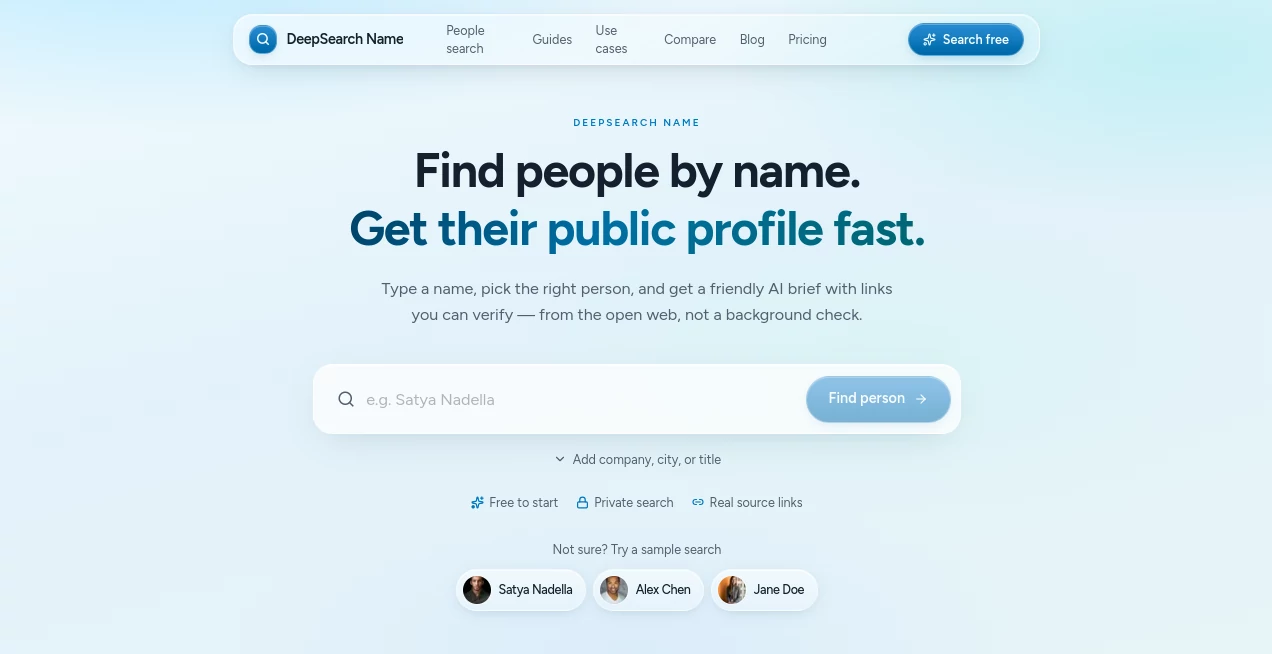
The service is designed for professional research rather than intrusive investigation. Users can enter a full name, add useful context such as a company, city, job title, education, or industry, and review potential matches before creating a profile. Once the correct person is confirmed, the system produces a structured AI brief with source links that can be opened and checked.
This approach is particularly useful when preparing for a meeting, researching a potential business contact, checking a public professional background, or gathering context before reaching out. Instead of jumping between numerous browser tabs, users get a more focused workflow that puts identity confirmation and source verification at the center.
Key Features
- Name-based people search using publicly available web information.
- Additional filters for company, location, job title, education, and field or industry.
- Candidate selection to help distinguish between people with the same or similar names.
- Structured AI-generated profiles based on public web sources.
- Links to sources behind important profile information for easier verification.
- Follow-up chat for exploring roles, public appearances, writing, and other sourced details.
- Private lookups without notifying the person being researched.
- Support for professional research involving recruiters, founders, sales teams, investors, and journalists.
- A public-web research model that avoids presenting itself as a regulated background-check service.
User Interface
The interface is deliberately straightforward. The main workflow begins with a name field, followed by optional contextual information. Adding a company or location can make a major difference when searching for someone with a common name.
After potential matches appear, users can review the available signals before choosing the correct person. This confirmation step is a useful touch because it prevents the system from immediately building a polished profile around the wrong individual.
The overall experience feels closer to a guided research workspace than a traditional people directory. The process is organized around four practical stages: search, confirm, brief, and chat.
Accuracy & Performance
One of the strongest aspects of the workflow is its emphasis on verification. Instead of treating an AI-generated paragraph as unquestionable fact, the service provides links to the public sources behind the information.
Results are naturally dependent on a person's public footprint. Someone with an active professional presence, company biography, public interviews, articles, conference appearances, or other indexed material can produce a much richer profile than someone with very little information online.
Common names can also require additional filtering. Adding an employer, city, or job title helps narrow the candidate pool and reduces the risk of confusing two different people. Recent career changes may also take time to appear consistently across public websites, so important claims should still be checked at the original source.
Capabilities
The platform is particularly good at compressing repetitive online research into a repeatable process. A user can start with a name, add a few clues, select the appropriate candidate, and then review a structured profile rather than manually collecting information from multiple pages.
The follow-up chat adds another useful layer. Once a profile has been created, users can ask questions about public roles, talks, interviews, writing, or gaps in the available information. This makes the tool useful for preparation rather than simply returning a list of search results.
It is also intentionally limited in scope. It does not position itself as a source of private databases, credit information, court dossiers, or regulated consumer reports. That distinction makes its intended use much clearer.
Security & Privacy
Privacy is an important part of the product's positioning. Searches are private, and the people being researched are not notified that a lookup has taken place. Search history remains associated with the user's account and can be cleared.
At the same time, private searching does not mean access to private information. The system works with information available on the open web. Users should therefore treat the service as a research and preparation tool rather than a way to obtain confidential personal information.
The service also clearly states that it is not intended for employment, housing, credit, insurance, or other decisions requiring a regulated background check.
Use Cases
Recruiting: Recruiters can research a candidate's public professional presence before an interview or initial conversation. Confirming the correct person first can be especially helpful when several candidates share a name.
Sales and Business Development: Sales professionals can gather public context about a prospect before sending an outreach message or joining a meeting. A company name, role, or city can help narrow the search and make preparation more focused.
Meeting Preparation: Before an important conversation, users can review a person's publicly documented roles, work, interviews, talks, or other professional activity and arrive with more relevant questions.
Founders and Investors: Entrepreneurs and investors can use the workflow when researching potential partners, founders, advisors, or people they may encounter through introductions.
Journalism and Research: Journalists and researchers can use sourced public information as an initial research layer, while still opening and verifying the original pages before publishing important claims.
Pros and Cons
Pros
- Simple name-first research workflow.
- Useful filters for narrowing down common names.
- Source-linked AI profiles make verification easier.
- Private lookups do not notify researched individuals.
- Follow-up chat keeps additional research connected to the original profile.
- Clear distinction between public-web research and regulated background checks.
- Useful across recruiting, sales, journalism, investing, and professional preparation.
Cons
- Results depend heavily on how much information is publicly available about a person.
- Very common names may require several identifying details.
- Recent job changes may not immediately appear consistently across the web.
- Login-protected and non-indexed pages are outside the public-web research workflow.
- Users still need to verify important claims through the cited sources.
Pricing Plans
The service offers several billing options while keeping the core product consistent across plans. Every plan includes unlimited name lookups, sourced AI profiles, follow-up chat, and private searching, with a fair-use soft cap of 25 lookups per day.
- Weekly: $7.99 per week.
- Monthly: $19.99 per month.
- Quarterly: $39.99 per quarter.
- Yearly: $59.99 per year.
The yearly option provides the lowest effective monthly cost for people who expect to use the service regularly. Subscriptions are billed through Stripe and can be canceled at any time, with access continuing through the period already paid for.
How to Use the Tool
- Enter the person's full name in the search field.
- Add a company, city, job title, education, or industry when additional context is available.
- Review the candidate results and identify the person that matches the information you already know.
- Confirm the correct candidate before generating the profile.
- Read the structured brief and open the provided source links for important claims.
- Use the follow-up chat to explore supported information such as previous roles, public talks, writing, or areas that remain unclear.
- Use verified information as preparation rather than treating an AI summary as a substitute for checking the original sources.
Comparison with Similar Tools
Traditional search engines are excellent when users already know what they are looking for, but researching a person manually can involve many separate searches and browser tabs. Professional networking platforms can provide strong career information, while contact databases are often designed around lead generation and business data.
This service takes a narrower approach. Its main advantage is the sequence of identifying candidates, confirming the correct person, creating a sourced profile, and continuing the research through chat. That makes it particularly appealing for situations where the goal is understanding a person's public professional context rather than simply finding contact information.
The distinction is important. Someone looking for a regulated background check, confidential records, or a large-scale contact database would need a different type of service. For public-web research before a meeting, introduction, article, or professional conversation, the focused workflow can save considerable manual effort.
Conclusion
Researching a person online does not always require an enormous collection of databases. Often, the real challenge is identifying the right person and organizing information that is already publicly available. This service addresses that problem with a practical name-first workflow and an emphasis on verification.
The combination of candidate matching, source-linked AI profiles, contextual filters, private searches, and follow-up chat makes it a useful option for professionals who regularly need quick background context before conversations or research tasks.
Its biggest strength is also its clearest boundary: it works with public-web information and encourages users to verify what they find. For recruiters, sales professionals, founders, investors, journalists, and anyone who frequently asks “Who is this person?”, that focused approach can make everyday research considerably easier.
Frequently Asked Questions (FAQ)
What does this people research tool do?
It helps users research people by name using publicly available information from the open web. Users can narrow results with details such as company, location, job title, education, or industry and then receive a sourced AI profile after confirming the correct person.
Can I search for someone with a common name?
Yes. Adding information such as the person's employer, city, job title, education, or industry can help distinguish between multiple people with similar names.
Are searches private?
Yes. The service states that people being researched are not notified when a lookup is performed. Search history is associated with the user's account and can be cleared.
Is this a background-check service?
No. It is designed for public-web research and is not an FCRA-compliant consumer reporting agency or regulated background-check product. It should not be used for employment, housing, credit, insurance, or similar screening decisions.
Can I ask follow-up questions about a profile?
Yes. After a profile is created, users can use the chat feature to explore supported information such as public roles, talks, interviews, writing, and gaps in the available sources.
What happens if there is not much information about someone online?
The resulting profile may be limited. A small public footprint can simply mean that there is not enough reliable information available to build a detailed profile. In such cases, the service is designed to avoid filling gaps with unsupported details.
Do I still need to verify the information?
Yes. The provided source links are intended to make verification easier. Important information should be checked against the original pages before it is used in outreach, publications, meetings, or other professional decisions.
AI Research Tool , AI Recruiting , AI Search Engine .
These classifications represent its core capabilities and areas of application. For related tools, explore the linked categories above.
DeepSearch Name details
Website unavailable — View Alternatives
Pricing
- Free
Apps
- Web App
Categories

DeepSearch Name Alternatives Product

Empiriolabs …

Candidate Sc…

Lessie AI

ForexCoupons

ResumeTailor…

ZoraInsights

Chrome Sidek…

AI Entity

LocaFlow