DetectGPT
What is DetectGPT?
Checking whether a piece of writing sounds AI-generated has become a practical step for students, writers, marketers, and anyone publishing content online. A quick review can reveal sentences that feel overly polished, repetitive, or simply unlike the writer’s usual voice.
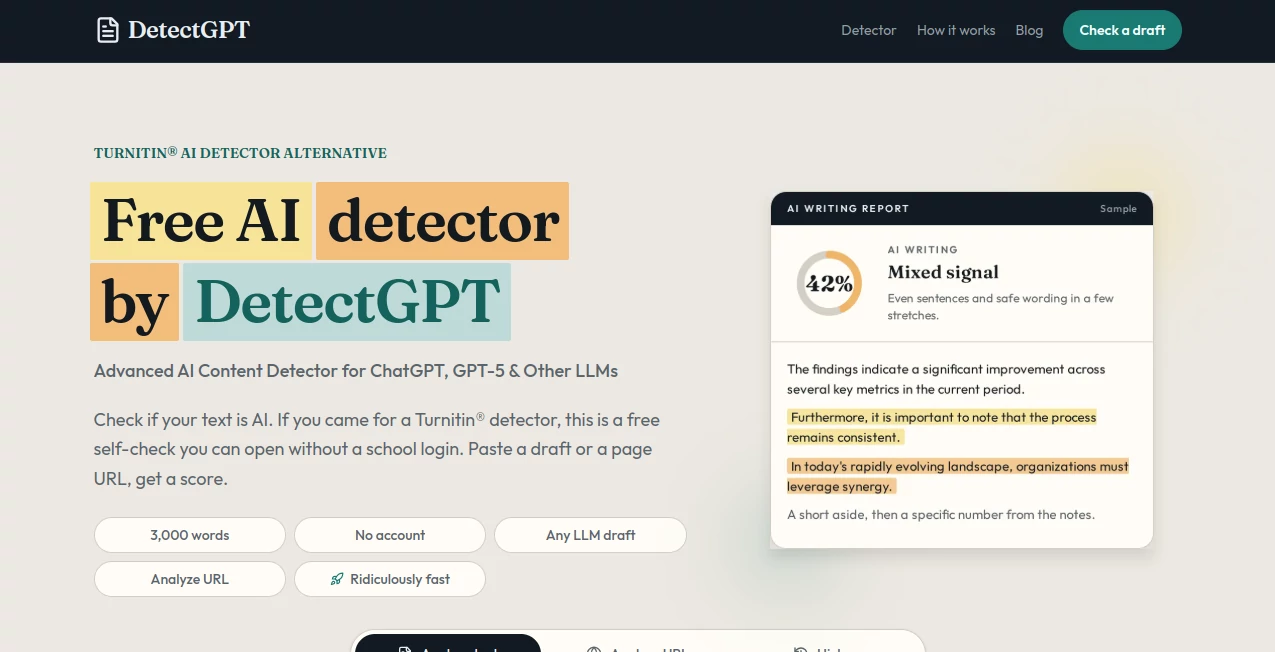
DetectGPT is built around that simple idea. It provides a free way to examine finished writing without requiring an account or a school login. Users can paste text directly into the checker or analyze a publicly accessible webpage and receive an AI writing score along with highlighted passages that may deserve another look.
The service supports drafts produced by popular language models as well as writing created entirely by humans. Rather than treating the result as a final judgment about authorship, it works best as a practical editing signal. If certain parts of a draft sound stiff or machine-like, the report gives the writer a useful place to start revising.
Key Features
- AI writing detection for text produced by different language models
- Up to 3,000 words per check
- No account or school login required
- Public URL analysis for accessible webpages
- Highlighted passages that may contain AI-like writing patterns
- AI writing percentage to help evaluate a finished draft
- Built-in plagiarism checking based on publicly available web content
- Matching phrases and source links for similarity results
- Support for drafts from ChatGPT, Claude, Grok, Gemini, and other LLMs
User Interface
The interface is intentionally straightforward. A writer can paste a draft into the main input area, upload a text file, or switch to URL analysis when the content is already published online. The 3,000-word limit is clearly presented, so there is little guesswork before starting a check.
Once the analysis is complete, the result is presented as a percentage together with highlighted sections. This is particularly useful when reviewing a long article because the writer does not have to manually inspect every sentence to find passages that may need attention.
The overall workflow feels closer to a quick proofreading step than a complicated technical analysis. For someone preparing an essay late at night or checking a blog post before publishing, that simplicity can be a real advantage.
Accuracy & Performance
The system looks at writing patterns rather than trying to access a user’s account with an AI service. It evaluates the finished prose and identifies characteristics that can make text appear machine-generated, including repetitive sentence structures, predictable transitions, and writing patterns that lack individual voice.
Results should be treated as signals rather than absolute proof of authorship. Short passages, highly structured academic writing, and writing produced by people using English as a second language can sometimes produce misleading results. Different AI detectors can also disagree because they use different scoring methods.
For the most useful results, it is better to read the highlighted sections alongside the percentage. A high score does not automatically mean that every sentence was written by AI, while a low score should not be considered definitive proof of human authorship.
Capabilities
One of the stronger aspects of the service is that it is not limited to a single AI model. A finished draft from ChatGPT, Claude, Grok, Gemini, or another language model can be checked in the same workflow.
There is also a separate similarity checking feature. Instead of producing an AI-writing percentage, this section looks for matching phrases across public webpages and provides source links. That makes it useful when a writer wants to investigate possible wording overlap as well as AI-like writing patterns.
URL analysis adds another convenient option. If an article is already published on a public webpage, users can provide its address rather than copying the entire article into the editor. Public pages can be analyzed, while login-protected pages and PDFs are outside the intended workflow.
Security & Privacy
Privacy is particularly important when dealing with unpublished essays, client work, business documents, or other sensitive material. The service states that text pasted for checking is scored in the browser, while history remains on the user's device. URL analysis is different because the server needs to retrieve the public page in order to read its content.
As with any online writing service, users should avoid submitting passwords, confidential business information, private documents, or other material that should not be shared with a web application. The safest approach is to use the checker for the portion of content that actually needs review.
Use Cases
Students: Students can use the checker before submitting an essay or research assignment to identify passages that may sound unusually formulaic. It can be especially useful when an AI tool was used during brainstorming or drafting and the final text needs to be reviewed in the student's own voice.
Bloggers and content writers: Writers can run articles through the checker before publication and inspect sections that feel repetitive or overly generic. This provides an additional editing step before content reaches an audience.
Marketing teams: Marketing copy often needs a distinctive brand voice. Checking drafts can help identify sections that feel too uniform, giving editors an opportunity to make the copy more natural and specific.
Second-language writers: Writers working in English can use the highlighted passages as an editing aid. Instead of attempting to achieve a perfect score, they can focus on improving sentence rhythm, word choice, and personal style.
Web publishers: The URL analysis option is convenient for reviewing already-published articles and public pages without manually copying the entire text.
Pros and Cons
- Pros: Free to use, no account required, quick analysis, supports multiple LLM-generated drafts, accepts public URLs, highlights potentially AI-like passages, and includes a public-web similarity checker.
- Pros: The 3,000-word limit is generous enough for many essays, articles, and individual sections of longer content.
- Pros: The results are presented in a way that encourages editing rather than simply displaying an unexplained number.
- Cons: The 3,000-word limit means longer documents need to be divided into multiple checks.
- Cons: AI detection cannot reliably establish who actually wrote a piece of text.
- Cons: Results can vary depending on writing style, text length, language proficiency, and the detector being used.
- Cons: Public URL analysis does not replace access to private pages, PDFs, or protected applications.
Pricing Plans
The service currently offers its core AI detection experience for free. Users can check up to 3,000 words per run without creating an account or entering payment information.
The same free workflow allows users to paste text or analyze an eligible public webpage. Longer documents can be divided into smaller sections when necessary, making the free limit practical for many everyday writing tasks.
Because AI detection is most useful as an editing aid rather than a definitive authorship test, the no-cost model makes it particularly accessible to students, independent writers, and publishers who simply want a quick second opinion on a draft.
How to Use the Tool
Start by preparing the finished draft you want to review. The text should contain enough writing for the detector to identify meaningful patterns rather than just a very short sentence.
Paste the content into the text checker and keep the submission within the 3,000-word limit. If the material is already available on a public webpage, the URL analysis option can be used instead.
After starting the analysis, review the displayed percentage and then examine the highlighted passages. The highlighted text is often more useful than the number itself because it shows where the writing may sound unusually mechanical.
Next, read those sections in context. Replace generic phrases, vary sentence structure, add specific details where appropriate, and make sure the wording reflects your actual voice. Run another check if needed, but avoid rewriting perfectly natural sentences simply to chase a particular percentage.
Comparison with Similar Tools
AI writing checkers differ considerably in their intended audience and access model. Some are designed primarily for individual users, while others are integrated into educational platforms and require an institutional license.
This service is particularly convenient for personal self-checking because there is no school account or campus login involved. ZeroGPT, for example, also provides a public AI detection service, while Turnitin is primarily associated with educational institutions and combines similarity checking with academic workflows.
Another important distinction is the type of result provided. An AI detector estimates whether writing contains patterns associated with language-model output, while a plagiarism checker looks for textual overlap with existing sources. These are different questions, so using one score as a substitute for the other can lead to incorrect conclusions.
For everyday editing, the most useful approach is to treat detection results as one piece of feedback. The quality, originality, accuracy, and authenticity of the actual writing still matter more than any single percentage.
Conclusion
A good AI checker should not encourage writers to obsess over reaching zero percent. Its real value is helping them notice passages that no longer sound like their own writing.
This service delivers that experience with a simple workflow, free access, support for multiple language models, public URL analysis, and a separate web-based similarity checker. The combination makes it useful for students, writers, marketers, and publishers who want a quick review before submitting or publishing content.
The strongest way to use the results is as an editing guide. Read the highlighted sentences, question the wording, add your own perspective, and keep the final version genuinely yours. Used that way, an AI detector becomes less of a pass-or-fail test and more of a practical writing companion.
Frequently Asked Questions (FAQ)
Is the AI checker free?
Yes. The core checker is available for free without an account or payment card, with a limit of 3,000 words per run.
Can I check text written with ChatGPT?
Yes. The service is designed to evaluate finished writing from ChatGPT and other major language models, including Claude, Grok, and Gemini.
Can it analyze a webpage?
Yes. A public webpage or homepage can be submitted through the URL analysis option. Pages behind login screens and PDFs are not supported by this workflow.
Does the AI percentage prove that a person used AI?
No. The percentage is a detection signal, not proof of authorship or academic misconduct. Human writing can sometimes be flagged, and AI-assisted writing can sometimes avoid detection.
Does it include plagiarism checking?
Yes. A separate plagiarism checker searches for matching phrases on public webpages and provides source links. Its similarity percentage should not be confused with the AI-writing percentage.
What should I do when my score is high?
Read the highlighted passages instead of focusing only on the number. Rewrite sections that feel generic or mechanical, add your own perspective, and vary the sentence structure naturally.
Can longer documents be checked?
Yes, but each run is limited to 3,000 words. Longer documents can be divided into smaller sections and checked separately.
Is a low AI score proof that writing is human?
No. AI detection results are not definitive proof of human authorship. They are best used as an additional editing signal alongside careful review.
Which languages work best?
The service states that its strongest performance is currently on English writing. Results for other languages may vary.
Does it access my ChatGPT or Claude account?
No. The detector evaluates the finished text rather than accessing your AI accounts or the original prompt used to create the content.
AI Detector , AI Checker Essay , AI Plagiarism Checker , AI Content Detector .
These classifications represent its core capabilities and areas of application. For related tools, explore the linked categories above.

DetectGPT Alternatives Product

GPTZero

TranslateAI …

Reverse Vide…
Copyleaks

AI Bypass Hub

AI ATS Check…

AHelp

SeoWebChecker

StealthGPT