
DigiBouquet
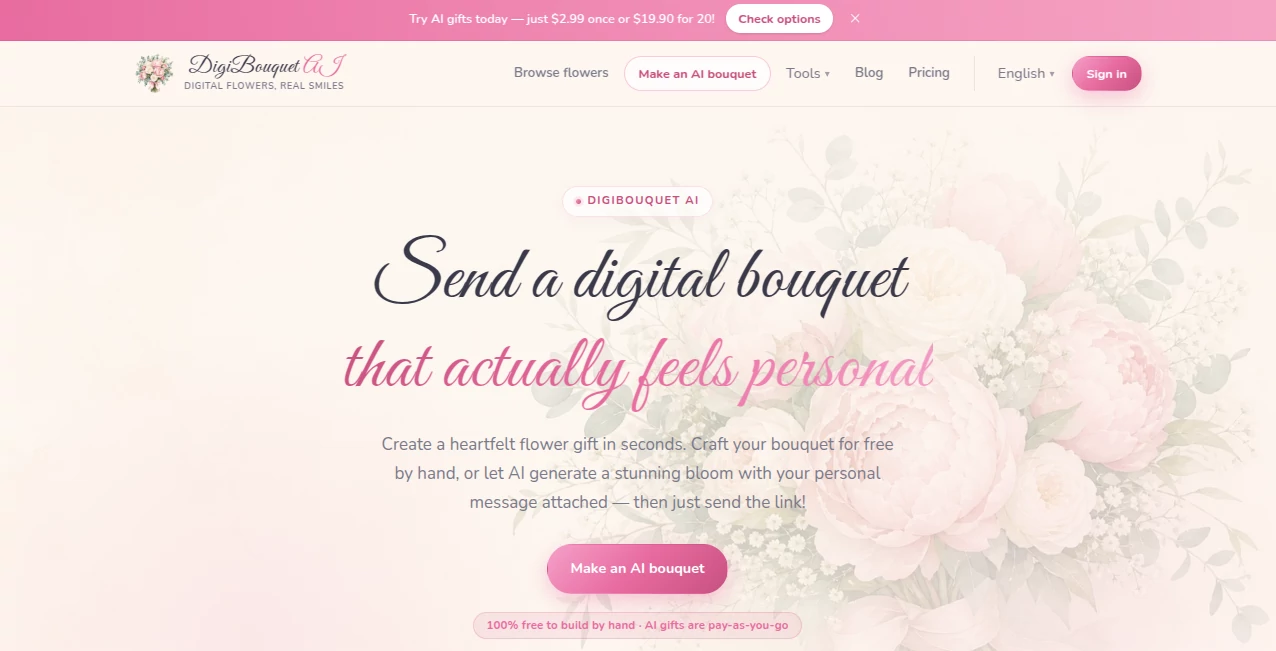
What is DigiBouquet?
Sending flowers has always been a simple way to say something that is sometimes difficult to put into words. The problem is that traditional flowers are not always practical. Distance, delivery times, busy schedules, and unexpected moments can all get in the way.
DigiBouquet AI takes a different approach by turning the idea of a flower gift into a digital experience. Users can build a bouquet themselves for free, or let AI create a finished arrangement based on a short prompt, mood, style, and personal message. The final gift can then be shared through a private link or downloaded as an image.
What makes the concept particularly appealing is that the recipient does not need to install an application or create an account. They simply open the gift link on their phone and see the bouquet together with the message. It is a small idea, but it fits surprisingly well into modern long-distance relationships, birthdays, apologies, thank-you messages, and everyday moments when someone simply wants to say, “I was thinking about you.”
Key Features
The platform combines a traditional bouquet-building experience with AI-generated digital artwork. Users can choose between creating everything manually or letting AI produce a complete gift card.
- Free step-by-step digital bouquet builder
- AI-generated flower gift cards
- Personal messages with To, Message, and From fields
- Multiple visual styles and moods
- Private gift links for easy sharing
- PNG and story-ready image exports
- Flower library with meanings and gifting guidance
- No account required for the free bouquet-building experience
- AI generation with starter credits after signing in
User Interface
The interface is designed around a straightforward gifting process rather than a complicated creative workflow. Users can start with a preset look, answer a few questions for an AI-generated bouquet, or design the arrangement themselves.
The manual option is especially useful for people who already know what they want. Flowers, greenery, card style, message, and mood can be selected step by step. For someone who would rather not make those decisions individually, the AI route provides a faster way to arrive at a complete visual result.
The experience also considers the recipient. Gift pages are designed to open directly on modern mobile browsers, which makes sharing practical even when the person receiving the bouquet is not particularly technical.
Accuracy & Performance
This is not a tool where accuracy means answering a factual question or producing a numerical result. Its success is better measured by how well the generated visual arrangement matches the requested mood, flowers, style, and message.
The AI workflow is intentionally simple. Users provide a short description and select relevant creative inputs, allowing the system to produce a complete bouquet image rather than forcing them through a long list of design controls. If the first result is close but not quite right, users can generate another version with a more focused change.
The manual builder provides an alternative when exact control matters more than automation. This is a useful distinction: AI is available when speed and creative assistance are valuable, while the free builder remains available for users who want to make the choices themselves.
Capabilities
The platform can create digital flower arrangements for a wide range of situations. The available examples include romantic bouquets, birthday designs, friendship-themed gifts, quiet support, apologies, congratulations, and long-distance messages.
The flower library adds another useful layer. Instead of treating every flower as purely decorative, it provides guidance around meanings and emotional context. Roses, tulips, orchids, sunflowers, lavender, lilies, peonies, daisies, and other flowers can therefore be considered based on the feeling the sender wants to communicate.
The AI-generated result combines the bouquet, mood, and personal card into one finished vertical image. That makes it suitable for sending privately through a link or sharing as an image in a messaging application or social story.
Security & Privacy
Privacy is particularly relevant for digital gifts because personal messages can sometimes contain sensitive or emotional information. The service states that its free bouquet flow can be used without an account, while AI generation and related account features require sign-in.
The privacy policy explains that account, credit, and AI generation information may be retained while an account is active and for a reasonable period afterward for billing, security, and support. The service also states that it does not sell, trade, or rent user information to third parties.
For analytics and advertising, third-party services such as Google Analytics and Google AdSense may be used. The privacy policy also notes that reasonable measures are taken to protect collected information, while acknowledging that no internet transmission or electronic storage system can be guaranteed to be completely secure.
Use Cases
The strongest use cases are situations where the sender wants to communicate warmth without arranging a physical delivery.
- Birthdays: Send a cheerful digital bouquet when a physical delivery is too late or impractical.
- Long-distance relationships: Share flowers instantly across cities, countries, and time zones.
- Apologies: Use a restrained visual style with a sincere message rather than relying on a generic greeting.
- Get-well messages: Send a quiet digital gift to someone recovering at home or in hospital.
- Friendship: Send a colorful bouquet simply because someone came to mind.
- Thank-you messages: Combine meaningful flowers with a short personal note.
- Congratulations: Create a celebratory arrangement without waiting for a florist.
- Everyday gestures: Sometimes “just because” is the best reason to send flowers.
A particularly practical advantage is timing. A digital bouquet can be sent immediately, which is useful for last-minute birthdays or moments when someone needs encouragement now rather than tomorrow.
Pros and Cons
Pros
- Free manual bouquet builder
- AI-assisted bouquet generation
- Personal message included with the visual gift
- Recipients do not need an app or account
- Private sharing through a gift link
- Image downloads are available
- Useful flower-meaning library
- Works well for same-day and long-distance gifting
Cons
- AI-generated bouquets require credits
- Individual flowers inside an AI-generated image cannot be edited separately
- The free experience focuses on manually building a classic bouquet rather than AI generation
- AI results may require another generation when the first visual interpretation is not exactly what the sender imagined
Pricing Plans
The service offers a free path for users who want to build and share a traditional digital bouquet themselves. AI generation works through credits, and new users can receive 10 starter credits after signing in.
For users who only need AI generation occasionally, one-time credit packs are available. The current listed options include a Basic Pack at $5.99 for 50 credits, a Pro Pack at $9.99 for 100 credits, and a Max Pack at $19.99 for 250 credits. The service states that credits do not expire.
Subscription plans are also available for people who expect to create AI bouquets more frequently. The current monthly options are Basic at $5.00 for 100 credits, Pro at $8.33 for 210 credits, and Max at $16.67 for 500 credits. Active subscriptions can also remove branding and the QR code from exports.
Because pricing and promotional offers can change, users should check the current pricing page before purchasing credits or choosing a subscription.
How to Use It
Getting started is straightforward. For a completely free experience, begin with the manual bouquet builder and select the flowers and greenery you want to use. Add a card, enter the recipient and sender details, write the message, and choose a suitable mood.
If you prefer an AI-generated design, sign in and use the AI bouquet option. Describe the kind of bouquet or feeling you want, select the available creative options, and generate the finished gift card.
Once the bouquet is ready, preview the result before sending it. You can share a unique gift link with the recipient or download an image for use in a messaging application or social story.
A useful habit is to open the gift link yourself before sending it. This gives you a chance to check names, spacing, wording, and the overall appearance on a phone. For emotional messages especially, a quick preview can prevent an otherwise avoidable mistake.
Comparison with Similar Tools
Digital flower generators generally fall into two groups: simple image generators that create flower artwork, and gifting platforms that turn the artwork into something a person can actually send. This service sits closer to the second group.
Instead of stopping at a generated image, the experience combines flowers, a personal message, mood, and a recipient-facing gift page. The recipient can open the shared link without installing an application or creating an account.
Another meaningful difference is the choice between manual and AI creation. Users who want complete control can build a bouquet without spending credits, while users who want a finished design can use the AI workflow. That combination makes the platform more flexible than a tool focused solely on generating decorative flower images.
Conclusion
Digital gifts work best when they feel intentional rather than automated, and this platform understands that distinction. The flowers are only part of the experience; the message, mood, occasion, and way the recipient opens the gift all matter.
The free builder makes the service accessible to anyone who wants to create something by hand, while the AI option is useful when a polished visual arrangement is needed quickly. The ability to send a private link without asking the recipient to install an app is another strong advantage.
For birthdays, long-distance relationships, apologies, encouragement, congratulations, or those ordinary moments when a physical bouquet is not practical, a digital flower gift can be a surprisingly personal alternative. The combination of creative control, AI assistance, and simple sharing makes it worth considering for anyone looking for a more thoughtful way to send flowers online.
Frequently Asked Questions (FAQ)
Is the digital bouquet builder free?
Yes. The manual bouquet-building experience can be created and shared for free without using AI credits.
Do recipients need an account?
No. Recipients can open a shared gift link on a modern phone or desktop browser without installing an app or creating an account.
Can I create a bouquet with AI?
Yes. The AI option can generate a finished bouquet and personal note as one vertical gift-card image. Users receive starter credits after signing in and can purchase additional credits when needed.
Can I download the finished bouquet?
Yes. AI-generated gifts can be downloaded as images, and the platform also supports sharing through a gift link.
Can I edit individual flowers after AI generation?
No. An AI bouquet is generated as one finished image, so individual blooms cannot be edited separately. You can generate another version with different inputs instead.
Do AI credits expire?
The current pricing information states that both subscription credits and one-time purchased credits do not expire.
Can I use it for birthdays and other occasions?
Yes. It supports many gifting situations, including birthdays, congratulations, friendship, long-distance messages, apologies, get-well wishes, and simple “thinking of you” moments.
Does it work on mobile devices?
Yes. The service is designed for modern mobile and desktop browsers, including current versions of Chrome, Safari, Firefox, and Edge.
Is there a free alternative to using AI generation?
Yes. The manual builder lets you select flowers, greenery, card details, and a message yourself without spending AI credits.
Are AI bouquets the same as physical flowers?
No. They are digital gifts designed to be viewed and shared online. They can provide an immediate personal gesture without physical delivery, shipping, or waiting for a florist.
AI Photo & Image Generator , AI Life Assistant , AI Fun Tools , AI Gift Ideas .
These classifications represent its core capabilities and areas of application. For related tools, explore the linked categories above.
DigiBouquet details
Website unavailable — View Alternatives
Pricing
- Freemium
Apps
- Web App
Categories

DigiBouquet Alternatives Product

ds image

Nano Banana …

Judgement Ta…

Style Art AI

Stinglo

AI Hairstyle

Kynelio

nana banana …

Pontefuerte …