
Ditto
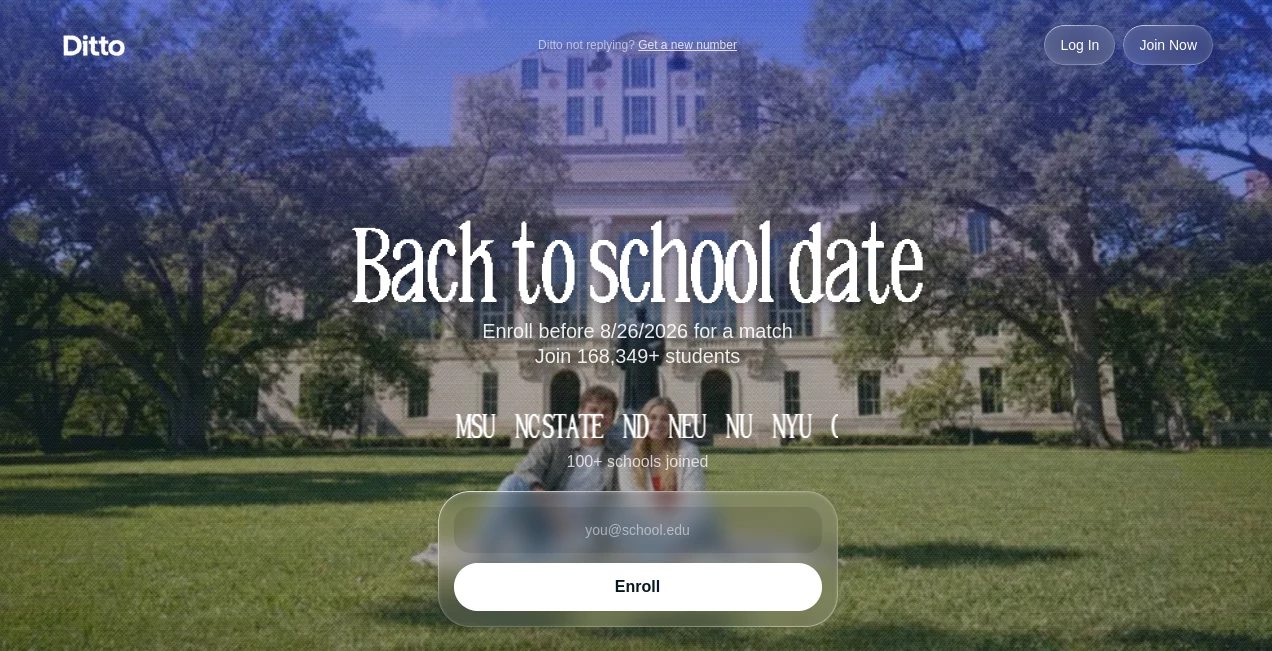
What is Ditto?
Finding someone you genuinely want to meet can be surprisingly difficult when dating apps turn the experience into endless profiles, swipes, and small talk. Ditto takes a very different approach. Built as an AI-powered matchmaking service for college students and young adults, it focuses on helping people move from online matching to an actual date with less effort.
Instead of asking users to browse through a long list of profiles, the service learns what someone is looking for and uses that information to identify a promising match. The result is intentionally simple: one personalized introduction rather than another evening spent scrolling through a dating feed.
The experience is also designed around real-world meetings. Matches are location-based, dates are arranged around nearby campus locations, and users receive practical help with scheduling. For someone who has grown tired of the usual dating-app routine, that difference can be meaningful.
Key Features
- AI-powered matchmaking based on personal preferences and compatibility.
- One curated match rather than an endless stream of profiles.
- Weekly personalized matches delivered through iMessage.
- Location-based matching to help keep dates genuinely local.
- Scheduling assistance for finding a suitable date and time.
- Curated date suggestions and practical dating guidance.
- Double-date options for users who prefer a more relaxed first meeting.
- Verified participation focused on eligible college students and young adults.
User Interface
One of the most appealing parts of the experience is that it does not require another complicated dating application to manage. Users can start through text messaging, answer a short series of questions, and receive their match directly through iMessage.
This conversational approach makes the process feel closer to interacting with a helpful matchmaker than operating a traditional dating platform. There are no endless cards to swipe through and no pressure to keep checking a feed.
Accuracy & Performance
The matching system is designed to look beyond a simple photo or proximity score. The service explains that it analyzes user profiles and preferences while using advanced AI reasoning to identify compatibility. Its system also combines several specialized components for tasks such as matchmaking, analysis, personalization, and scheduling.
No matchmaking system can guarantee chemistry between two people, of course. Dating is still human. What the technology does well is reduce some of the guesswork involved in deciding who might be worth meeting in the first place.
Capabilities
The platform combines several useful parts of the dating experience into one flow. It can learn a user's preferences, search across the available pool, select a personalized match, provide information about why the pairing may work, and help coordinate the date.
It also supports feedback. If a match does not feel right, users can provide a reason and adjust their preferences so future recommendations can better reflect what they actually want.
Security & Privacy
Privacy matters considerably in a service dealing with personal preferences and dating information. The platform states that participation is restricted to verified students at participating schools, while its dating experience is designed so that only the relevant date sees a user's profile information.
Dates are also intended to take place at selected on-campus locations, adding another practical layer to the experience. Users should still review the current privacy policy and terms before providing personal information, particularly because the service uses AI systems and third-party technologies to process user inputs.
Use Cases
This service is particularly useful for college students who want to meet someone without spending hours on traditional dating apps. It can also suit people who find choosing between hundreds of potential matches exhausting or who prefer having a specific opportunity to meet someone rather than maintaining multiple conversations.
- College dating: Meet another verified student within the participating campus community.
- People tired of swiping: Replace endless profile browsing with a single curated match.
- Busy students: Let the service help with matching and scheduling instead of handling every step manually.
- Nervous first daters: Use the double-date option to make the first meeting feel more casual.
- Local dating: Find someone nearby instead of matching with people who are technically in the same region but difficult to meet.
Pros and Cons
Pros
- Removes the endless-swiping cycle common to dating platforms.
- Uses AI to consider compatibility and personal preferences.
- Focuses on getting users to real dates rather than prolonged online conversations.
- Location-based matching makes meeting in person more practical.
- Text-based onboarding is simple and convenient.
- Double dating provides an alternative for people who dislike one-on-one first dates.
- The service is currently free in participating locations.
Cons
- Availability depends on participating schools and locations.
- The service is primarily aimed at students and young adults.
- A curated matching model provides less control than browsing a large dating catalog.
- AI recommendations cannot guarantee personal chemistry.
- Users need access to the supported messaging experience to participate.
Pricing Plans
The service is currently offered free of charge in participating locations. There are no subscription fees or premium tiers required to receive the core weekly matchmaking experience in locations where the service is available.
Availability and eligibility can vary by location, so prospective users should check whether their school or area is currently supported before signing up.
How to Use It
- Step 1: Sign up using your eligible school email or the available enrollment process.
- Step 2: Answer questions about your preferences, personality, and what you are looking for.
- Step 3: Submit your preferences before the weekly matching deadline.
- Step 4: Receive your personalized match through iMessage.
- Step 5: Review the match information and coordinate your availability.
- Step 6: Confirm the date and location.
- Step 7: Show up, meet your match, and see where the conversation goes.
Comparison with Similar Tools
Traditional dating applications usually give users a large selection of profiles and leave most of the work to them. That model can be useful for people who enjoy browsing and making their own decisions, but it can also become repetitive and time-consuming.
This service takes the opposite route. Rather than presenting dozens or hundreds of possibilities, it focuses on selecting one potentially compatible person and helping turn that introduction into a real date. The difference is less about having more profiles and more about reducing the amount of work required from the user.
For someone who enjoys controlling every part of the dating process, a conventional app may still be preferable. For someone who wants fewer choices and more action, an AI-assisted matchmaking model can feel considerably more refreshing.
Conclusion
Modern dating does not always need another feed to scroll through. Sometimes the bigger problem is having too many options and too little reason to actually meet anyone. This AI matchmaking approach addresses that problem by narrowing the experience down to a personalized introduction and a practical path toward a real date.
Its strongest idea is also its simplest: spend less time swiping and more time meeting people. With preference-based matching, local recommendations, scheduling support, and a double-date option, it offers a thoughtful alternative for students who want dating to feel more personal and less like another social media task.
Frequently Asked Questions (FAQ)
Who can use the service?
The current experience is primarily available to college students who are 18 or older at participating schools, with access expanding to additional young adults and locations.
Is it free?
Yes. The service is currently free in participating locations, with no subscription or paywall required for the core matchmaking experience.
Does it require a dating app?
No traditional app download is required for the core experience. Users can begin through iMessage and complete the matchmaking process through text-based interaction.
How often do I receive a match?
The standard experience provides one personalized match each Wednesday, with the match delivered through iMessage.
How are matches selected?
The system analyzes information supplied by users, including their preferences and profile details, and uses AI-based reasoning and specialized matchmaking processes to identify a suitable pairing.
Can I give feedback about a match?
Yes. Users can provide feedback when a match is not suitable and can update their preferences to help improve future recommendations.
Are matches located near me?
The matching experience is location-based, with the goal of connecting users with people who are actually in their local area or around their campus.
Is there a double-date option?
Yes. Users can form a squad with a friend and be matched with another duo, providing a more relaxed way to meet new people.
When are matches delivered?
The regular weekly match is delivered on Wednesday evening, with users then able to coordinate a suitable time for the date.
Does AI guarantee a successful date?
No. AI can analyze preferences and identify potential compatibility, but it cannot predict human chemistry with certainty. The final experience still depends on the two people involved.
AI Life Assistant , AI Dating Assistant , AI Chatbot .
These classifications represent its core capabilities and areas of application. For related tools, explore the linked categories above.

Ditto Alternatives Product

Sourcetable

Klyra AI

FLINT AI

QuickPick

Rizzwords

Pinpoint Ans…

Lexikon AI

Free AI Chat

Chatbots AI