
















Chatbots AI
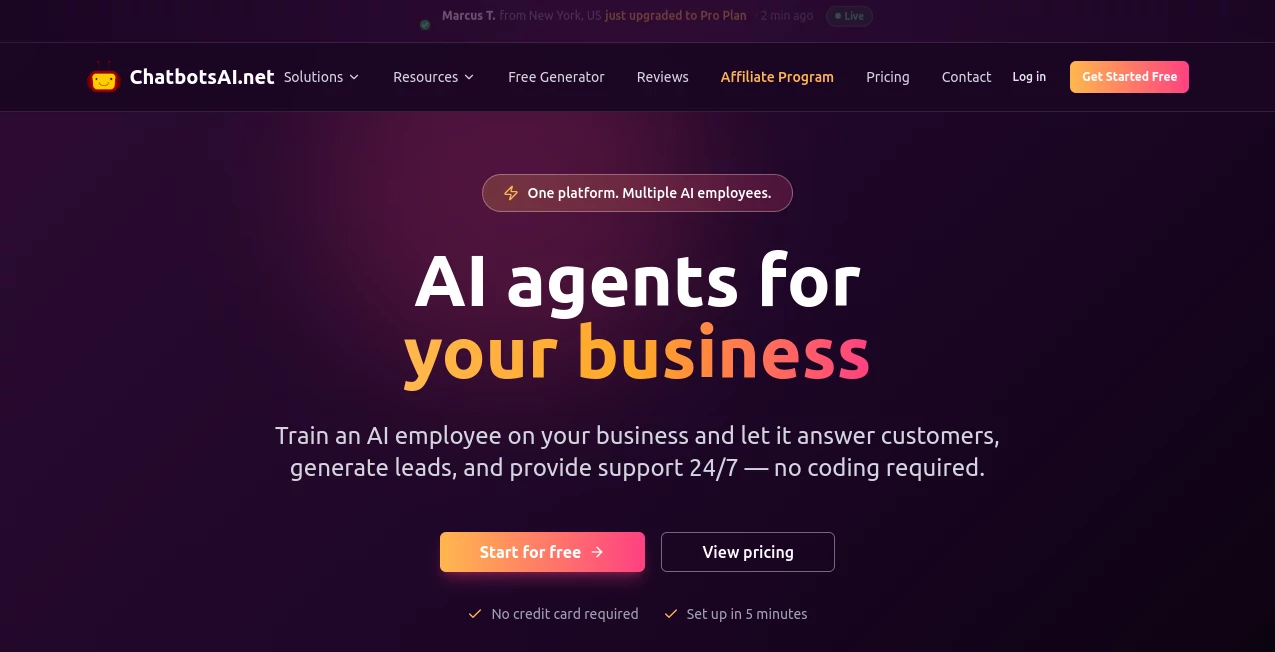
What is Chatbots AI?
Businesses are constantly looking for better ways to answer questions, support customers, and turn website visitors into potential buyers. An AI chatbot can take care of those conversations without making every interaction dependent on a human agent. ChatbotsAI.net is built around that idea, giving businesses a way to create AI-powered chat experiences using their own business information.
One of the more useful aspects of the platform is its focus on different types of business data. Instead of treating every chatbot conversation as a generic question-and-answer session, it is designed to work with five distinct data types and support information across eight key business pages. This makes it particularly interesting for companies that want their chatbot to understand the context of their business rather than simply provide generic answers.
The platform also covers several practical business scenarios, including customer support and sales. Its industry-focused approach extends to ecommerce and retail, education and training, fitness and wellness, and travel and hospitality. For a small business owner, this can make the idea of adding an AI assistant to a website feel much more practical.
Key Features
- AI-powered chatbots designed for business interactions
- Support for five different types of business data
- Management of information across eight key business pages
- Customer support chatbot use cases
- Sales-focused AI agent capabilities
- Support for ecommerce and retail businesses
- Use cases for education and training organizations
- Applications for fitness and wellness businesses
- Applications for travel and hospitality companies
- Dedicated documentation and a user guide
User Interface
A business chatbot should not require users to understand complicated AI systems before they can get value from it. The platform is structured around business use cases, data, and pages, which gives the experience a practical direction. The presence of dedicated guide and documentation sections is also useful for users who want to understand how the system fits into their workflow before deploying it.
For businesses that are new to AI automation, this approach can be more approachable than starting with a highly technical chatbot framework. The focus stays on what the assistant needs to know and what customers are expected to ask.
Accuracy & Performance
For an AI chatbot used in customer-facing situations, useful answers depend heavily on the information supplied to it. The platform's support for multiple data types gives businesses more room to organize the information behind their conversational assistant.
This can be especially helpful when customers ask questions that are closely tied to a company's own products, services, policies, or business information. A well-prepared knowledge source can make conversations more relevant and reduce the need for customers to search through several pages manually.
Capabilities
The platform is positioned for two particularly important business functions: customer support and sales. A support-oriented chatbot can help visitors find answers to common questions, while a sales agent can assist people who are still deciding whether a product or service is right for them.
Its industry coverage also gives it a broader range of potential applications. An ecommerce store could use an AI assistant to handle common shopper questions. A training business could provide quick answers about its educational offerings. A fitness company could make information easier to access, while a travel business could use conversational assistance to help visitors navigate services and offerings.
The combination of business data and conversational interaction is what makes the platform stand out. Instead of adding AI simply because it is popular, businesses can use it around specific customer-facing tasks.
Security & Privacy
Privacy is an important consideration whenever business information is connected to an AI system. The platform provides dedicated privacy policy and terms of service pages, giving businesses documentation to review before deciding how they want to use the service.
Companies should still review the current privacy documentation and determine what information is appropriate to provide to any AI-powered customer service system. Sensitive internal information should always be handled according to the company's own security requirements and applicable regulations.
Use Cases
- Customer Support: Businesses can use an AI assistant to help visitors find answers and handle common support questions.
- Sales Assistance: A conversational sales agent can engage potential customers and help them explore products or services.
- Ecommerce: Online retailers can use conversational assistance to make product and business information easier for shoppers to access.
- Education: Training providers and educational organizations can offer visitors a more direct way to ask questions.
- Fitness & Wellness: Fitness businesses can make service information and common answers easier for visitors to find.
- Travel & Hospitality: Hotels, travel businesses, and hospitality providers can use conversational assistance to improve the visitor experience.
- Business Websites: Companies can provide an always-available first point of contact for visitors who need quick information.
Pros and Cons
Pros
- Designed specifically around business chatbot use cases.
- Supports multiple types of business data.
- Includes both customer support and sales applications.
- Covers several common business industries.
- Provides documentation and a dedicated guide.
- Can make business information easier for website visitors to access.
Cons
- The quality of chatbot responses depends on the quality and completeness of the business information provided.
- Businesses with highly specialized workflows may need to evaluate the available capabilities carefully before adopting it.
- Pricing details should be reviewed directly before making a purchasing decision.
Pricing Plans
The platform has a dedicated pricing section, but the publicly accessible page does not currently expose enough readable pricing information to reliably list individual plan names or prices. Rather than presenting estimated figures, businesses should check the current pricing page when evaluating the service.
This is particularly important for companies comparing chatbot platforms because factors such as usage limits, data capacity, chatbot availability, and business features can have a significant effect on the overall value of a plan.
How to Use the Platform
Start by identifying the main reason you want an AI chatbot. If your biggest challenge is answering repetitive customer questions, a customer support workflow is a natural starting point. If the goal is helping potential buyers, a sales-oriented approach may make more sense.
Next, prepare the business information the chatbot will need. Clear, accurate, and well-organized information gives the assistant a much better foundation for conversations. Think about the questions customers repeatedly ask and make sure the relevant answers are available in the information you provide.
After setting up the required information, use the available guide and documentation to understand the configuration process. Test the chatbot with realistic questions rather than only simple examples. For instance, a retailer could test questions about products, services, policies, and general shopping information to see whether the responses are useful and consistent.
Finally, monitor real conversations and improve the underlying information when customers encounter gaps. This ongoing refinement is often what turns a basic chatbot into a genuinely useful part of a business website.
Comparison with Similar Tools
There are many AI chatbot products available, but they do not all approach the problem in the same way. Some are primarily focused on general-purpose conversational AI, while others concentrate on customer service, lead generation, automation, or developer-oriented chatbot infrastructure.
This platform takes a more business-centered route. Its combination of multiple data types, business page management, customer support, and sales use cases makes it appealing to companies that want their chatbot to work around their own business information.
For a small ecommerce company, for example, the attraction may be the ability to combine business knowledge with a conversational sales experience. For a service company, customer support may be the more valuable application. The right choice ultimately depends on the complexity of the business, the amount of information the chatbot needs to handle, and the type of conversations customers typically have.
Conclusion
AI chatbots are most useful when they solve a real communication problem rather than simply adding an AI feature to a website. This platform takes a practical business-first approach, combining chatbot interactions with business data and specific applications such as customer support and sales.
Its coverage of ecommerce, education, fitness, travel, and other business scenarios also makes it worth considering for companies that want to experiment with conversational customer experiences. The five data types and eight business pages provide a useful foundation for organizing the information behind the assistant.
For businesses looking to make their websites more interactive and give visitors a quicker way to find answers, it offers an appealing starting point. As with any AI customer-facing system, the best results will come from providing accurate information, testing realistic conversations, and continuously improving the experience based on customer needs.
Frequently Asked Questions (FAQ)
What is this AI chatbot platform used for?
It is designed for businesses that want AI-powered chatbots for customer interactions, including customer support and sales conversations.
What types of businesses can use it?
The platform highlights applications for ecommerce and retail, education and training, fitness and wellness, and travel and hospitality, in addition to general business use cases.
Can it be used for customer support?
Yes. Customer support is one of the specific use cases highlighted by the platform, making it suitable for businesses that want to provide automated assistance to website visitors.
Can it help with sales?
Yes. A sales agent use case is provided for businesses that want conversational assistance during the customer journey.
How much does it cost?
The service has a dedicated pricing page, but pricing details should be checked directly because the currently accessible page does not provide enough readable information to state the plans and prices accurately.