


















Doubleword
What is Doubleword?
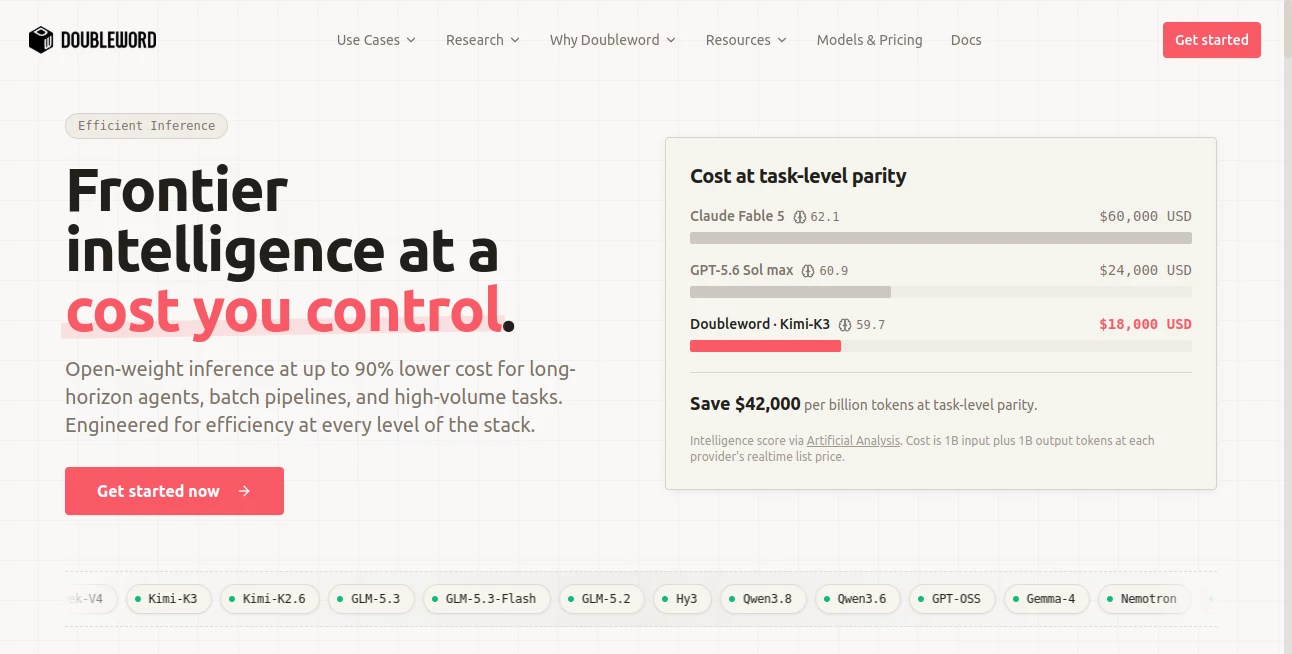
Doubleword is an AI inference platform designed for teams that need to run large volumes of AI workloads without letting inference costs become a bottleneck. Instead of focusing only on instant chatbot-style responses, it is built around the workloads that often run quietly in the background: autonomous agents, batch processing, evaluations, document processing, data enrichment, synthetic data generation, and other long-running AI pipelines.
Its approach is particularly interesting for developers and businesses already working with open-weight language models. The platform provides access to models through an OpenAI-compatible API, making it possible to integrate inference into existing applications without rebuilding an entire AI stack from scratch.
The biggest appeal is the way it connects cost with latency. Real-time inference is available when immediate responses matter, while async and batch processing provide lower-cost options when a workload can afford to wait. That makes the platform feel less like another generic AI application and more like infrastructure built for serious production workloads.
Key Features
- OpenAI-compatible inference APIs for easier integration with existing applications.
- Realtime, async, and batch inference options for different performance and cost requirements.
- Access to a growing catalog of open-weight models covering text, vision, embeddings, and other workloads.
- High-throughput processing for background agents and large-scale AI pipelines.
- Support for tool calling and structured generation.
- Workloads for classification, data processing, data enrichment, embeddings, image processing, evaluations, and synthetic data generation.
- Developer integrations with popular AI frameworks and agent platforms.
- Usage-based pricing with no minimum spend for the standard service.
User Interface
The experience is designed primarily for developers and technical teams rather than casual AI users. The web interface provides access to models, API-related functionality, workload management, and supporting resources, while the documentation explains how to connect applications and frameworks to the inference service.
That developer-first approach makes sense for the product. Someone looking for a simple text-generation website may find it more technical than necessary, but an engineering team trying to move an existing application to a scalable inference backend gets a much more useful environment.
Accuracy & Performance
Performance depends on the selected model and inference mode, but the platform is designed around efficient utilization of compute resources and high-throughput workloads. Realtime requests are intended for applications where response speed matters, while async processing can trade some latency for lower costs. Batch processing goes further by prioritizing economical large-scale execution.
This distinction is valuable in real projects. A customer-facing assistant may need an immediate response, while generating embeddings for millions of records or evaluating thousands of model outputs rarely requires the same urgency. Being able to choose the appropriate delivery window can have a noticeable impact on infrastructure spending.
Capabilities
The platform goes beyond basic chat completions. It can be used for background AI agents, large-scale document processing, classification, summarization, data enrichment, moderation, ETL workflows, synthetic datasets, model evaluations, embeddings, and image-related processing.
Its model catalog includes a range of open-weight models, and new models can be requested when a particular model is not already available. The API is compatible with common OpenAI client libraries, while integrations are available for agent frameworks, application frameworks, memory systems, and evaluation platforms.
For teams already using tools such as LangChain, LangGraph, LlamaIndex, CrewAI, OpenAI Agents SDK, or similar infrastructure, this compatibility can significantly reduce the work required to experiment with a different inference provider.
Security & Privacy
Security and governance become especially important when AI inference is used inside business applications. The platform provides infrastructure and control features aimed at organizational deployments, including centralized management, access controls, authentication, role-based access control, logging, and usage monitoring through its broader control-layer offering.
For organizations handling sensitive workloads, private infrastructure options are also available. These deployments are intended for private cloud, on-premises, or hybrid environments, giving technical teams more control over where inference takes place.
Use Cases
One of the strongest use cases is running AI agents that perform many operations in the background. For example, a company could run thousands of automated research, classification, extraction, or coding tasks overnight instead of paying premium realtime inference rates for every request.
Large-scale document processing is another natural fit. Businesses can process, summarize, classify, or enrich substantial collections of documents without requiring every operation to return instantly.
Data teams can also use the infrastructure for enrichment pipelines, structured extraction, embeddings, synthetic data generation, and evaluation workflows. A machine-learning team testing several models against a large benchmark can benefit from an inference system designed for continuous high-volume processing.
Developers building AI agents may find the economics particularly attractive. Agentic workflows often make several model calls for a single task, and background agents can perform hundreds or thousands of iterations. Lower inference costs can therefore make previously expensive workflows considerably more practical.
Pros and Cons
- Pros: OpenAI-compatible API, multiple inference modes, strong focus on high-volume workloads, access to open-weight models, developer-friendly integrations, usage-based pricing, and support for private infrastructure.
- Pros: Async and batch processing can significantly reduce the cost of workloads that do not require immediate responses.
- Pros: Useful model selection across text, vision, embeddings, and other AI workloads.
- Cons: The platform is primarily aimed at developers, engineering teams, and businesses rather than casual users.
- Cons: Batch and async inference are not suitable when every request needs an immediate response.
- Cons: Choosing the right model and inference mode still requires some technical understanding.
Pricing Plans
The pricing model is based primarily on token usage and the selected inference mode rather than a conventional monthly subscription. Realtime inference uses standard pricing, while async and batch options provide reduced rates in exchange for greater latency flexibility.
The exact price varies by model. The catalog includes separate input and output token rates, with batch processing generally positioned as the lowest-cost option. The service also states that there is no minimum spend and that customers pay for the tokens they actually use.
For larger workloads, custom pricing is available for bulk usage, dedicated deployments, and enterprise requirements. This makes the platform more suitable for organizations whose AI usage can grow substantially over time.
How to Use It
- Create an account and obtain an API key from the developer console.
- Select an available model that matches the requirements of your application.
- Connect your application using the OpenAI-compatible API endpoint.
- Choose realtime inference when immediate responses are important.
- Use async inference when you can tolerate some delay in exchange for lower costs.
- Use batch processing for large jobs where the lowest possible inference cost is more important than immediate results.
- Monitor usage and adjust the model or inference mode as your workload changes.
Because the API follows the OpenAI interface, developers can often adapt existing applications by changing the API endpoint and model configuration rather than rewriting the entire application. This makes experimentation relatively straightforward for teams already familiar with OpenAI-compatible tooling.
Comparison with Similar Tools
Traditional AI APIs are often optimized around interactive applications where every request should return as quickly as possible. That model works well for chat applications, interactive assistants, and customer-facing features, but it can become expensive when the workload consists of millions of background requests.
This platform takes a different approach by making latency a configurable part of the economics. Teams can use realtime inference for interactive features, async inference for background workloads, and batch processing for jobs where waiting longer can substantially reduce the cost.
It also stands out through its focus on open-weight models and compatibility with established developer tooling. For an engineering team that wants more flexibility than a single-model provider offers, this can make the infrastructure easier to adapt as new models appear.
Conclusion
For businesses and developers running AI at scale, inference cost can become just as important as model quality. A workflow that looks inexpensive during testing can become surprisingly costly once it processes thousands or millions of requests.
Doubleword approaches that problem from an infrastructure perspective. Its combination of open-weight models, OpenAI-compatible APIs, async execution, batch processing, and high-throughput workloads gives technical teams more control over the relationship between speed and cost.
It is not trying to be a simple AI chatbot for everyday users. Its real value appears when AI becomes part of a production pipeline and the volume of inference starts to matter. For those workloads, the ability to trade response time for substantially lower inference costs can make a meaningful difference.
Frequently Asked Questions (FAQ)
What is this platform mainly used for?
It is primarily designed for AI inference at scale, including background agents, batch processing, evaluations, data enrichment, document processing, synthetic data generation, embeddings, and other high-volume workloads.
Does it support OpenAI-compatible APIs?
Yes. Its inference API is OpenAI-compatible, allowing applications and tools that support custom OpenAI endpoints to connect with the service.
What is the difference between realtime, async, and batch inference?
Realtime inference is designed for immediate responses. Async inference accepts additional latency in exchange for lower pricing, while batch inference is intended for large jobs where the lowest cost is more important than immediate results.
Can it be used for AI agents?
Yes. Background and long-running AI agents are one of the platform's key use cases, particularly when an agent needs to make many model calls as part of an automated workflow.
Does it provide open-weight models?
Yes. The model catalog includes a range of open-weight models, including models for language, vision, embeddings, and related AI workloads.
Is there a monthly subscription?
The standard inference service uses usage-based pricing. Costs depend on the selected model, the number of input and output tokens, and the inference mode.
Can developers use existing OpenAI SDKs?
Yes. Because the inference API is OpenAI-compatible, developers can use compatible OpenAI client libraries and configure them to communicate with the service's API endpoint.
Is it suitable for enterprise workloads?
Yes. The platform offers features aimed at business and enterprise deployments, including governance capabilities and private infrastructure options for organizations with more demanding security and deployment requirements.
Can a specific model be requested?
Yes. If a desired model is not already listed, the platform provides a way to request additional models.
Who would benefit most from using it?
Developers, AI startups, data teams, and enterprises running large-scale inference workloads are likely to benefit the most, especially when their workloads can use async or batch processing instead of requiring realtime responses.
Large Language Models (LLMs) , AI Developer Tools .
These classifications represent its core capabilities and areas of application. For related tools, explore the linked categories above.

Doubleword Alternatives Product

RepoClip

AI Complianc…

ShipAhead

GPTZero

Lovable APP

freellm.net

Prelight

OGimage

Gemini Omni
