DryRun
What is DryRun?
Interview preparation is often much easier in your head than it is out loud. You may know your experience, understand the job and even have strong answers prepared, yet find yourself rambling or losing your train of thought when someone actually asks the question. DryRun is designed to close that gap by turning interview preparation into a realistic spoken conversation.
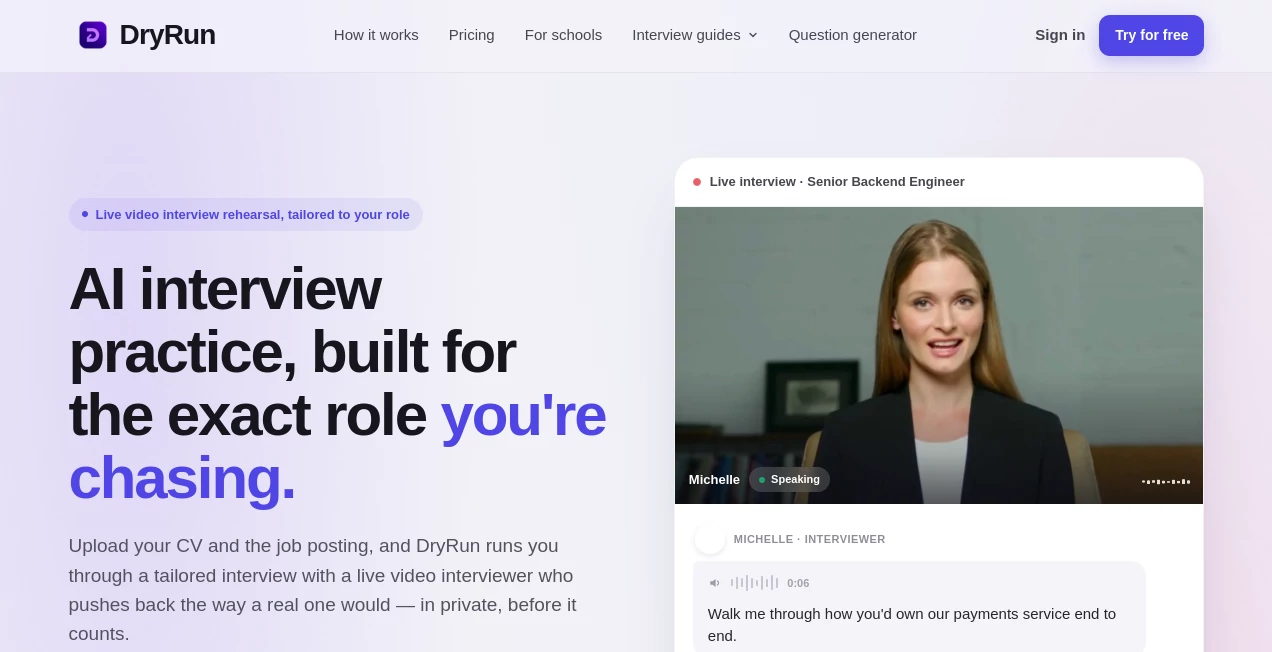
The platform builds an interview around the actual position you are applying for. You provide your CV and the job posting, and it uses that information to create questions that relate to your background and the requirements of the role. Instead of working through a generic list of common interview questions, you get a practice session that feels much closer to a conversation about the job in front of you.
The experience is particularly useful for candidates who want to practise speaking rather than simply reading interview advice. The interviewer talks to you through video, listens to your response and can follow up when an answer is vague or leaves an important point unexplained.
Key Features
- Interview practice based on your CV and the actual job description.
- Live spoken conversations with a video AI interviewer.
- Follow-up questions that respond to what you actually say.
- Optional interview context, including the round you are preparing for and what happened previously.
- Choice of interviewer face, name and accent.
- Detailed coaching after each attempt.
- Three full attempts included with each paid interview.
- Support for different stages of an interview process.
- Browser-based practice without requiring software installation.
- A free five-minute trial for first-time users.
User Interface
The experience is deliberately straightforward. You begin with the information that matters most: your CV, the job posting and, if useful, additional context about the interview. From there, the platform creates the practice session and places you in a face-to-face video conversation.
One thoughtful detail is the ability to choose the interviewer's appearance and accent. That small element makes the exercise feel less like answering questions in a form and more like sitting across from another person. You can also interrupt, ask for a question to be repeated or ask for clarification during the conversation.
Accuracy & Performance
The strength of the interview experience comes from its focus on relevance rather than prediction. It does not claim to know the exact questions an employer will ask. Instead, it uses the information supplied about the role and the candidate to build plausible questions around the experience and responsibilities that matter.
The interviewer can also react to an answer. If a candidate gives a broad response without enough detail, the conversation can dig further. For example, saying that you solved a difficult project problem may lead naturally to questions about what you personally did, why you chose a particular approach and what the final result was.
Each attempt can use a fresh set of questions, giving candidates a reason to think on their feet instead of memorising a single script.
Capabilities
The platform is suitable for a wide range of written job descriptions, from engineering and sales to healthcare, finance, retail, hospitality and graduate positions. Its approach is flexible because the interview is shaped around the role rather than a fixed collection of questions.
It can also support multiple interview rounds. A candidate preparing for an initial screening, a technical discussion and a final interview can provide information about the stage they are facing. Previous areas of discussion can be taken into account so later practice can concentrate on subjects that have not yet been explored.
After the conversation, the coaching report looks at the candidate's actual answers. Rather than simply giving a generic score, it highlights what worked, where an answer could be stronger and recurring patterns that may be easy to miss when practising alone.
Security & Privacy
Privacy is an important consideration when an interview preparation service handles CVs and spoken answers. The service states that uploaded CVs, job postings, interview context and answer transcripts are used to provide the interview and coaching experience.
It does not retain recordings of the candidate's voice. Spoken answers are transcribed during the interview, while the stored information is primarily the resulting text. The company also states that customer content is not used to train AI models.
Payments are handled through Stripe, meaning the service does not receive or store full payment card details. The privacy policy also explains the use of third-party technology providers involved in areas such as speech processing, AI generation, hosting and payments.
Use Cases
For job seekers, the most obvious use is preparing for an important interview without needing to find a friend, colleague or professional coach who has time to run a practice session.
It can be especially helpful before a first interview, when candidates are unsure how their answers sound when spoken. A person might rehearse a strong answer on paper and then discover during the conversation that it takes three minutes to reach the main point. Repeating the experience gives them a chance to tighten the response before the real interview.
It is also useful for experienced candidates preparing for specialised positions. Someone applying for a technical role, for example, can practise explaining decisions from their own CV while responding to follow-up questions rather than simply reciting prepared technical answers.
Schools can use the service for students preparing for their first jobs, apprenticeships or college interviews. The school offering provides ready-made entry-level roles, allowing students to practise without having to supply their own CV or job posting.
Pros and Cons
- Pros: Tailored to the candidate and job, realistic spoken interaction, adaptive follow-up questions, useful coaching reports, multiple attempts, no camera required for the candidate, browser-based access and straightforward pay-per-interview pricing.
- Cons: It cannot predict the exact questions an employer will ask, the candidate needs a microphone and a reasonably quiet environment, and each interview round is purchased separately.
Pricing Plans
The standard individual option uses a pay-per-interview model rather than a subscription. One interview costs €15 and includes three complete attempts. Each attempt provides a different practice conversation based on the same role, followed by a coaching report.
There is also a five-minute free trial for users who want to experience the interview format before paying. The individual plan includes a 14-day refund period, while unused attempts expire 90 days after purchase.
Schools have a separate group offering priced at €10 per student for qualifying groups of 10 or more. This version is aimed at student interview preparation and includes access to a library of entry-level job interviews.
How to Use the Tool
Start by providing your CV and the job description for the position you are targeting. You can also add useful context, such as which interview round you are preparing for, what happened during an earlier round or areas you expect the interviewer to focus on.
Next, choose the interviewer style that suits you. You can select an interviewer face and accent, then begin the conversation from your browser. Speak naturally and treat the session like a genuine interview rather than reading prepared answers.
When the interview is finished, review the coaching report carefully. Pay particular attention to repeated weaknesses rather than trying to memorise every suggestion. Then use another attempt to see whether your answers become clearer, more specific and easier to deliver.
Comparison with Similar Tools
Many interview preparation products focus on question banks, written model answers or general advice. This approach is different because the preparation starts with the specific job and the candidate's own experience.
The spoken format is another important distinction. Reading a question and typing an answer can help with preparation, but it does not recreate the pressure of having to respond immediately. Here, the candidate has to listen, think, speak and react to follow-up questions in real time.
It is also less dependent on memorisation. Because subsequent attempts can change the questions, candidates are encouraged to understand their own experience and communicate it clearly rather than memorising a perfect sequence of responses.
Conclusion
Good interview preparation is not only about knowing what to say. It is about being able to say it clearly when someone is sitting across from you and asking the next question.
That is where this platform makes a strong case for itself. It combines a candidate's own CV, the real job description and spoken interview practice into one focused preparation experience. The adaptive conversation and post-interview coaching make it particularly useful for people who have already done the basic preparation and now need to improve how they perform under pressure.
For €15, getting three complete attempts gives candidates enough room to identify weak spots, try again and make their answers more natural. It is a practical option for anyone who would rather discover their interview mistakes during practice than on the day that matters.
Frequently Asked Questions (FAQ)
Does it predict the exact questions I will be asked?
No. The service does not claim to predict an employer's exact interview. Instead, it creates realistic practice questions based on the job description, CV and additional context provided by the candidate.
Do I need to turn on my camera?
No. The interviewer appears on video, but the candidate only needs a microphone. The candidate's camera is not required.
How long does a practice interview take?
A full attempt generally takes around 10 to 15 minutes, followed by a coaching report.
How many attempts are included?
Each individual interview includes three full attempts. The questions can change between attempts, so candidates are not simply repeating the same script.
Can I practise different interview rounds?
Yes. Candidates can prepare separate interviews for different stages, such as screening, technical and final rounds, with later practice informed by what has already been covered.
Do I need an account to try the interview questions?
The free interview question generator can be used without an account. An account is required for the full spoken interview experience.
Is my voice recording stored?
No. The service states that it does not retain recordings of the candidate's voice. Spoken responses are transcribed during the interview, with text used for the interview and coaching experience.
Is there a subscription?
No. Individual access is sold per interview, so there is no recurring subscription charge.
Can schools use the platform?
Yes. There is a school-focused offering designed for students preparing for their first jobs and other early interview experiences, with ready-made entry-level roles and student-focused coaching.
AI Coaching , Education , AI Interview Assistant , AI Recruiting .
These classifications represent its core capabilities and areas of application. For related tools, explore the linked categories above.

DryRun Alternatives Product

CoPrep AI

GetFIT App

Interview Te…

JobbTwine

Metric Conve…

Nav Ai

Candidate Sc…

Hirescope.te…

ResignWell