















tanship
What is tanship?
TANSHIP Template is a complete TanStack Start SaaS boilerplate designed for indie developers and small teams that want to move from an idea to a working product without rebuilding the same infrastructure every time. Instead of starting with an empty repository and spending days connecting authentication, payments, databases, email services, AI workflows, and deployment infrastructure, developers get a ready-to-deploy codebase built specifically for Cloudflare Workers.
The project goes beyond being a simple collection of UI screens. Authentication, billing, database operations, transactional email, AI workflows, storage, theming, internationalization, and security protections are already connected. Configure the required credentials, customize the modules, and focus your development time on the part that makes your product different.
For an indie developer working on an MVP, that difference can be substantial. The less time spent wiring basic SaaS infrastructure, the more time remains for validating the actual product idea.
Key Features
- TanStack Start SaaS boilerplate built for Cloudflare Workers
- Better Auth with email/password authentication and Google OAuth
- Stripe, PayPal, and Creem payment integrations
- Drizzle ORM with Cloudflare D1 and ready-made database tables
- Cloudflare R2 storage for user-uploaded assets
- Resend-powered transactional email and newsletter functionality
- AI workflows powered by Cloudflare Workers AI
- Credit metering, rate limits, and usage deductions for AI features
- 34 built-in theme presets with a visual customizer
- English and Chinese URL-based internationalization
- Changelog and 36 bilingual guides included in the delivered codebase
- Cloudflare Turnstile and rate limiting for protected forms
User Interface
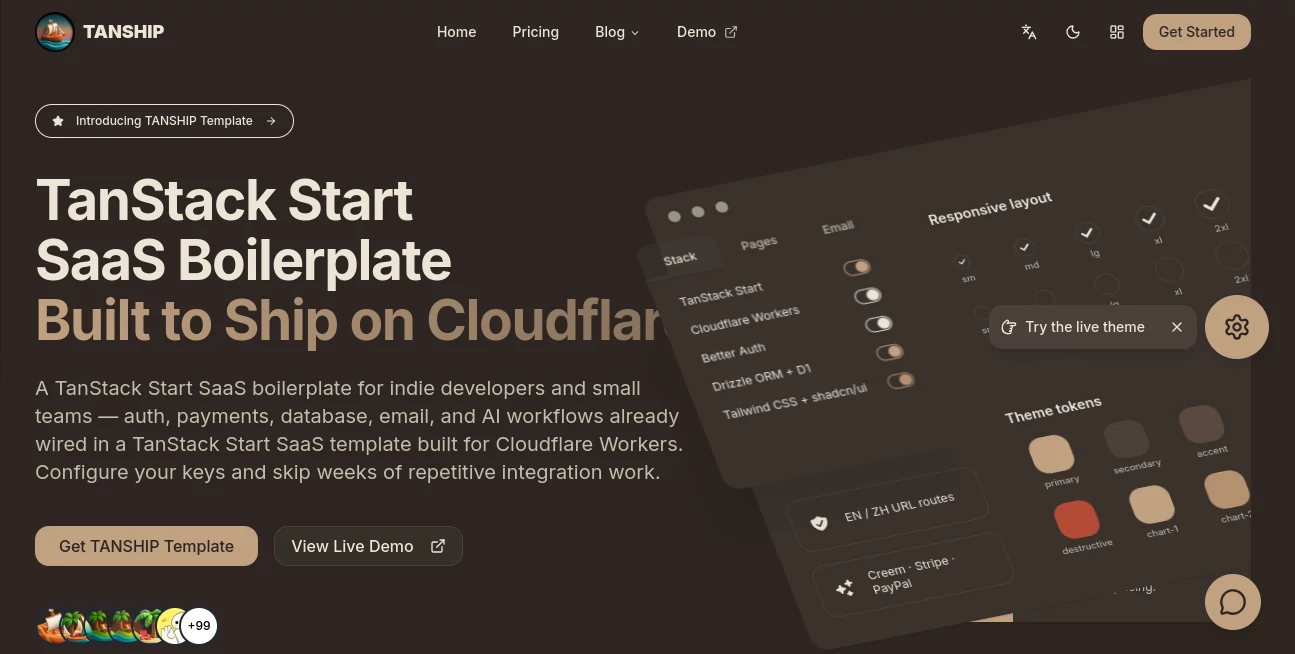
The interface is designed to feel like a working SaaS product rather than a collection of disconnected template screens. The project includes a dashboard, billing views, profile functionality, authentication flows, AI tool interfaces, theme customization, and content pages.
One particularly useful detail is the visual theme system. There are 34 light and dark presets, along with controls for border radius, sidebar layouts, and display modes. Developers can rebrand the interface without manually editing every theme file.
The bilingual setup is also more complete than simply translating a few buttons. English and Chinese routes are handled through the URL structure, while visible strings, accessibility labels, and SEO metadata are included in the translation system.
Accuracy & Performance
For a developer template, performance is closely tied to the architecture behind it. The codebase is designed around Cloudflare Workers and uses native bindings for services such as D1, R2, Workers AI, and Turnstile. This avoids relying on an additional hosting adapter for its primary deployment environment.
The included AI workflows also demonstrate actual execution rather than presenting only static mockups. Core workflows run through Workers AI and deduct credits from the application's usage system. This gives developers a practical example of how AI requests, quotas, and metering can work together inside a SaaS product.
The project also includes more than 750 automated checks, giving developers an additional layer of confidence when modifying the delivered codebase.
Capabilities
The strongest part of the template is the number of fundamental SaaS systems that are already connected. Authentication supports email/password accounts, Google OAuth, email verification, session management, and password recovery.
Billing is handled through adapters for Creem, Stripe, and PayPal. Payment webhooks are signature-verified and designed to be idempotent, helping prevent duplicated billing events from incorrectly changing subscription access.
On the data side, Drizzle ORM works with Cloudflare D1 and includes 18 ready-made tables covering areas such as users, sessions, subscriptions, orders, newsletter subscriptions, and contact messages. R2 is available for user-uploaded assets.
The AI layer contains eight modules covering tasks such as summarization, translation, tagline generation, text-to-speech, image description, image generation, and image editing. Some workflows are already connected to Workers AI, while other interfaces are intentionally structured as extension points for connecting another model provider.
Developers also receive a built-in content system, a Changelog, 36 bilingual guides, a 12-view dashboard, deployment scripts, migrations, and environment configuration support.
Security & Privacy
Security is treated as part of the application's foundation rather than something left for later. Passwords are hashed, failed sign-in attempts are throttled, and new accounts use email verification. Password reset links use time-limited, single-use tokens.
Protected routes are already defined through the authentication system, while credential-related account changes require additional verification. Payment events are processed through signature-verified webhooks, reducing the risk of trusting client-side billing information.
Forms can also use Cloudflare Turnstile with rate limiting based on IP address and email. The newsletter implementation uses double opt-in, with confirmation tokens that expire after 24 hours and are stored as hashes.
As with any self-hosted software project, the final security and privacy posture depends on how the developer configures credentials, infrastructure, third-party providers, and production deployment.
Use Cases
- SaaS MVPs: Start a subscription-based product without implementing the basic infrastructure from scratch.
- AI SaaS products: Use the existing AI workflows and credit system as a foundation for an AI-powered application.
- Indie hacker projects: Validate a product idea while avoiding weeks of repetitive setup work.
- Client projects: Build and host SaaS products for clients while retaining the source code.
- Developer tools: Create applications that require authentication, payments, databases, email, and AI capabilities.
- Cloudflare applications: Deploy a SaaS application directly around Cloudflare's Workers ecosystem.
- Bilingual products: Launch products with English and Chinese routing already supported.
Pros and Cons
Pros
- Complete source code rather than a simple UI template
- Strong Cloudflare-native architecture
- Authentication, billing, database, email, and AI systems are already connected
- Three payment provider integrations are included
- Real AI workflows with credit metering
- 34 theme presets provide considerable customization freedom
- Includes bilingual documentation and guides
- Perpetual license with unlimited products and deployments
- Useful foundation for both personal and client projects
Cons
- Cloudflare is central to the intended deployment architecture
- Developers still need to configure their own third-party credentials and services
- Some AI interfaces are extension points rather than fully connected production workflows
- Multi-tenancy, RBAC, and an admin panel are intentionally not included
- Cloudflare, email, and payment provider fees are separate from the purchase
- Developers unfamiliar with TanStack Start or Cloudflare may need time to understand the architecture
Pricing Plans
The template uses a straightforward one-time purchase model rather than a recurring subscription. The complete source code is currently offered for $199 as a one-time payment.
The purchase includes a perpetual license for the purchased version, allowing developers to build unlimited products, deploy to unlimited environments, and remove the template branding. Source code is delivered through a private repository invitation after purchase.
Email support and future template updates are included under the applicable sales terms. Cloudflare usage, Resend, and payment provider fees are not included in the purchase price.
There is also a launch-week discount advertised on the site, with 20% off available using the published promotional code.
How to Use the Template
- Purchase the template and connect the GitHub account used to receive repository access.
- Clone the delivered source code and install the project's dependencies.
- Configure the required environment variables and credentials for your selected services.
- Set up the Cloudflare Workers environment together with D1 and R2.
- Configure authentication providers such as email authentication or Google OAuth.
- Select and configure the payment provider that matches your business model.
- Connect email delivery through Resend.
- Review the included AI workflows and configure your preferred model provider where required.
- Customize the visual theme, branding, content, and localization.
- Run the application locally, test the main SaaS flows, and deploy it to Cloudflare when ready.
Comparison with Similar Tools
Compared with starting a SaaS application from an empty TanStack Start project, this template provides a much larger head start. Authentication, billing, database structure, email workflows, AI metering, theming, and deployment patterns are already present, meaning developers can spend their early development time on product-specific functionality.
Compared with a basic frontend starter, the difference is even more significant. A visual template may provide attractive pages but still leave developers responsible for authentication, payment webhooks, database migrations, email verification, subscription states, and AI usage accounting. Here, those systems are part of the delivered codebase.
On the other hand, developers looking for a large enterprise platform with multi-tenancy, advanced role-based access control, and a dedicated administration system may need a more specialized foundation. This project deliberately focuses on the core requirements of indie developers and small teams.
Conclusion
For developers who have already decided to build with TanStack Start and Cloudflare, this template offers a practical shortcut through many of the repetitive tasks that normally appear before the interesting work begins. It combines the essentials of a modern SaaS application with working AI workflows, payment infrastructure, authentication, email, database support, theming, and deployment foundations.
The one-time licensing model is another appealing aspect for independent builders. Instead of adding another monthly software subscription to an early-stage project, developers can purchase the source code and use it as a foundation for their own products.
It is not intended to solve every possible SaaS requirement, and its deliberately focused scope is worth considering before buying. For indie hackers, small teams, and developers who want a Cloudflare-native starting point, however, it can remove a considerable amount of repetitive engineering work and make the first version of a product much easier to ship.
Frequently Asked Questions (FAQ)
Is this a complete SaaS application or only a UI template?
It is a deployable SaaS codebase rather than a UI-only template. Authentication, payments, database operations, email, AI workflows, theming, and other core systems are implemented in the source code.
Which payment providers are supported?
Creem, Stripe, and PayPal are supported through payment adapters. The architecture is designed so the provider can be selected without rebuilding the entire billing flow.
Does it include AI features?
Yes. Eight AI modules are included, with core workflows running through Cloudflare Workers AI. The application also includes credit metering, rate limits, and usage deductions.
Can another AI provider be connected?
Yes. The AI modules use service boundaries that make it possible to replace or extend the provider call. The existing interface, credit deduction, and result rendering can remain in place while the model provider is changed.
Can I use the source code for client projects?
Yes. The license allows developers to develop and host products for clients while keeping the source code. A client that needs the complete source is expected to obtain its own license.
Does it support multiple languages?
English and Chinese are included through URL-based internationalization. Translation files cover visible interface text as well as accessibility labels and SEO metadata.
Does it include multi-tenancy and RBAC?
No. Multi-tenancy, role-based access control, and an admin panel are intentionally outside the current scope. The template concentrates on the core SaaS infrastructure needed by indie developers and small teams.
What is the pricing model?
The template is sold with a one-time purchase rather than a recurring license. The listed price is $199 for the complete source code and perpetual license for the purchased version.
Is Cloudflare required?
The project is designed specifically around Cloudflare Workers and native Cloudflare services such as D1, R2, Workers AI, and Turnstile. Developers choosing this template should therefore be comfortable with the Cloudflare ecosystem.
What do I receive after purchasing?
After payment, the buyer connects a GitHub account and receives access to a private repository containing the source code, migrations, deployment scripts, environment synchronization, bilingual documentation, Changelog and Guides pages, and the dashboard.