
eb1avisa.ai
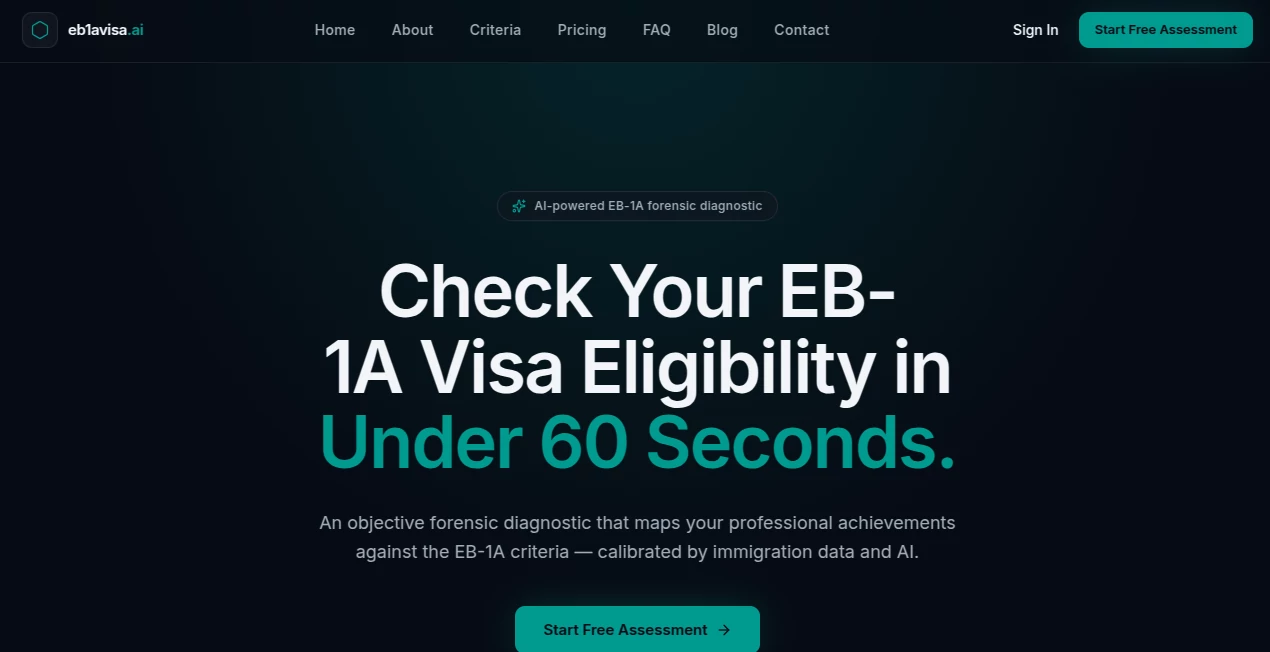
What is eb1avisa.ai?
Applying for an EB-1A visa can be difficult to evaluate before spending significant time and money on a petition. The challenge is not simply understanding the requirements; applicants also need to see how their professional achievements fit into the ten USCIS evidentiary criteria and where their profile may have weaknesses.
eb1avisa.ai takes a structured approach to this early-stage evaluation. Its AI-powered forensic diagnostic reviews a professional profile against the EB-1A framework and produces an eligibility assessment in under 60 seconds. The platform is designed for researchers, founders, executives, creators, and other accomplished professionals who want a clearer picture of their case before moving further into the immigration process.
Rather than functioning as a general-purpose chatbot, the platform focuses specifically on EB-1A case preparation. It combines profile scoring, evidence organization, case tracking, document preparation tools, and an AI assistant into one workspace.
Key Features
- Ten-criteria EB-1A profile assessment based on the USCIS framework.
- Risk exposure scoring and a case-readiness score.
- Estimated approval probability and a decision-prediction feature.
- Evidence Vault for organizing criterion-related documentation.
- Automatic exhibit indexing for petition evidence.
- Petition outline and recommendation-letter builder tools.
- RFE Simulator covering 30 potential USCIS challenge vectors.
- AI Co-Pilot for case-aware drafting and argument refinement.
- Timeline Planner and Letter Tracker for organizing the preparation process.
- Attorney Dossier generation for sharing a structured case summary with legal counsel.
- Unlimited PDF exports with the paid plan.
User Interface
The interface is organized around the actual stages of an EB-1A case rather than presenting users with a generic collection of AI tools. The workflow moves through assessment, evidence gathering, tracking, and filing preparation, which makes the platform easier to understand when a case contains a large amount of information.
The assessment area provides a visual overview of the ten criteria, while the evidence tools help connect supporting documents to the criteria they are intended to support. This structure can be particularly useful for applicants who currently keep their evidence across scattered folders, cloud storage, emails, and personal notes.
The dashboard-style approach also makes it easier to see which areas are already supported and which ones may require additional evidence or development.
Accuracy & Performance
The platform is built around the ten EB-1A evidentiary criteria and states that its initial diagnostic can be completed in under 60 seconds. During the assessment process, users can enter their professional milestones and provide a CV or resume, after which the system analyzes the information and generates a structured eligibility readout.
Its scoring system separates areas into categories such as secured, borderline, high exposure, and not assessed. That gives users more context than a simple yes-or-no eligibility result.
It is important, however, to treat algorithmic scores and approval estimates as decision-support information rather than guarantees. Immigration decisions are made by USCIS, and an automated assessment cannot replace a qualified immigration attorney's review of the underlying evidence and circumstances.
Capabilities
The strongest part of the platform is its broader case-management approach. After the initial diagnostic, users can move into evidence collection and petition preparation instead of starting from scratch with another application.
The Evidence Vault provides criterion-linked organization for supporting documents, while the exhibit indexer can help create a more structured evidence package. Builder Tools extend this workflow with petition outlines, expert recommendation-letter assistance, and exhibit compilation.
Another notable feature is the RFE Simulator. It is designed to stress-test a petition against 30 different challenge vectors and help applicants think about potential weaknesses before submitting their case. The AI Co-Pilot then provides case-aware assistance for refining arguments and drafting responses.
For someone who prefers a practical checklist over a collection of disconnected resources, this combination can make the preparation process considerably more manageable.
Security & Privacy
Immigration preparation involves sensitive professional and personal information, so privacy is an important consideration. The platform states that its assessment environment is confidential and encrypted. Users should still review the current Privacy Policy and Terms of Service before uploading resumes, evidence, recommendation letters, or other personal documents.
The service also clearly identifies itself as a diagnostic intelligence platform rather than a law firm. Its website states that the information provided is not legal advice, which is an important distinction when using automated immigration software.
Use Cases
The platform is particularly useful for professionals who are considering an EB-1A self-petition and want to understand their current position before committing to a full legal preparation process.
- Early eligibility screening: Professionals can quickly see how their achievements map to the ten EB-1A criteria.
- Evidence planning: Applicants can identify evidence gaps and organize supporting documents around individual criteria.
- Founder and executive immigration planning: Business achievements, leadership roles, media coverage, and commercial success can be reviewed as part of the broader profile.
- Researchers and academics: Publications, judging activities, original contributions, and recognition can be organized into a structured case.
- Petition preparation: Users can work with outlines, recommendation-letter tools, exhibit indexing, and other preparation features.
- RFE preparation: Applicants can use the challenge simulator to consider potential objections before filing.
- Attorney collaboration: A structured dossier can make it easier to present a prepared case summary to immigration counsel.
Pros and Cons
Pros
- Focused specifically on EB-1A preparation rather than general immigration questions.
- Fast initial assessment with results designed to be available in under a minute.
- Maps a professional profile to all ten USCIS criteria.
- Combines assessment, evidence management, drafting, and preparation tools.
- Includes an RFE-focused simulation feature.
- Offers a free assessment before requiring payment.
- The paid version uses a one-time payment rather than a recurring subscription.
Cons
- It is designed for EB-1A cases, so it is not a general immigration management platform.
- Algorithmic probability estimates should not be interpreted as guarantees of USCIS approval.
- Users with complicated immigration histories may still need professional legal guidance.
- The quality of an assessment depends partly on the completeness and accuracy of the information provided by the applicant.
Pricing Plans
The platform offers a free assessment for users who want to establish an initial baseline. The free option includes the ten-criteria profile assessment, risk exposure scoring, an executive scorecard and risk matrix, an estimated USCIS approval probability, and a decision-prediction feature.
For users who want the complete preparation workspace, the Full Lifetime Access plan costs $249 as a one-time payment. It includes the free assessment features plus the Evidence Vault, Builder Tools, attorney dossier functionality, the 30-vector RFE Simulator and defense engine, unlimited access to the AI Immigration Co-Pilot, unlimited PDF exports, and future template and petition updates.
The lifetime model is appealing for applicants who do not want another monthly subscription during what can already be an expensive immigration process.
How to Use It
- Start the free assessment: Create a secure workspace and begin the initial profile evaluation.
- Complete your profile: Enter relevant professional milestones and information connected to the EB-1A framework.
- Add your CV or resume: The platform can analyze the information in your professional background as part of the assessment.
- Review your criteria: Examine which of the ten criteria appear strong, borderline, exposed, or not yet assessed.
- Gather evidence: Use the Evidence Vault and exhibit tools to organize documentation around your target criteria.
- Build the case: Use the preparation and drafting tools to develop petition materials and supporting documentation.
- Stress-test the petition: Run the case through the RFE Simulator to identify areas that may need stronger explanations or evidence.
- Prepare for legal review: Generate a structured dossier that can be reviewed alongside qualified immigration counsel before filing.
Comparison with Similar Tools
Many immigration-related digital products focus primarily on educational information, document templates, or connecting applicants with attorneys. This platform takes a more integrated route by combining eligibility analysis with evidence organization and petition preparation.
That distinction matters for users who are still trying to determine whether their professional record is worth developing into an EB-1A case. Instead of immediately moving into document preparation, they can begin with a structured assessment and then progress toward evidence gathering if the results justify further work.
It is also more specialized than a general AI assistant. Its scoring model, evidence structure, RFE simulator, and preparation workflow are all centered on the EB-1A framework. For applicants who already understand that this is the immigration category they are exploring, that specialization can be more useful than starting with a broad chatbot.
Conclusion
For accomplished professionals exploring an EB-1A petition, the biggest challenge is often knowing where to begin. A strong career history can contain awards, publications, leadership positions, media coverage, original contributions, judging experience, or commercial achievements, but turning those accomplishments into a coherent immigration case requires structure.
This platform provides that structure through a fast initial diagnostic followed by tools for evidence management, petition preparation, RFE simulation, and ongoing case organization. The free assessment makes it easy to test the concept without an upfront commitment, while the $249 lifetime plan is aimed at users who want access to the complete preparation environment.
It should not be viewed as a replacement for qualified immigration counsel or as a guarantee of approval. Used appropriately, though, it can serve as a practical starting point for understanding an EB-1A profile, organizing evidence, identifying weaknesses, and preparing for a more informed conversation with an immigration professional.
Frequently Asked Questions (FAQ)
What is this platform designed for?
It is designed to help professionals evaluate and organize potential EB-1A cases using an AI-powered diagnostic and a structured case-preparation workflow.
How quickly can I receive an initial assessment?
The website states that the initial profile assessment can be completed in under 60 seconds, provided the required information is entered.
How many EB-1A criteria does the assessment cover?
The diagnostic is structured around all ten USCIS evidentiary criteria and provides a profile assessment across the framework.
Is there a free version?
Yes. The free assessment is available at no cost and includes the ten-criteria assessment, risk scoring, a scorecard, a risk matrix, and estimated approval-related metrics.
How much does full access cost?
The full lifetime plan is listed at $249 as a one-time payment. The website states that there is no recurring subscription for this plan.
Does it include evidence management?
Yes. The full plan includes an Evidence Vault, criterion-linked exhibit organization, evidence gap analysis, and an exhibit indexer.
Can it help with an RFE?
The full plan includes an RFE Simulator designed around 30 potential USCIS challenge vectors. It can be used to identify possible weaknesses and help users prepare responses, but it should not be treated as a substitute for legal advice.
Is this a law firm?
No. The website explicitly states that the service is not a law firm and that its diagnostic intelligence is not legal advice.
Can I use it before speaking with an immigration attorney?
Yes. One practical use is to organize your professional achievements and supporting evidence before consulting an attorney. A structured case summary can also make the initial legal discussion more focused.
Does a high score guarantee EB-1A approval?
No. An automated score or probability estimate cannot guarantee an immigration outcome. USCIS makes the final determination based on the submitted petition, evidence, applicable rules, and the individual circumstances of the case.
These classifications represent its core capabilities and areas of application. For related tools, explore the linked categories above.
eb1avisa.ai details
Website unavailable — View Alternatives
Pricing
- Freemium
Apps
- Web App
Categories

eb1avisa.ai Alternatives Product

Clearterms

AI Complianc…

Harvey

TuCanChat