
EcomIQX
What is EcomIQX?
EcomIQX is an AI-powered ecommerce intelligence platform built to help online stores find weak spots across their product catalogs and turn those findings into practical improvements. Instead of checking hundreds or thousands of product pages one by one, merchants can connect their catalog, analyze product quality, identify SEO and content issues, and prioritize the changes that deserve attention first.
The platform looks beyond simple text generation. It evaluates areas such as title quality, description completeness, image coverage, SEO signals, keyword opportunities, and readiness for AI-powered search. This makes it particularly useful for ecommerce teams dealing with large catalogs where even small improvements across many products can have a meaningful impact.
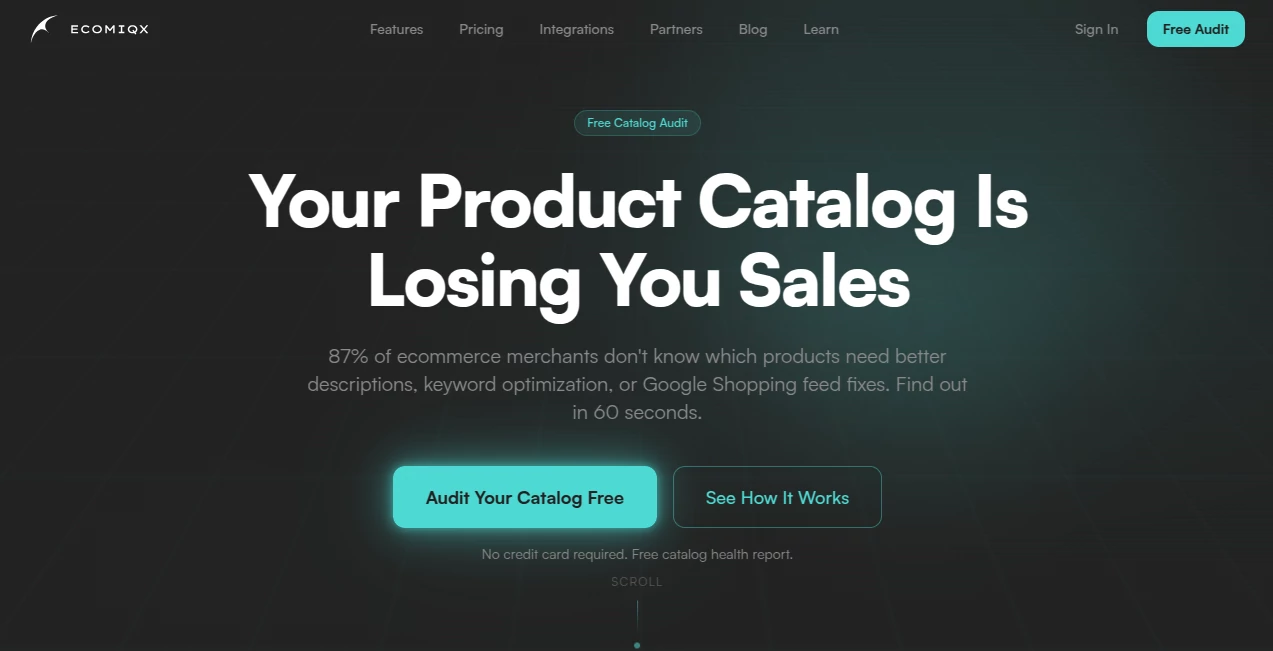
There is also a useful free starting point: merchants can run a catalog audit without a credit card and receive a catalog health report. That makes it easy to see where the biggest problems are before committing to a paid plan.
Key Features
- Full catalog health scoring across individual products
- Priority-based detection of content and SEO problems
- AI-assisted product description rewrites
- Brand voice, vocabulary, and forbidden-term controls
- Batch processing for large product catalogs
- Keyword-informed content optimization
- SEO-adapted localization for multiple markets
- Generative Engine Optimization scoring for AI search
- AI citation tracking and content recommendations
- Controlled A/B testing for titles, descriptions, and keywords
- AI Copilot for querying catalog, Google Search Console, Merchant Center, and keyword data
- Goal-driven agents with configurable levels of autonomy
User Interface
The interface is designed around the problems an ecommerce operator actually needs to solve. Rather than forcing users to work through a spreadsheet of hundreds of SKUs, the platform surfaces product health information and ranks issues by importance.
The workflow is also straightforward. A merchant connects a product feed or ecommerce platform, lets the system analyze the catalog, and then works through the recommendations. For content changes, the side-by-side review experience is especially practical because users can compare the original copy with an AI-generated version before approving anything.
For teams managing a substantial catalog, this approach can save a considerable amount of repetitive checking. A store owner who normally spends an afternoon looking through product descriptions can instead start with the products that the system identifies as needing the most attention.
Accuracy & Performance
The platform takes a data-oriented approach rather than treating every product as an isolated writing task. Product health can be evaluated using multiple signals, including title quality, description completeness, image coverage, SEO indicators, keyword gaps, and GEO readiness.
Its optimization workflow can also use information from Google Search Console and Google Merchant Center. This is valuable because recommendations can be connected to actual search and shopping data rather than relying purely on generic content suggestions.
For larger catalogs, batch processing is another strong point. Hundreds of products can be queued for rewriting, while users retain control over which changes are eventually approved and published.
Capabilities
One of the strongest aspects of the platform is the range of optimization tasks it brings together. Merchants can audit product content, improve descriptions, identify keyword opportunities, optimize listings for Google Shopping, and adapt content for additional languages and markets.
Its GEO capabilities are particularly relevant as product discovery increasingly moves beyond traditional search results. The platform provides GEO scoring, AI citation tracking, and recommendations designed to make product information easier for AI-powered search systems to understand and surface.
The AI Copilot adds another layer of usefulness. Instead of manually switching between different dashboards, users can ask questions across catalog information, Google Search Console, Merchant Center, and keyword data. For example, a team could look for products receiving substantial Merchant Center impressions while experiencing declining organic click-through rates, then investigate possible keyword gaps.
For organizations that want more automation, goal-driven agents can be configured with report-only, proposal, or autonomous operating modes. Monthly credit limits help keep automated activity under control.
Security & Privacy
Because the platform can work with ecommerce catalogs and connected marketing data, data access and operational control are important considerations. The service provides different levels of integration, including product feeds, ecommerce platforms, custom API connections, Google Merchant Center, and Google Search Console.
Businesses that require stronger organizational controls can choose the Enterprise option, which includes self-hosted deployment, SSO, audit logs, custom API rate limits, dedicated account management, and a custom SLA. Teams should review the platform's current policies and integration documentation for requirements specific to their own data environment before connecting production systems.
Use Cases
Ecommerce SEO: Stores can identify weak product titles, missing keywords, incomplete descriptions, and other catalog-level SEO problems without manually auditing every SKU.
Large Product Catalogs: Merchants with hundreds or tens of thousands of products can use health scoring and batch processing to focus resources where they are likely to matter most.
Product Content Creation: Ecommerce teams can generate improved product descriptions while maintaining defined brand vocabulary, tone, and terminology.
Google Shopping Optimization: Product listings can be reviewed and improved with information from Merchant Center and other connected data sources.
International Expansion: Businesses entering new markets can adapt product content for local search intent rather than relying on literal word-for-word translation.
AI Search Optimization: Brands preparing for discovery through ChatGPT, Perplexity, Google AI Overviews, and other AI-powered search experiences can monitor GEO-related signals and improve content structure.
Marketing Teams: Teams can combine catalog data with search and keyword information in one workflow, reducing the need to jump between several separate platforms.
Pros and Cons
Pros
- Free catalog scoring is available without a credit card
- Designed specifically around ecommerce product catalogs
- Useful combination of content, SEO, keyword, and catalog analysis
- Batch rewriting makes large-scale content work more practical
- Brand voice controls help avoid generic product copy
- Human approval remains part of the content publishing workflow
- GEO optimization addresses an increasingly important discovery channel
- Integrates with major ecommerce platforms and marketing data sources
- Advanced plans provide testing, automation, API access, and agents
Cons
- The more advanced automation features are aimed at businesses with larger catalogs or more demanding workflows
- Paid plans can become a significant monthly investment for smaller stores
- Some of the platform's benefits depend on having useful catalog and search data available
- Businesses looking for a simple standalone copywriting tool may find the broader platform more extensive than necessary
Pricing Plans
The platform currently offers several plans designed around different catalog sizes and levels of automation.
- Free: $0, including full catalog scoring, 30 credits per month, 5 keyword research operations per month, quality validation, and 1 connector.
- Pro: $99 per month, with 1 agent, 1,500 credits per month, 50 keyword research operations, impact tracking, 1 translation language, and 3 connectors.
- Business: $299 per month, with 3 agents, 3 verified A/B tests, 5,000 credits per month, 250 keyword research operations, 5 translation languages, REST API access, and 5 connectors.
- Scale: $699 per month, with unlimited agents and goals, 10 verified A/B tests, 20,000 credits per month, 1,000 keyword research operations, 10 translation languages, REST API access, and unlimited connectors.
- Enterprise: Custom pricing with unlimited products, credits, and connectors, plus self-hosted deployment, dedicated account management, custom SLA, SSO, audit logs, custom API rate limits, and priority support.
An annual billing option is also available with a stated 25% saving. The free plan is a useful way for merchants to inspect catalog quality before deciding whether the more advanced automation and optimization features justify a paid subscription.
How to Use It
Step 1: Connect your data. Import a product feed in XML, CSV, or JSON format, connect a supported ecommerce platform such as Shopify or WooCommerce, or use the API.
Step 2: Analyze your catalog. The system evaluates products for content quality, SEO performance, keyword opportunities, and GEO readiness. Problems are organized so that important issues can be addressed first.
Step 3: Choose what to improve. Merchants can select products individually or work with groups based on health scores, categories, or other criteria.
Step 4: Generate and review changes. AI-assisted rewrites can be created according to the brand profile. Users can compare the original and proposed versions, edit them when necessary, and approve or reject individual changes.
Step 5: Measure the result. Advanced plans can test changes and track their impact, helping teams determine whether an optimization actually improved important business metrics before applying the same pattern more broadly.
Comparison with Similar Tools
Many ecommerce tools focus on one specific job, such as writing product descriptions, performing keyword research, managing feeds, or monitoring SEO. The main difference here is the attempt to bring several of these activities into a single catalog-focused workflow.
A conventional AI writing tool may produce a polished description from a product brief, but it usually does not know which products in a 10,000-SKU catalog deserve attention first. A conventional SEO platform may identify ranking opportunities, but it may not provide brand-controlled batch rewriting and product-level content scoring in the same workflow.
This broader approach makes the platform more interesting for ecommerce teams that need to manage optimization as an ongoing operational process rather than a collection of isolated tasks. For a small store with only a handful of products, a simpler tool may be enough. For a growing catalog, however, centralized scoring, optimization, testing, and automation can become considerably more valuable.
Conclusion
Managing an ecommerce catalog at scale is rarely just a matter of writing better descriptions. Product titles, keywords, missing information, images, search performance, localization, and emerging AI search channels can all influence how products are discovered and evaluated.
This platform takes a practical approach to that challenge by combining catalog auditing, AI-assisted content optimization, search data, experimentation, localization, and automation. The free audit makes the first step relatively easy, while the higher plans are designed for teams that need deeper integrations and more autonomous workflows.
For ecommerce businesses with a growing catalog, it offers a compelling way to replace scattered manual checks with a more structured optimization process. The biggest appeal is not simply generating more content; it is helping teams understand which product content needs attention, what should change, and whether those changes are producing measurable results.
Frequently Asked Questions (FAQ)
What does the platform do?
It analyzes ecommerce product catalogs, identifies content and SEO issues, helps generate optimized product content, and provides tools for localization, GEO optimization, experimentation, and automation.
Is there a free plan?
Yes. The Free plan costs $0 and includes full catalog scoring, 30 monthly credits, 5 keyword research operations per month, quality validation, and one connector.
Can it generate product descriptions?
Yes. The product content workflow can generate keyword-informed descriptions based on a defined brand voice, vocabulary, and list of forbidden terms. Users can review and approve the generated copy before publication.
Can I process many products at once?
Yes. Batch processing allows merchants to queue large groups of products for content rewriting rather than handling each product individually.
Does it support Shopify and WooCommerce?
Yes. Shopify and WooCommerce are among the supported commerce platforms. The platform also lists Magento, BigCommerce, custom API connections, XML, CSV, and other data sources.
Can it help with Google Shopping?
Yes. The platform can work with Google Merchant Center data and provides product optimization capabilities intended to improve ecommerce listings and identify issues affecting product visibility.
Does it support AI search optimization?
Yes. GEO scoring, AI citation tracking, and content structure recommendations are designed to help product information perform better in AI-powered discovery environments.
Can I control the brand voice?
Yes. Users can define tone descriptors, required vocabulary, forbidden terms, and example copy so generated content follows the brand's preferred communication style.
Does it publish AI-generated changes automatically?
The product description workflow includes human review before publication. Users can compare the original and rewritten content, then approve, reject, or edit proposed changes.
Does it offer API access?
REST API access is included in the Business and Scale plans, while Enterprise customers receive custom API rate limits as part of the enterprise offering.
AI SEO Assistant , AI Analytics Assistant , AI E-commerce Assistant .
These classifications represent its core capabilities and areas of application. For related tools, explore the linked categories above.

EcomIQX Alternatives Product

BuildRoy

TrueSource AI

Pixelied

Shufaf

AICosts.ai

TrackRev

URL2Pin

Crawlly AI

ytzolo