Edra
What is Edra?
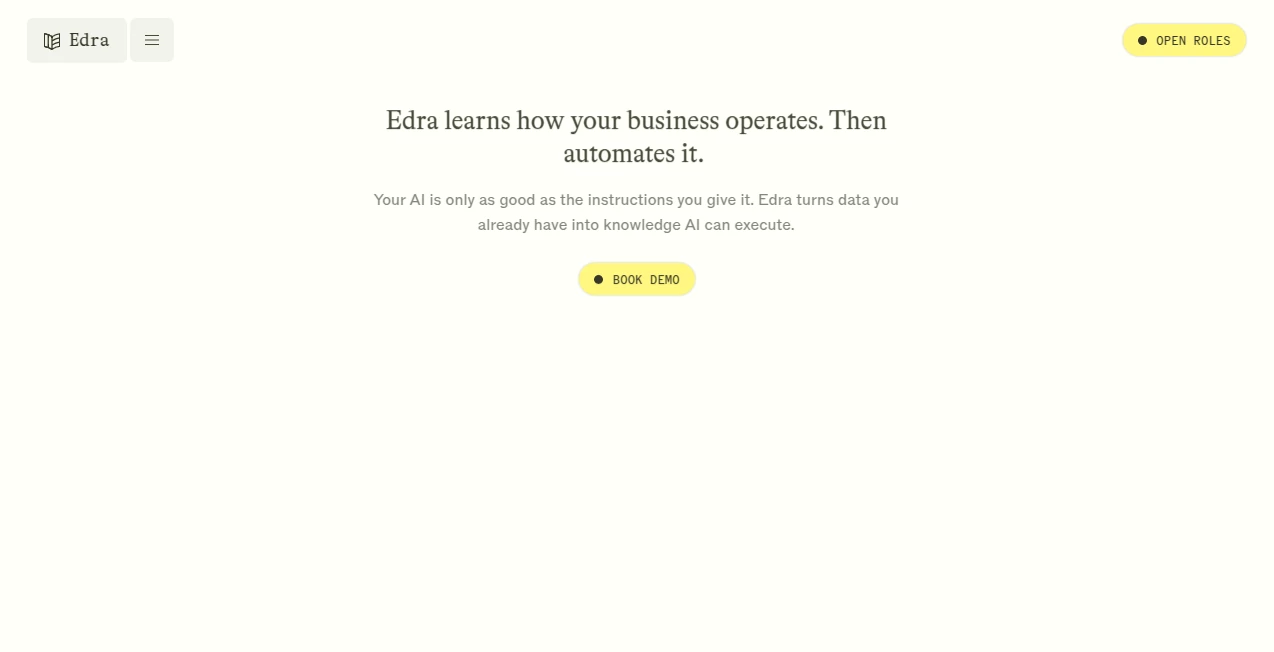
Most AI tools sound smart until you ask them to handle the messy reality of how a real company works. Suddenly the answers feel generic and the automation falls apart. This platform takes a different path. It digs into the tickets, messages, and logs your teams already create every day, figures out how work actually gets done, and turns that messy knowledge into clear, editable playbooks that AI agents can follow. The result feels less like another black-box experiment and more like hiring a team that already knows the unwritten rules of your business.
Introduction
Enterprise AI has a quiet problem. Models keep getting smarter, yet they still struggle inside real organizations because they lack the specific context of how things actually run. Policies sit in outdated PDFs. Edge cases live only in the heads of long-time employees. Support tickets and email threads hold the real playbook, but no one has time to extract it. This tool was built to close that gap. It connects to systems you already use, reverse-engineers the processes from real activity, and produces human-readable instructions that agents can execute. Teams at companies like HubSpot and ASOS are already using it to expand knowledge coverage and cut unnecessary handoffs. It turns tribal knowledge into something that scales without forcing people to write endless documentation first.
Key Features
User Interface
The experience stays focused on clarity rather than flashy dashboards. You connect your existing tools, watch the platform surface processes, and then review or edit the resulting playbooks in plain language. Everything is designed so operations and support leaders can understand and adjust the rules without needing a data science team in the room. The interface feels practical — more like a living knowledge library than a complex control panel.
Accuracy & Performance
Because it learns from actual tickets, logs, and conversations rather than idealized process maps, the resulting instructions tend to match how work really happens. It catches inconsistencies and gaps that static documentation misses. Agents then follow those instructions with transparency, so you can see why a decision was made. Continuous feedback from the team keeps the knowledge current instead of letting it drift out of date after the first deployment.
Capabilities
It starts with zero-setup discovery across systems like ServiceNow, Jira, Zendesk, Salesforce, Outlook, and HubSpot. From there it builds a library of executable knowledge that agents can act on. You can review every rule, edit it in plain English, and deploy automation directly inside the tools your teams already live in. As people keep working and giving feedback, the playbooks update automatically. The focus is strongest on IT service management and technical support, but the same approach applies wherever processes hide in historical data.
Security & Privacy
Enterprise-grade controls sit at the center of the design. Data stays within the systems and permissions you already trust. Playbooks remain fully auditable, so every automated decision can be traced back to a clear rule. The platform is built for organizations that need both automation and accountability rather than opaque AI behavior.
Use Cases
An IT team uses it to expand knowledge base coverage from a fraction of common issues to the vast majority, reducing repetitive tickets. A customer support organization feeds years of conversation history into the system and watches an AI assistant handle more cases without constant human escalation. A large retailer turns scattered support practices into consistent, up-to-date playbooks that new agents can follow immediately. Operations leaders gain visibility into how work actually flows across departments without running endless workshops. In each case the platform sits on top of existing tools rather than forcing a full technology overhaul.
Pros and Cons
Pros:
- Learns from real operational data instead of requiring perfect documentation upfront.
- Produces transparent, human-readable playbooks that teams can review and edit.
- Continuously updates as the business changes, keeping knowledge current.
- Works with tools companies already use, reducing friction and risk.
- Strong track record in high-volume support and IT environments.
Cons:
- Best suited for organizations with substantial historical ticket and message data.
- Pricing and full capability details typically require a conversation with the sales team.
- Requires thoughtful review of the generated playbooks before full automation.
Pricing Plans
Pricing is structured around enterprise needs and is not listed as a simple public self-serve menu. Most organizations start with a demo to map the scope of systems and processes involved. The investment reflects the value of turning years of operational history into living, automated knowledge. Teams usually evaluate it against the cost of manual documentation, repeated handoffs, and inconsistent process execution.
How to Use Edra
Connect the platform to the systems where your work already lives — support tickets, chat logs, email, or IT tools. Let it read and organize the patterns it finds into a library of executable knowledge. Review the resulting playbooks, adjust anything that needs refinement, and then deploy agents that follow those rules inside your existing platforms. As your team continues working and providing feedback, the knowledge library stays current without constant manual updates. Most teams see meaningful visibility within the first week of connection.
Comparison with Similar Tools
Traditional knowledge bases rely on people writing and maintaining documents that quickly go stale. Pure AI agents often act generically because they lack the specific context of how a particular company operates. Process mining tools can map flows but rarely produce the clear, editable instructions needed for reliable automation. This approach sits in a useful middle ground: it extracts real operational knowledge automatically, keeps it readable and owned by the business, and feeds it directly to agents that can act on it. The result feels more practical for day-to-day enterprise work than either pure documentation platforms or black-box automation tools.
Conclusion
The hardest part of putting AI to work inside a real company has never been the model itself. It has been capturing the unwritten rules, edge cases, and institutional memory that actually make the business run. This platform tackles that problem head-on by learning from the data your teams already create and turning it into clear, living instructions that agents can follow. For organizations tired of generic AI that ignores how work really happens, it offers a more grounded and transparent path forward. The more your teams work, the smarter and more accurate the automation becomes — without forcing everyone to become documentation experts first.
Frequently Asked Questions (FAQ)
What kinds of systems does it connect to?
It works with common enterprise tools such as ServiceNow, Jira, Zendesk, Salesforce, Outlook, and HubSpot, among others.
Do we need perfect documentation before starting?
No. The platform is designed to learn from the tickets, logs, and messages that already exist.
Can we edit the rules the AI follows?
Yes. Every playbook is human-readable and fully editable so teams stay in control.
How quickly can we see results?
Many organizations gain useful visibility into their processes within the first week after connecting systems.
Is the automation transparent?
Yes. Decisions can be traced back to specific, reviewable rules rather than hidden model behavior.
AI Workflow Management , AI SOP , AI Knowledge Management , AI Knowledge Base .
These classifications represent its core capabilities and areas of application. For related tools, explore the linked categories above.

Edra Alternatives Product

TrySchedule

Sourcetable

Google Skills

Ecom Mediate…

Calculadora …

Clay Read

BillEasy Inc

MindSnapz

Lynote