
Elvix
What is Elvix?
Sales teams lose opportunities for surprisingly simple reasons: a message arrives after working hours, a lead does not receive a quick response, or a potential customer has a question that nobody is available to answer. An AI sales agent can help remove these gaps by keeping customer conversations active around the clock.
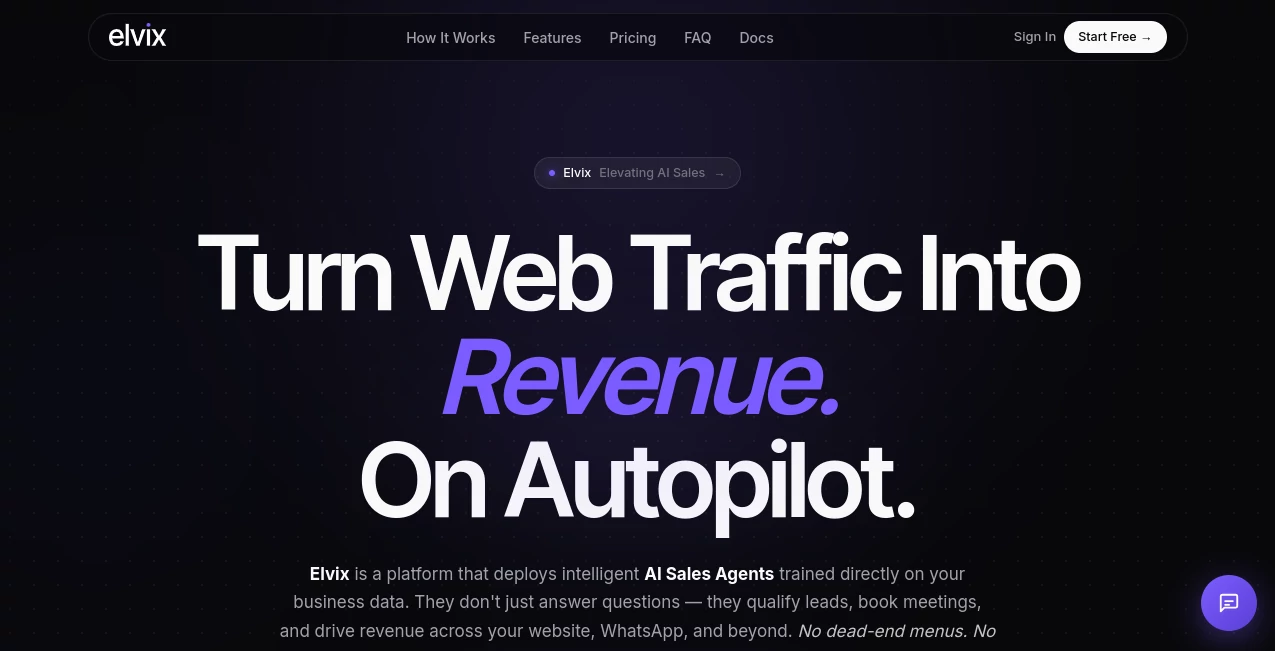
Elvix is designed around this idea, giving businesses an AI-powered sales assistant that can engage prospects continuously and help move conversations toward a purchase. Instead of relying entirely on a human sales representative to respond to every first interaction, businesses can use an automated agent to handle routine conversations and keep leads moving through the sales process.
This approach is particularly useful for companies receiving inquiries outside normal business hours. A visitor who asks a product question at midnight should not necessarily have to wait until the next morning to receive an answer.
Key Features
- AI-powered sales conversations designed to engage potential customers.
- 24/7 availability for lead and customer interactions.
- Automated responses that reduce the need for constant manual intervention.
- Lead engagement designed to support the sales process.
- Conversational interactions that can help businesses respond faster to prospects.
- Automation aimed at reducing repetitive work for sales teams.
User Interface
A useful sales automation platform needs to feel practical rather than complicated. The experience is built around the idea of letting businesses deploy AI-driven conversations without turning every interaction into a technical project.
For a sales team, that simplicity matters. The less time spent managing the system, the more time remains for conversations that actually require human judgment. The concept is especially appealing to smaller teams that cannot afford to have someone monitoring incoming inquiries throughout the day and night.
Accuracy & Performance
Speed is one of the biggest advantages of AI-assisted sales. A prospect can receive an immediate response instead of entering a queue for a sales representative. That can make a meaningful difference when someone is comparing several businesses at the same time.
Performance should still be viewed realistically. AI can handle many routine conversations effectively, but complex negotiations, unusual requests, and high-value decisions may still benefit from human involvement. The strongest setup is usually one where automation handles the repetitive first layer while people step in when their expertise is needed.
Capabilities
The platform focuses on sales-oriented conversations rather than acting as a general-purpose chatbot. Its purpose is to help businesses engage prospects, answer questions, maintain conversations, and support the journey from initial interest toward conversion.
This makes it relevant for companies that receive a steady flow of website inquiries or digital leads. Instead of treating every message as an isolated support request, an AI sales agent can become part of the broader customer acquisition process.
Security & Privacy
Businesses should always review the provider's current privacy policy and data-handling terms before connecting customer information or sensitive business material. This is particularly important for sales environments where conversations can contain contact details, purchasing intentions, or confidential commercial information.
For organizations considering AI-based sales automation, privacy should therefore be evaluated alongside features, integrations, response quality, and pricing rather than treated as an afterthought.
Use Cases
There are several situations where an AI sales agent can be useful. An online business can use it to respond to visitors while the sales team is offline. A service company can use automated conversations to handle initial questions before passing qualified prospects to a salesperson. SaaS companies can also benefit when potential customers want quick answers before booking a demonstration or starting a trial.
It can also be useful for teams that receive leads from multiple campaigns. Rather than allowing new inquiries to sit unanswered until someone becomes available, automated engagement can keep the conversation moving.
For example, imagine a potential customer discovering a product late on a Friday evening. Instead of waiting until Monday, the customer can immediately begin a conversation, ask basic questions, and continue exploring the offer. That small improvement in responsiveness can make the buying experience feel considerably smoother.
Pros and Cons
- Pros: 24/7 availability, faster lead responses, reduced repetitive sales work, scalable customer engagement, and a sales-focused approach to conversational automation.
- Cons: AI should not replace human judgment in complex sales situations, response quality depends on the information and instructions provided to the system, and businesses should carefully review privacy and data-handling policies before deployment.
Pricing Plans
Pricing information for the product was not reliably available from the accessible official source at the time of review. Because pricing can change as an AI product evolves, businesses should check the current offer directly before making a purchasing decision.
When evaluating the cost, it is worth looking beyond the monthly price. The more useful comparison is the potential value of faster lead response, reduced manual workload, and additional sales conversations handled without expanding the team.
How to Use Elvix
Getting started with an AI sales solution generally begins by defining what the agent should accomplish. Businesses should identify their target customers, common questions, products or services, and the actions they want prospects to take.
Next, the sales conversation should be structured around real customer scenarios. Clear product information and sensible sales rules can help the agent provide more useful responses. Once the experience is tested, businesses can introduce it into their customer-facing workflow and monitor conversations to identify areas that need improvement.
A practical approach is to begin with straightforward questions and qualification tasks before allowing the system to handle more sensitive or complicated parts of the sales process.
Comparison with Similar Tools
Traditional chatbots usually focus on predefined answers and basic customer support. General-purpose AI assistants can have broader conversational abilities, but they are not necessarily designed around the specific objectives of a sales team.
An AI sales agent sits somewhere between these approaches. Its value comes from applying conversational AI specifically to lead engagement and sales activity. For businesses that care primarily about responding to prospects and keeping opportunities active, this specialization can be more useful than deploying a generic chatbot.
The right choice ultimately depends on the sales process. A company that only needs a simple FAQ widget may not need an advanced sales agent, while a business with a constant stream of prospects may gain considerably more from continuous automated engagement.
Conclusion
AI sales automation is becoming increasingly practical for businesses that want to respond to prospects faster without continuously expanding their sales teams. Elvix takes a focused approach to this problem by putting AI-powered sales conversations at the center of the experience.
The biggest appeal is straightforward: potential customers can receive attention even when the human sales team is unavailable. For businesses where response time matters, that can turn otherwise missed conversations into genuine opportunities.
It is not a replacement for experienced salespeople in every situation. Instead, it can serve as an always-available first layer that handles repetitive interactions and allows human representatives to spend more of their time on conversations where personal expertise makes the difference.
Frequently Asked Questions (FAQ)
What is an AI sales agent?
An AI sales agent is a conversational system designed to interact with potential customers, answer questions, qualify prospects, and support sales activities automatically.
Can an AI sales agent work outside business hours?
Yes. One of the main advantages of this type of technology is continuous availability, allowing businesses to engage prospects outside traditional working hours.
Can it replace a human sales team?
It is better viewed as a sales-support layer rather than a complete replacement for human representatives. Complex negotiations, sensitive conversations, and important purchasing decisions can still require people.
Who can benefit from AI sales automation?
Online businesses, SaaS companies, service providers, agencies, and other organizations that regularly receive digital leads can benefit from faster and more consistent customer engagement.
Is pricing publicly available?
Reliable current pricing was not available from the accessible official source during this review. Businesses should verify the latest pricing before subscribing or purchasing.
Is an AI sales agent suitable for small businesses?
It can be particularly useful for small teams because it can handle initial customer interactions without requiring a salesperson to be available for every incoming inquiry.
AI Lead Generation , AI Sales Assistant , AI CRM Assistant , AI Customer Service Assistant .
These classifications represent its core capabilities and areas of application. For related tools, explore the linked categories above.

Elvix Alternatives Product

Sourcetable

FINIITE AI

Sales Prospe…

AILeadz.io

Zorin

Jotform AI A…

ZynfoAI

Chatbots AI

MyReply