

















Zorin
What is Zorin?
Zorin is a pricing intelligence platform designed for e-commerce sellers who want to make better pricing decisions using their own sales history. Instead of relying on guesswork, competitor prices, or manually reviewing spreadsheets, the platform analyzes historical transactions and estimates how customers respond to different price points.
The core idea is straightforward: your previous sales already contain useful information about price sensitivity. By studying quantities, prices, dates, and other signals across a catalog, the platform can recommend whether a product should be raised, lowered, or kept at its current price.
It is particularly interesting for store owners who already have a reasonable amount of sales data but do not want to spend hours building pricing models themselves. A CSV upload can be enough to get started, while Shopify and WooCommerce integrations are available on higher plans.
Key Features
- Price recommendations based on historical sales data
- Elasticity modeling for individual products and SKUs
- Estimated profit lift for recommended price changes
- Confidence scores showing how reliable a recommendation is
- Automatic promotion detection to prevent unusual sales periods from distorting the model
- CSV sales-data upload with automatic parsing of quantities, prices, and dates
- Shopify and WooCommerce synchronization on supported plans
- What-if simulation for testing potential pricing decisions
- Catalog-wide pricing recommendations in a single dashboard
- Van Westendorp price sensitivity analysis
User Interface
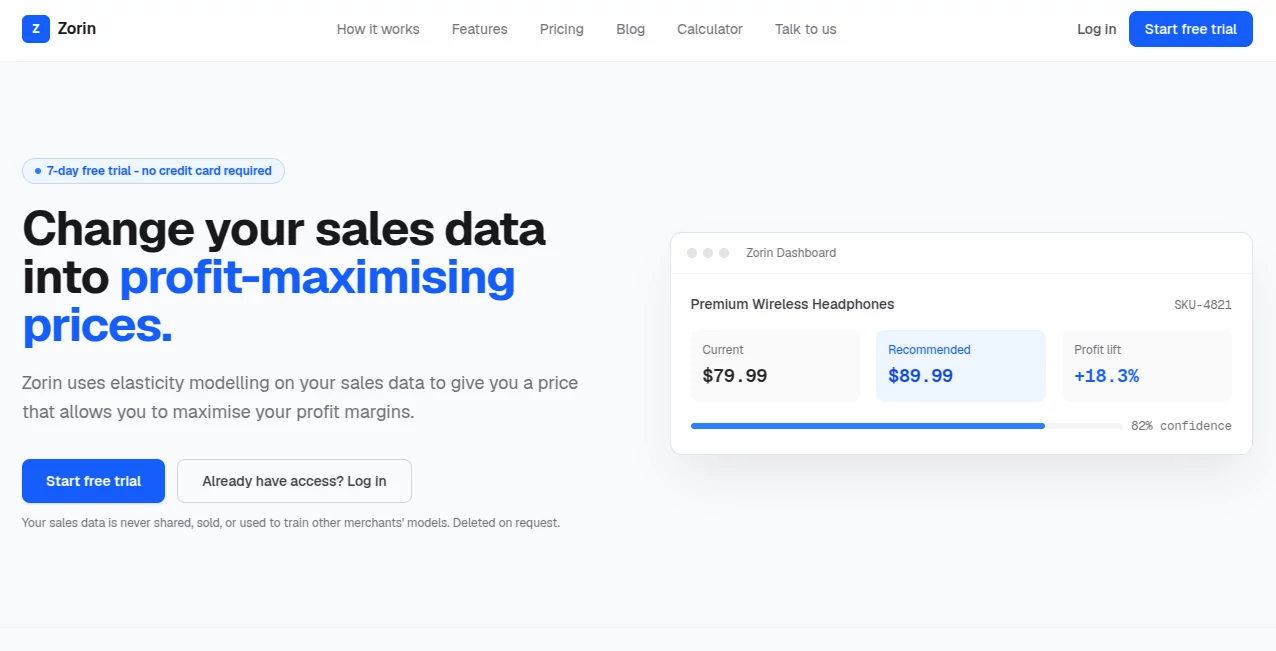
The dashboard is built around the information a merchant actually needs to make a pricing decision. Products can be viewed alongside their recommended action and estimated profit impact, making it easier to identify items that may be underpriced or overpriced.
The workflow is also refreshingly simple. Rather than forcing a store owner through a complicated analytics setup, the platform focuses on getting historical data into the system and turning it into actionable recommendations. For a busy merchant, that simplicity can make a noticeable difference.
Accuracy & Performance
The platform bases its recommendations on statistical demand modeling rather than simply comparing a store's prices with competitors. Its elasticity model examines how demand changes as prices change, while confidence scores provide additional context around each recommendation.
Promotion detection is another useful detail. Promotional periods can create unusual sales patterns that do not represent normal customer behavior. Automatically identifying those spikes and excluding them from the model can help produce more meaningful pricing analysis.
The website also demonstrates recommendations with metrics such as elasticity, R-squared, data-point counts, and confidence levels. This gives merchants more context than a simple instruction to raise or lower a price.
Capabilities
One of the strongest aspects is the ability to analyze an entire product catalog rather than treating pricing as a one-product-at-a-time exercise. Recommendations can indicate whether individual products should be raised, lowered, or held, together with an estimated effect on profit.
The system also incorporates the Van Westendorp price sensitivity meter. This approach uses four price-perception questions to identify an acceptable price range and an optimal price point, providing another perspective alongside historical elasticity data.
For example, a store owner might discover that a product currently selling for $79.99 could potentially generate more profit at a higher price. Instead of making that decision purely from intuition, the merchant can review the estimated impact and confidence behind the recommendation before acting.
Security & Privacy
Pricing analysis requires sensitive commercial information, so data handling is an important consideration. The platform states that merchants' sales data is not sold, shared, or used to train models for other merchants.
Its pricing models are also described as isolated, with each merchant's model based on that merchant's own historical data. The company further states that uploaded sales history can be permanently deleted upon account closure when requested.
These policies make the service more suitable for businesses that are understandably cautious about uploading sales figures, customer records, and margin-related information to an external platform.
Use Cases
The most obvious use case is an online store that has accumulated enough historical transactions to identify meaningful pricing patterns. Instead of checking every product manually, the merchant can use recommendations to prioritize products where a pricing adjustment may have the greatest effect.
It can also be useful for growing catalogs. A store with dozens or hundreds of products may find it increasingly difficult to revisit pricing consistently. A centralized view of recommended actions makes it easier to spot products that deserve attention.
Another practical use is evaluating price changes before implementing them. The what-if simulator available on the Growth and Scale plans can help merchants explore potential scenarios instead of immediately changing live prices.
For Shopify and WooCommerce sellers, the available integrations can make the workflow more convenient as the store grows. Multi-store support on the Scale plan also makes the platform more relevant to merchants managing more than one operation.
Pros and Cons
- Pros: Uses real sales history instead of generic pricing assumptions.
- Pros: Provides profit-focused recommendations rather than only reporting analytics.
- Pros: Elasticity modeling helps explain customer price sensitivity.
- Pros: Confidence scores make recommendations easier to evaluate.
- Pros: Promotion detection helps reduce distortion from unusual sales periods.
- Pros: CSV upload makes the initial setup relatively simple.
- Pros: Shopify and WooCommerce integrations are available on higher plans.
- Cons: The usefulness of the recommendations depends on having sufficient historical sales data.
- Cons: Businesses looking for a completely free pricing analytics solution may find the subscription plans expensive.
- Cons: It is focused specifically on pricing intelligence, so it is not intended to replace a complete e-commerce analytics suite.
Pricing Plans
The platform currently offers a 7-day free trial without requiring a credit card, which gives merchants an opportunity to evaluate the workflow before committing to a subscription.
- Starter – $39/month: Supports up to 25 products and includes CSV upload, elasticity modeling, and profit recommendations.
- Growth – $99/month: Supports up to 150 products and adds Shopify and WooCommerce synchronization, a what-if simulator, and priority support.
- Scale – $249/month: Offers unlimited products, Shopify and WooCommerce synchronization, what-if simulation, multi-store support, and dedicated support.
The plan structure makes sense for different stages of an e-commerce operation. A smaller store can start with historical data through CSV, while larger merchants can move toward connected stores and broader catalog management.
How to Use the Tool
- Start the trial: Create an account and begin the 7-day free trial without entering credit card details.
- Upload sales history: Provide a CSV containing historical transaction information. The system can parse quantities, prices, and dates automatically.
- Let the model analyze demand: The statistical model evaluates how customers have responded to different prices for individual products.
- Review recommendations: Check the suggested price, estimated profit lift, and confidence score for each product.
- Investigate unusual periods: Review automatically detected promotions and other factors that could affect the model.
- Make informed changes: Use the recommendations and available simulation tools to decide which prices should be raised, lowered, or left unchanged.
Comparison with Similar Tools
Traditional e-commerce pricing often comes down to checking competitors, reviewing costs, or making decisions based on experience. Those methods still have their place, but they do not necessarily reveal how a particular store's own customers respond to price changes.
Generic analytics platforms can provide plenty of charts and sales reports, yet merchants may still need to interpret the information themselves. This platform takes a narrower approach by focusing specifically on the relationship between price, demand, and profit.
It also differs from simply asking a general-purpose AI assistant to analyze a spreadsheet. A dedicated pricing system can apply a purpose-built statistical model, account for promotions, calculate elasticity, and attach confidence information to its recommendations. That specialization is valuable when pricing decisions have a direct impact on margins.
Conclusion
For e-commerce sellers, pricing is one of those decisions that can quietly influence profitability across an entire catalog. A difference of a few dollars may look insignificant on a single order, but the effect can become substantial when repeated across hundreds or thousands of transactions.
This platform takes a practical approach by turning historical sales data into pricing recommendations instead of asking merchants to rely entirely on intuition. Elasticity modeling, promotion detection, confidence scores, profit estimates, and price-sensitivity analysis give users several useful signals to consider before changing their prices.
The strongest fit is likely a growing online store with enough historical sales data to reveal meaningful patterns. For those merchants, the service offers a focused way to move from “What price should I try?” toward a more evidence-based pricing process.
Frequently Asked Questions (FAQ)
Do I need a developer or data scientist to use the tool?
No. The platform is designed around a simple workflow and does not require coding or a dedicated data scientist. Merchants can begin by uploading their sales history as a CSV file.
How much sales data do I need?
The quality of pricing recommendations depends on the amount and quality of historical sales information available. More relevant sales observations generally give the model more information about customer price sensitivity.
Can it detect promotions in historical sales?
Yes. The system includes promotion detection that flags promotional spikes so they can be excluded from the pricing model when appropriate.
Does it work with Shopify?
Yes. Shopify synchronization is included in the Growth and Scale plans.
Does it work with WooCommerce?
Yes. WooCommerce synchronization is available on the Growth and Scale plans.
Can I use it with multiple stores?
Yes. Multi-store support is included in the Scale plan.
Does the platform sell my sales data?
The company states that sales figures, customer records, and margin data are not sold, monetized, or exposed to third parties or competitors. It also states that each merchant's pricing model is based strictly on that merchant's own historical data.
Is there a free trial?
Yes. New users can start with a 7-day free trial without providing a credit card.
Can I disagree with a pricing recommendation?
Yes. Recommendations are intended to support business decisions, not replace them. Merchants can review the estimated profit impact and confidence information before deciding whether to make a change.
What makes this different from checking competitor prices?
Competitor pricing shows what other merchants charge, but it does not necessarily tell you how your own customers respond to price changes. This approach focuses on the store's own historical demand and profitability data.