
Emerge
What is Emerge?
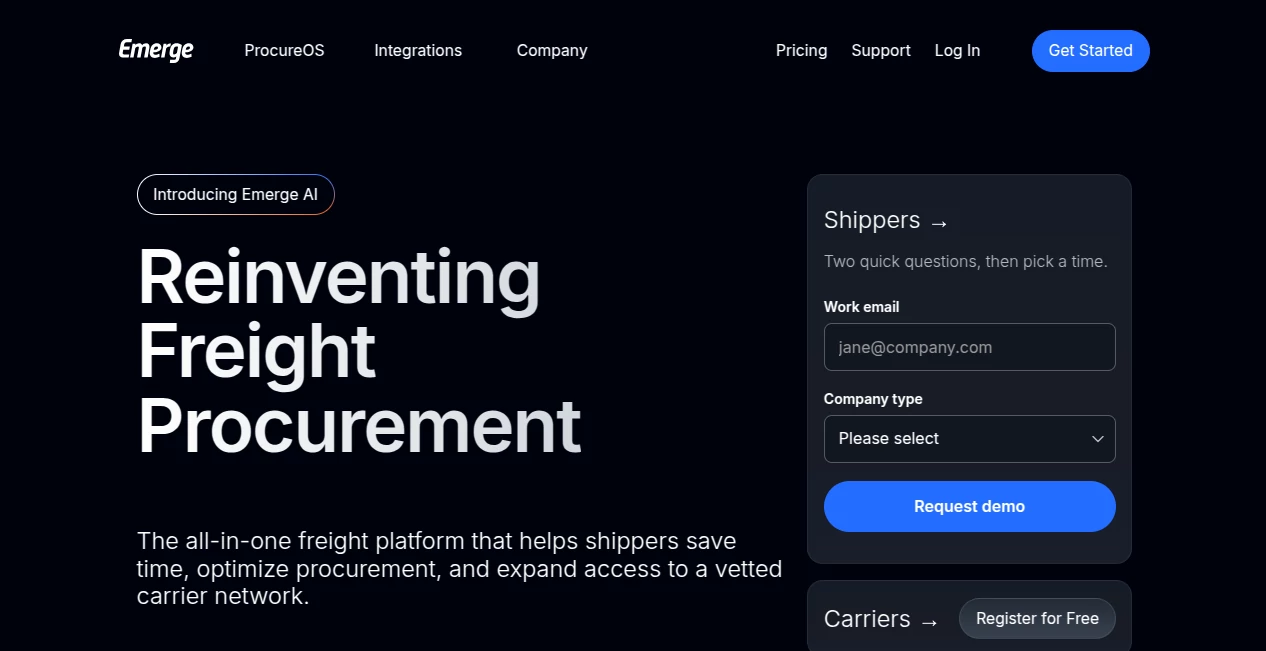
Emerge Market is a modern freight procurement platform built for shippers that want more control over transportation spending, carrier relationships, and procurement decisions. Rather than relying on disconnected spreadsheets, emails, and manual rate comparisons, the platform brings contract procurement, spot procurement, analytics, carrier access, and AI-powered decision support into one environment.
Its approach is particularly useful for companies managing a large number of shipments, lanes, carriers, or procurement events. The platform combines transportation data with practical procurement workflows, helping teams make faster decisions without losing sight of cost, service requirements, or carrier performance.
One of the strongest aspects of the platform is the way its AI capabilities are connected to real procurement tasks. Instead of simply generating recommendations, the system is designed around freight scenarios such as benchmarking rates, evaluating lanes, optimizing spend, and finding suitable carrier capacity.
Key Features
- AI-powered freight procurement and decision support
- Spend optimization and procurement scenario modeling
- Contract and spot freight benchmarking
- Lane intelligence and carrier matching
- Annual RFP and mini-bid management
- Dynamic spot quoting and rate management
- Carrier scorecards and procurement reporting
- Access to a network of pre-vetted carriers
- No-code integrations with transportation systems and data partners
- Support for large-scale transportation programs
User Interface
The platform is designed around the way transportation procurement teams actually work. Procurement activities, carrier interactions, reporting, and analytical tools are organized within a single workspace instead of being scattered across spreadsheets and separate applications.
The interface puts practical information close to the decision point. For example, procurement teams can work with bidding events, compare market information, review carrier responses, and use analytical insights without constantly switching between different systems.
For larger organizations, this unified approach can make everyday workflows easier to follow. The company also provides guided onboarding and dedicated procurement support, which is valuable when a transportation team is moving an established process onto a new platform.
Accuracy & Performance
Accuracy matters greatly in freight procurement because even a small difference in transportation rates can become significant across hundreds or thousands of shipments. The platform uses market and procurement data to support benchmarking, scenario analysis, and carrier selection.
Its AI capabilities can evaluate different procurement scenarios while considering business constraints such as delivery requirements, preferred carriers, and cost targets. This makes the analysis more practical than a simple lowest-price calculation.
Lane Intelligence adds another useful layer by helping match freight with carriers that have experience servicing particular routes. The goal is to balance competitive pricing with realistic carrier availability and lane expertise.
Capabilities
The platform covers several areas of freight procurement. Contract procurement supports annual RFPs and shorter mini-bids, while spot procurement is designed for situations where transportation capacity and market rates can change quickly.
The AI layer adds spend optimization, contract benchmarking, spot benchmarking, and lane intelligence. Teams can build procurement scenarios, examine cost-effective options, identify unfavorable lanes, and use market information to make better-informed decisions.
Another useful capability is dynamic rate management. Rate Pulse provides market insights for competitive spot quotes, while Dynamic Book It Now can support faster rate adjustments and booking decisions. Auto Book Partners can also be configured with eligibility requirements so that only appropriate carrier partners participate in selected opportunities.
For organizations that already have their own technology stack, no-code integrations can connect the procurement environment with transportation management systems, data partners, and other industry services.
Security & Privacy
Security is an important consideration when transportation platforms handle sensitive business and procurement information. The platform states that it is SOC 2 compliant and follows a privacy-first approach.
The company also states that customer company data is not shared with external vendors. Data hosting is available across both United States and European data centers, giving organizations additional flexibility when considering regional data requirements.
Enterprise customers can also benefit from dedicated support, professional services, and an infrastructure designed to handle large transportation programs with hundreds of thousands of shipments and lanes.
Use Cases
Freight Procurement: Transportation teams can manage annual RFPs, mini-bids, carrier responses, awards, and procurement reporting from one environment.
Spot Freight: Companies dealing with changing market conditions can use real-time market insights, competitive quoting, dynamic rate setting, and selective carrier participation to improve spot procurement decisions.
Transportation Spend Optimization: Procurement leaders can model different scenarios and compare potential outcomes based on cost, service requirements, carrier preferences, and other business constraints.
Lane Management: Teams can identify underperforming lanes, benchmark transportation costs, and find carriers with relevant lane experience.
Enterprise Transportation Programs: Large organizations managing extensive shipment volumes can use centralized procurement, analytics, integrations, and dedicated support to manage transportation programs at scale.
Carrier Network Expansion: Shippers can access a network of pre-vetted carriers, while carriers can participate in relevant freight opportunities through the marketplace.
Pros and Cons
- Pros: Combines freight procurement, AI analytics, benchmarking, spot procurement, and carrier access in one platform.
- Pros: AI features are closely connected to real transportation procurement scenarios.
- Pros: Lane Intelligence can help balance carrier expertise, capacity, and pricing.
- Pros: Supports both contract and spot procurement workflows.
- Pros: Designed to support large transportation programs and extensive shipment volumes.
- Pros: SOC 2 compliance, privacy-focused policies, and multi-region hosting.
- Cons: Pricing is customized rather than publicly displayed, so prospective customers need to request a quote.
- Cons: The platform is primarily aimed at professional shippers and transportation teams rather than casual users.
- Cons: Organizations with simple freight requirements may not need the full range of procurement and analytics capabilities.
Pricing Plans
Pricing is customized according to the customer's freight program rather than being based on a simple fixed subscription. The final cost depends on factors such as procurement capabilities, freight volume, freight type, and the level of partnership required.
The platform offers two primary approaches. The Marketplace option combines the procurement platform with access to a network of pre-vetted carriers. The SaaS ProcureOS option allows organizations to use the procurement software with their own carrier network without requiring the marketplace.
Available capabilities can include platform access, spot quoting, dynamic booking, reporting and analytics, annual RFPs, mini-bids, carrier scorecards, AI-powered spend optimization, benchmarking, lane intelligence, integrations, and enterprise-level services.
Because transportation programs vary considerably between organizations, the company provides custom pricing rather than publishing a standard monthly price list. Businesses can request a quote and review the platform through a demo before choosing the appropriate setup.
How to Use the Platform
Start by identifying the part of your freight procurement process that creates the most manual work. This could be annual RFPs, spot quoting, carrier selection, rate benchmarking, or transportation spend analysis.
Next, connect the relevant transportation systems, data sources, or carrier relationships. Organizations can use the platform with their existing carrier network or take advantage of the available marketplace.
For contract procurement, create an RFP or mini-bid, invite the appropriate participants, review responses, and use the available analytics to support award decisions.
For spot procurement, use market information to develop competitive quotes and apply rate or carrier-selection rules before booking freight.
For strategic analysis, use the AI tools to model procurement scenarios, examine unfavorable lanes, benchmark rates, and identify carrier matches that fit specific transportation requirements.
Companies that are new to the platform can also work with the onboarding and procurement support teams to establish an appropriate workflow.
Comparison with Similar Tools
Traditional spreadsheet-based procurement can work for smaller transportation programs, but it becomes increasingly difficult to manage as the number of lanes, carriers, bids, and shipments grows. Manual processes also make it harder to maintain consistent benchmarking and quickly react to market changes.
Basic transportation management systems can provide important operational functionality, but procurement teams may still need additional tools for sophisticated bidding, benchmarking, carrier sourcing, and spend analysis.
This platform takes a broader approach by connecting procurement workflows with market intelligence, AI-driven analysis, carrier access, and transportation data. That makes it particularly interesting for organizations that want procurement and decision-making capabilities to sit closer together rather than operating as separate processes.
Conclusion
Freight procurement is one of those areas where small inefficiencies can become expensive when multiplied across thousands of shipments. The strongest value of this platform comes from bringing procurement workflows, market data, carrier relationships, and AI-assisted analysis into the same environment.
Its combination of contract procurement, spot procurement, benchmarking, spend optimization, and lane intelligence makes it a strong option for companies with meaningful transportation spend and more complex freight operations.
For teams still relying heavily on spreadsheets and email to manage freight procurement, the shift toward a centralized, data-driven workflow could be particularly valuable. The custom pricing model means it is best suited to organizations willing to evaluate the platform against their actual freight program rather than looking for a simple self-service subscription.
Frequently Asked Questions (FAQ)
What is this platform used for?
It is used for freight procurement and transportation spend management. Its capabilities cover contract procurement, spot procurement, carrier management, benchmarking, analytics, and AI-assisted procurement decisions.
Does it provide AI-powered procurement tools?
Yes. The AI capabilities include spend optimization, contract benchmarking, spot benchmarking, and lane intelligence designed specifically for freight procurement scenarios.
Can companies use their own carriers?
Yes. The SaaS option is designed to allow organizations to run procurement across their existing carrier base. Companies can also use the marketplace when they want access to additional pre-vetted carriers.
Does it support spot freight procurement?
Yes. Spot procurement features include market-based quote building, dynamic rate management, and carrier eligibility controls for selected procurement opportunities.
Can it handle large transportation programs?
Yes. The platform states that it supports enterprise customers managing hundreds of thousands of shipments and lanes.
Is the platform secure?
The company states that the platform is SOC 2 compliant, follows a privacy-first approach, and provides data hosting across the United States and Europe.
Is pricing publicly available?
No fixed public pricing is listed. Pricing is customized according to the customer's procurement requirements, freight characteristics, and program size.
Who can benefit most from using it?
It is particularly well suited to shippers, transportation procurement teams, supply chain organizations, and enterprises that manage substantial freight spend or complex carrier networks.
AI Workflow Management , AI Productivity Tools , AI Research Tool , AI Analytics Assistant .
These classifications represent its core capabilities and areas of application. For related tools, explore the linked categories above.

Emerge Alternatives Product

Beamtrace
CartLens

Prelight

TrySchedule

Solovio

AyeWatch AI

YouMind

PDF Inspector

JSON to TOON…