
EMIX API
What is EMIX API?
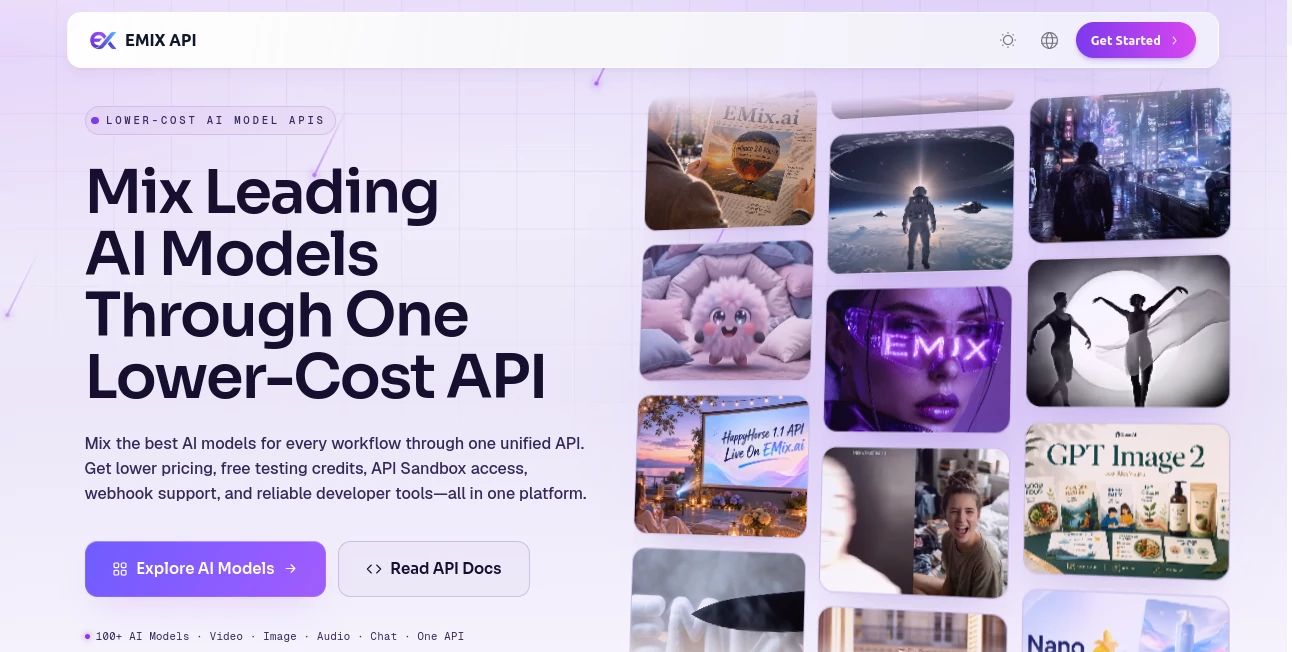
Emix.ai brings a practical solution to one of the more frustrating parts of building AI-powered software: dealing with different models, providers, APIs, pricing systems, and integration methods. Instead of connecting every application to a separate service, developers can access a broad selection of AI models through one unified API.
The platform is designed around more than 100 AI models covering video, image, audio, chat, and other AI capabilities. It also provides free testing credits, an API Sandbox, webhook support, and usage-based pricing, making it useful for developers who want to experiment before committing their application to a production workflow.
For a startup building an AI product, this can make a noticeable difference. Rather than maintaining several integrations just to offer different generation models, a team can work with a consistent API structure and choose the model that best fits each task.
Key Features
- Unified API access to a growing library of AI models
- Support for image, video, audio, chat, and enhancement models
- More than 100 AI models available through the platform
- Usage-based pricing with model-specific rates
- Free API credits for new users
- Built-in API Sandbox for testing endpoints and workflows
- Webhook support for long-running generation tasks
- Polling options for monitoring asynchronous requests
- Failed generation tasks are not charged
- Access to newly released AI models as the model library expands
- Developer-focused API documentation and integration tools
- Support for production-oriented AI workflows
User Interface
The interface is clearly geared toward developers rather than casual AI users. Instead of putting the emphasis on a simple consumer-facing generator, the platform organizes its experience around models, APIs, testing, pricing, and deployment.
The API Sandbox is particularly useful during the early stages of development. A developer can experiment with supported models and evaluate responses before writing a complete production integration. The model marketplace also makes it easier to browse available capabilities and compare costs before selecting an API.
Accuracy & Performance
Performance depends largely on the model selected and the type of generation being requested. The advantage here is choice. Developers are not restricted to a single AI model, so they can select different options for different workloads.
The platform supports asynchronous workflows for media generation, with tasks moving through stages such as queued, running, and completed. Webhook callbacks and polling make it possible to monitor these longer-running operations without constantly keeping an application request open.
For teams testing several models, the ability to compare model pricing and outputs before production deployment can also reduce unnecessary experimentation costs.
Capabilities
The platform covers a surprisingly broad range of AI development requirements. Image APIs can be used for generation and editing, while video APIs support modern text-to-video and image-to-video workflows. Audio capabilities extend the platform into music and voice-related applications, and LLM APIs can support chat, reasoning, coding, and AI agent experiences.
The model library includes well-known options from different AI providers. Developers can therefore build products that combine several types of intelligence without creating an entirely separate integration for every model.
Another useful capability is the pricing comparison system. Current model prices can be reviewed before integration, with costs presented according to the model's billing unit, such as images, video seconds, requests, or tokens.
Security & Privacy
For developers, an important consideration is how an API platform fits into an application's existing security architecture. This service is primarily positioned as an infrastructure and API layer, so teams should review the current documentation and applicable terms before sending sensitive or regulated information through any third-party model endpoint.
API credentials should be stored securely on the server side and never exposed in client-side code. Teams should also evaluate the privacy policies, data handling practices, and individual model requirements that apply to their particular use case.
Use Cases
This platform is a strong fit for developers and businesses building products around generative AI. A startup could use it to power an AI content application while keeping several model options available behind one integration.
It can also be useful for media platforms that need image or video generation, applications that create audio content, AI assistants powered by large language models, and SaaS products that allow users to choose between different generation models.
For example, a developer building a marketing application might use one model for generating product images, another for creating promotional videos, and an LLM for writing campaign copy. Managing these capabilities through a common API layer can make the application's backend easier to organize.
It is also well suited to experimentation. Teams can test a newly released model, compare its output with an existing choice, and decide whether the improvement justifies changing their production workflow.
Pros and Cons
- Pros: One API can provide access to a wide range of AI models and modalities.
- Pros: Free testing credits and an API Sandbox lower the barrier to experimentation.
- Pros: Usage-based pricing makes it possible to pay according to actual model usage.
- Pros: Failed generation tasks do not consume credits.
- Pros: Webhooks and polling are useful for asynchronous image, video, and audio workflows.
- Cons: Developers still need to understand the differences and limitations of individual models.
- Cons: Pricing varies by model and usage type, so estimating costs requires checking the specific endpoint.
- Cons: Teams with highly specialized requirements may still need direct integrations with particular model providers.
Pricing Plans
Rather than relying on a traditional monthly subscription structure, the platform uses usage-based pricing. The cost depends on the model and the type of operation being performed. Depending on the API, billing can be calculated per image, per second of video, per request, or per million tokens.
The pricing model is especially interesting for developers who want to test an idea without immediately committing to a large recurring plan. New users receive free API credits, and the platform provides a Sandbox for evaluating models before moving into production.
Another appealing detail is that failed image, video, audio, or other generation tasks do not consume credits when no successful output is produced. For developers running experiments, this can make repeated testing less expensive and easier to manage.
How to Use It
Getting started is straightforward. First, create an account and use the available free API credits to explore the platform. From there, select a model based on the capability, expected output, and pricing that fit your application.
Next, test the selected endpoint through the API Sandbox. This gives you an opportunity to inspect the request structure and response before connecting it to your own application.
Once the workflow works as expected, integrate the API into your backend using the documented request structure. For longer-running media tasks, configure webhook callbacks or use polling to monitor the task status. Finally, retrieve the generated result and move the tested workflow into production.
Comparison with Similar Tools
AI API platforms generally take different approaches to model access. Some focus heavily on language models, others specialize in image or video generation, while some are built around a single provider's ecosystem.
The main advantage of this platform is its breadth. Developers can work with image, video, audio, chat, and enhancement models from one API environment instead of building every integration independently. This can be particularly valuable for SaaS products where the required AI capability may change as new models appear.
Another point worth considering is cost visibility. Model-specific usage prices allow developers to evaluate the economics of an integration before scaling it. Combined with free credits and non-billed failed generations, this makes the platform particularly attractive for experimentation and early-stage product development.
Conclusion
For developers who are tired of maintaining a collection of separate AI integrations, this platform offers a compelling alternative. Its biggest strength is not a single generation feature but the combination of model variety, a unified API, transparent usage-based pricing, testing tools, and production-oriented workflow support.
The ability to experiment with different image, video, audio, and language models without rebuilding an application's entire integration layer can save both development time and infrastructure effort. Free credits and the API Sandbox make it easier to evaluate the service before making it part of a production stack.
Whether you are prototyping an AI SaaS product, adding generative media to an existing application, or looking for a more flexible way to access multiple AI models, this is a platform worth exploring.
Frequently Asked Questions (FAQ)
What is Emix.ai?
It is a developer-focused AI API platform that provides unified access to a broad selection of image, video, audio, chat, and other AI models through one API.
How many AI models are available?
The platform currently promotes access to more than 100 AI models, with the available model library continuing to expand as new models are introduced.
Does it provide free AI API credits?
Yes. New users receive free API credits that can be used to test supported models. An API Sandbox is also available for experimenting with endpoints and workflows.
How is API usage charged?
Pricing is usage-based and depends on the model and operation. Depending on the service, charges may be calculated per image, per second of video, per request, or per million tokens.
Are failed AI generation requests charged?
No. Failed image, video, audio, or other generation tasks do not consume credits when the task fails and does not produce a successful result.
Can multiple AI models be accessed through one API?
Yes. The platform is specifically designed to provide a unified API experience across multiple AI model categories, allowing developers to work with different models without maintaining a separate integration for each provider.
AI Music Generator , AI Video Generator , AI API Design , AI Developer Tools .
These classifications represent its core capabilities and areas of application. For related tools, explore the linked categories above.

EMIX API Alternatives Product

Toonifyit

Seedance 2.0

Flow Veo 3

VercelAPP

AI Dance Vid…

Video Upscal…
langextract.…

AI ASMR Gene…

MemoTune