


















Etlr
What is Etlr?
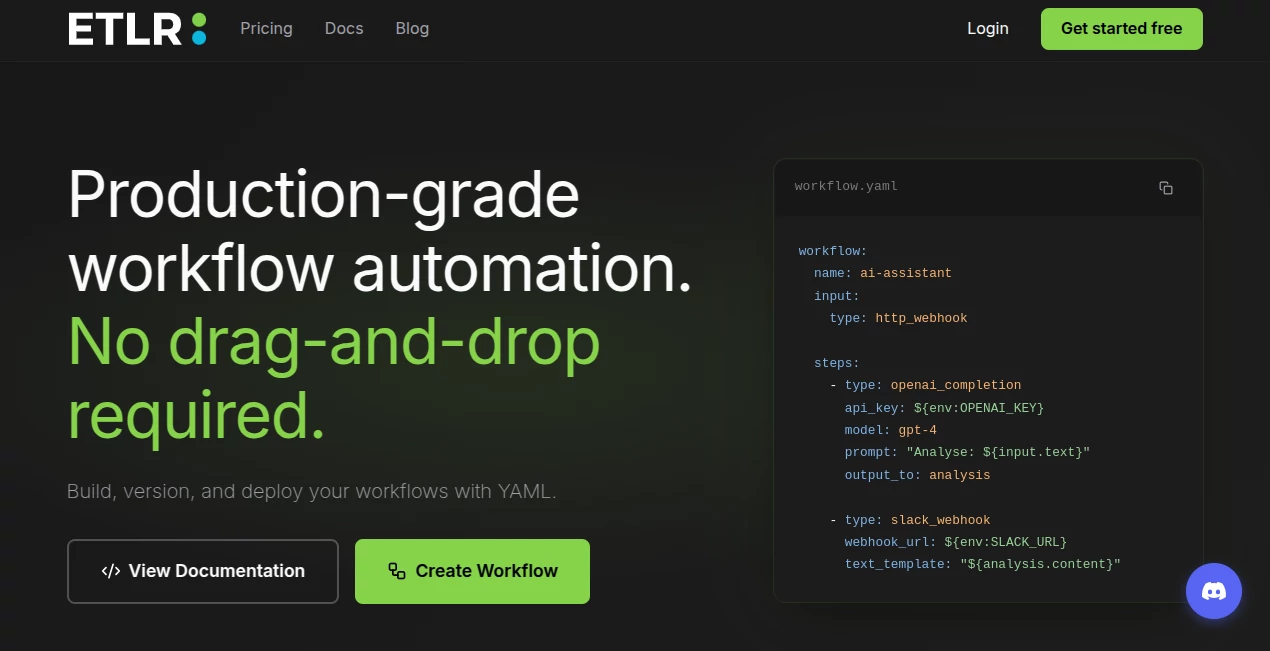
In today’s data-driven world, managing information from multiple sources can quickly become overwhelming. Businesses rely on fast, accurate, and automated data pipelines to stay competitive. This platform steps in as a modern solution designed to simplify data integration, transformation, and workflow automation without the traditional complexity of engineering-heavy ETL systems.
What makes it stand out is its focus on accessibility and speed. Instead of spending days writing scripts or configuring complex infrastructure, users can visually design and deploy data pipelines in a fraction of the time. Whether you're a startup handling early-stage analytics or an enterprise managing large-scale datasets, the platform adapts smoothly to your needs.
Key Features
User Interface
The interface is clean, minimal, and designed for both technical and non-technical users. Drag-and-drop functionality allows users to build workflows visually, reducing the need for deep coding knowledge. Navigation feels intuitive, even when managing complex multi-step pipelines.
Accuracy & Performance
Performance is optimized for handling large datasets with minimal latency. Data transformations are executed efficiently, ensuring that pipelines remain stable even under heavy workloads. The system is designed to reduce errors during transfers and maintain consistency across sources.
Capabilities
This platform supports a wide range of data sources including databases, APIs, cloud storage, and third-party applications. It allows users to extract, transform, and load data seamlessly while offering automation triggers and scheduling options. Real-time processing capabilities also help businesses stay updated with live data flows.
Security & Privacy
Security is treated as a core priority. Data is encrypted both in transit and at rest, ensuring sensitive information remains protected. Role-based access control helps organizations manage permissions effectively, while compliance-ready architecture supports enterprise-grade requirements.
Use Cases
- Building automated data pipelines for business intelligence dashboards
- Integrating multiple SaaS platforms into a unified data warehouse
- Real-time analytics for e-commerce and marketing performance tracking
- Automating reporting workflows for finance and operations teams
- Synchronizing customer data across CRM and internal systems
Pros and Cons
Pros
- Fast and intuitive workflow builder
- Supports multiple data sources and integrations
- Scalable architecture for growing businesses
- Reduces need for manual coding
- Strong focus on automation and scheduling
Cons
- Advanced customization may require technical understanding
- Learning curve for users new to ETL concepts
- Some enterprise features may require higher-tier plans
Pricing Plans
The pricing structure is typically flexible to accommodate different user needs. A free or trial version is often available for testing core features, while paid tiers unlock advanced automation, higher data limits, and enterprise-grade integrations. Businesses can scale their usage based on workload and team size.
How to Use etlr.io
Getting started is straightforward. After signing up, users can create a new project and begin building their first pipeline using a visual editor. Data sources can be connected through built-in connectors, after which transformation steps can be added using simple configuration blocks.
Once the workflow is defined, it can be tested in a sandbox environment before deployment. Scheduling options allow pipelines to run automatically at specific intervals or trigger based on events. Monitoring tools provide insights into execution history and performance.
Comparison with Similar Tools
Compared to traditional ETL solutions, this platform reduces complexity by eliminating heavy setup requirements and infrastructure management. While some older tools focus heavily on engineering teams, this solution is designed for both technical and semi-technical users.
In comparison to modern low-code data platforms, it offers a balanced approach between simplicity and flexibility. Users get enough customization power without being overwhelmed by overly complex configurations. This makes it a strong competitor in the evolving data integration landscape.
Conclusion
For businesses seeking a streamlined way to manage data pipelines, this platform delivers a practical and modern solution. It reduces the friction of traditional ETL processes while still offering powerful capabilities for scaling data operations. Its combination of usability, performance, and flexibility makes it suitable for teams aiming to improve data efficiency without investing heavily in engineering overhead.
Frequently Asked Questions (FAQ)
Is coding required to use this platform?
No, the platform is designed with a visual interface that minimizes the need for coding, although advanced users can extend functionality if needed.
Can it handle large datasets?
Yes, it is built to support scalable data processing and can manage large volumes of information efficiently.
Does it support real-time data processing?
Yes, it includes capabilities for near real-time data synchronization and processing depending on configuration.
Is it suitable for enterprise use?
Yes, with features like encryption, access control, and scalable architecture, it can support enterprise-level requirements.
What types of data sources are supported?
It supports databases, APIs, cloud services, and various third-party applications for flexible integration.
AI No-Code & Low-Code , AI Data Mining , AI API Design , AI Developer Tools .
These classifications represent its core capabilities and areas of application. For related tools, explore the linked categories above.

Etlr Alternatives Product

BootstrapKing

JSON-Tools
HostFinder

Nestify

Emergent

DiRe-RAPIDS

TutuoAI

Claude and C…

Standard Com…