


















FARSEER AI
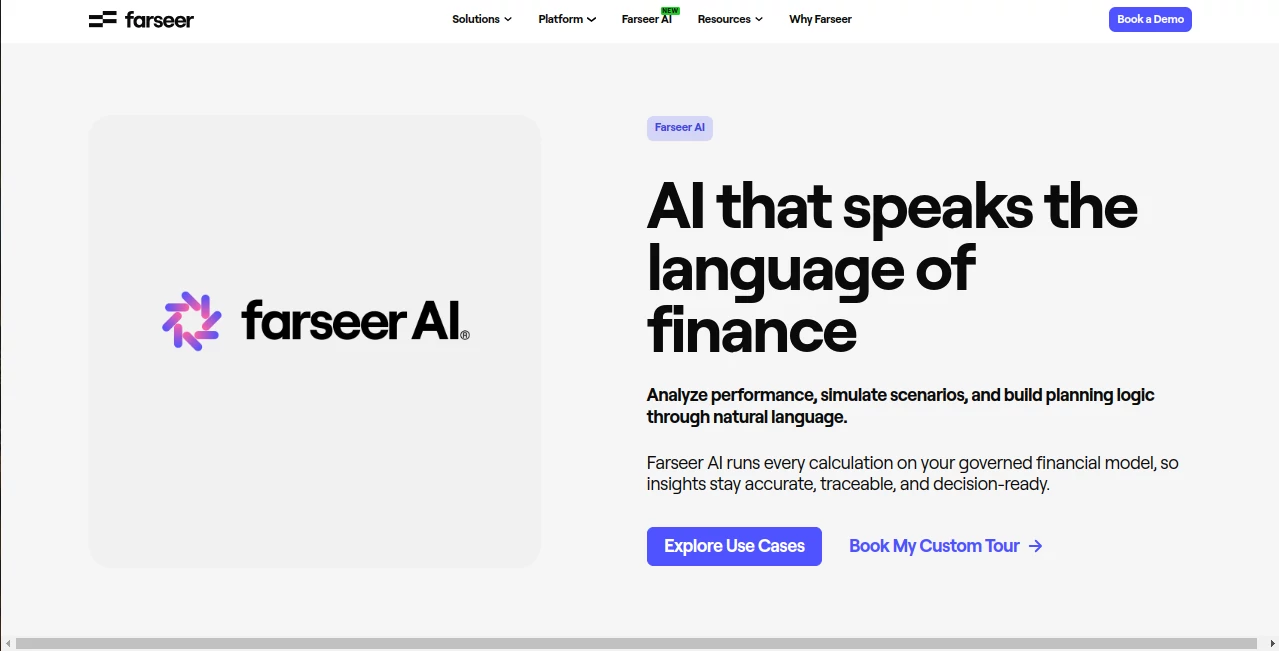
What is FARSEER AI?
FARSEER AI is built for finance teams that need more than a chatbot that can describe numbers. It connects natural-language interaction with a governed financial model, allowing users to ask business questions, investigate performance, test scenarios, and create planning logic without relying on a maze of spreadsheets.
The platform is designed around financial planning and analysis (FP&A). Instead of asking an AI system to guess what a financial figure means, users can work directly with the underlying model, assumptions, drivers, and calculations. This makes the resulting analysis much easier to follow and validate.
For a finance professional who has spent hours opening Excel files just to answer a relatively simple question, the difference can be substantial. A question about revenue, margins, costs, customers, regions, or forecasts can be expressed in plain English and turned into an analysis based on the organization's financial model.
Key Features
- Natural-language financial analysis for business and performance questions.
- Scenario simulation for pricing, costs, demand, revenue, margin, and cash-flow decisions.
- Natural-language creation of financial models, formulas, dimensions, and dashboards.
- Calculations performed on a governed financial model rather than generated as unsupported estimates.
- Traceability from results back to financial assumptions, drivers, formulas, and source data.
- Integration with enterprise systems including ERP, CRM, and other business data sources.
- Support for large financial datasets through the platform's dedicated calculation engine.
- Enterprise security features including single-tenant infrastructure, role-based access controls, audit trails, and ISO/IEC 27001:2022 certification.
User Interface
The experience is centered around natural-language interaction, which makes complex financial analysis feel considerably less technical. Instead of navigating through multiple spreadsheets or manually constructing calculations, finance users can describe what they want to understand and let the system translate the request into operations on the financial model.
The wider platform also includes spreadsheet-style Sheets and interactive dashboards. This combination is useful for teams that still appreciate the familiarity of a spreadsheet but want their data, calculations, reporting, and planning processes connected in one environment.
The interface is particularly suited to finance professionals rather than casual AI users. Its value becomes clearer when working with budgets, forecasts, profitability, financial drivers, and enterprise reporting.
Accuracy & Performance
One of the most important design choices is the separation between language processing and financial calculation. The AI translates a user's question into commands, while the dedicated calculation engine performs the financial mathematics. This approach is intended to reduce the risk of an AI model producing a convincing but incorrect calculation.
The platform states that calculations run against governed financial models, allowing results to be traced to real assumptions, drivers, and formulas. Its calculation engine is also designed to process millions of rows and support large-scale scenario simulations.
That distinction matters in finance. A useful answer is not simply one that sounds reasonable; it needs to be connected to the same logic and data that the finance team uses for planning and reporting.
Capabilities
The platform brings together three main AI capabilities for different stages of the FP&A process. The Analyst focuses on investigating financial performance and explaining the factors behind changes in revenue, costs, margins, and other business metrics.
The Strategist is designed for what-if analysis. Finance teams can explore questions such as what could happen if prices increase, costs rise, demand changes, or another operational assumption moves. The system can evaluate how several drivers interact across revenue, margin, and cash flow.
The Modeler takes a different approach by helping users create planning structures through natural language. Business logic can be described in ordinary language and translated into structured models, formulas, dimensions, and dashboards.
Together, these capabilities cover analysis, decision simulation, and model creation rather than treating AI as a standalone question-and-answer tool.
Security & Privacy
Financial information requires a higher standard of protection than ordinary business data. The platform uses a single-tenant architecture, meaning each customer operates in an isolated environment with dedicated infrastructure and databases.
Its security documentation states that the service is hosted on Google Cloud's Belgium region, follows GDPR requirements, and is ISO/IEC 27001:2022 certified. Role-based access controls govern what users and the AI can access, while model changes are recorded through audit trails.
For AI interactions, the platform states that its language-model component is used to translate natural-language requests into commands, while financial calculations remain within its own calculation infrastructure. It also states that customer data is not used to train OpenAI models.
Use Cases
Financial forecasting: Finance teams can use natural-language questions to investigate forecasts and work with historical and current financial data without manually assembling every analysis.
Scenario planning: A finance manager can explore the potential effect of changing prices, operating costs, demand, or other drivers before making a decision that affects the P&L.
Variance analysis: Teams can investigate differences between actual results, budgets, forecasts, and previous periods while identifying the operational drivers behind those changes.
Profitability analysis: Businesses can examine performance across products, customers, entities, or regions to understand where revenue and margin changes are coming from.
Financial model creation: FP&A professionals can describe the business logic they need and use natural language to accelerate the creation of planning models and calculations.
Management reporting: Interactive dashboards and model-connected reporting can provide leadership with more current information than static presentations assembled from separate files.
Enterprise planning: Organizations can connect financial and operational data from systems such as SAP, Oracle, Microsoft Dynamics, NetSuite, Workday, and data warehouses to support a connected planning environment.
Pros and Cons
Pros
- Designed specifically around financial planning and analysis rather than generic AI conversations.
- Financial calculations are performed by a dedicated calculation engine.
- Natural-language interaction makes complex financial questions easier to formulate.
- Strong emphasis on traceability and governed financial models.
- Supports scenario analysis across revenue, margin, costs, and cash flow.
- Combines AI, modeling, dashboards, data integration, and reporting in one platform.
- Enterprise-focused security and isolated customer environments.
Cons
- The platform is primarily aimed at enterprise finance teams, so it may be excessive for a freelancer or small business looking for a simple budgeting tool.
- Getting the full benefit requires a structured financial model and connected business data.
- The pricing structure is not presented as a simple public self-service subscription.
- Users looking only for basic spreadsheet calculations may not need such a broad FP&A platform.
Pricing Plans
Pricing is not presented as a standard public monthly or annual plan on the product website. The company instead encourages organizations to request a customized platform tour and discuss their requirements with its team.
This approach is consistent with the product's enterprise focus. Implementation can involve connecting ERP and CRM systems, structuring financial data, configuring planning models, and adapting workflows to an organization's requirements. Companies evaluating the platform should therefore contact the provider for pricing based on their specific environment and needs.
How to Use It
- Connect the relevant financial and operational data sources to the platform.
- Establish the governed financial model that will serve as the source of truth.
- Use natural-language questions to investigate performance, profitability, costs, revenue, or other financial metrics.
- Ask what-if questions when evaluating potential business decisions and compare the resulting scenarios.
- Use the modeling capabilities to create or extend planning logic through natural-language descriptions.
- Review the calculations, assumptions, and underlying drivers behind the results before using them in a business decision.
- Use dashboards and reporting features to share current financial insights with relevant teams and decision-makers.
Comparison with Similar Tools
Traditional spreadsheet-based planning gives finance teams considerable flexibility, but it can become difficult to maintain when data, formulas, versions, and contributors multiply. Generic AI assistants can make questions easier to ask, but they are not necessarily connected to the company's governed financial model.
This platform takes a more specialized approach. Its AI layer is positioned as an interface to a financial planning environment rather than a replacement for the underlying finance system. The calculation engine handles the mathematics, while the AI helps users communicate with and explore the model.
Compared with conventional FP&A software, the natural-language layer is one of the more distinctive elements. Compared with general-purpose AI, the stronger focus on traceability, financial logic, scenario modeling, and enterprise data makes it more relevant to CFOs, controllers, FP&A managers, and larger finance organizations.
Conclusion
For finance teams that have outgrown disconnected spreadsheets but still need the flexibility of interactive modeling, this platform offers an appealing middle ground between traditional FP&A software and general-purpose AI.
Its strongest idea is simple: financial AI should understand the model behind the numbers, not merely generate a response about them. By combining natural-language analysis with governed calculations, scenario simulation, financial modeling, dashboards, and enterprise integrations, it gives finance professionals a practical way to bring AI into everyday planning and decision-making.
It is not intended to replace every finance system or eliminate human judgment. Instead, it can reduce the repetitive work surrounding analysis and planning, giving finance teams more time to investigate what the numbers actually mean and decide what to do next.
Frequently Asked Questions (FAQ)
What is this AI financial planning platform used for?
It is designed for financial planning and analysis, including forecasting, performance analysis, scenario planning, financial modeling, profitability analysis, and reporting.
Can I ask financial questions using natural language?
Yes. Users can ask business and financial questions in natural language. The system translates those questions into calculations and analysis performed against the governed financial model.
Can it simulate financial scenarios?
Yes. Scenario simulation can be used to examine potential changes such as pricing adjustments, cost increases, demand shifts, and other operational decisions and see how they could affect revenue, margin, and cash flow.
Can it create financial models?
Yes. The Modeler capability can translate descriptions of business logic into structured planning models, formulas, dimensions, and dashboards.
Does it replace an ERP?
No. The platform is designed to sit above source systems and use data from ERP, CRM, HRIS, and other systems for planning, forecasting, reporting, and analysis.
How does it reduce the risk of incorrect AI calculations?
The language model does not perform the core financial mathematics. Natural-language requests are translated into commands that are executed by the dedicated calculation engine against the governed financial model. This allows results to remain connected to the formulas, assumptions, and drivers used by the organization.
Is the platform suitable for enterprise organizations?
Yes. Its feature set is strongly oriented toward enterprise finance teams, with integrations, large-scale data processing, single-tenant architecture, role-based permissions, audit trails, and ISO/IEC 27001:2022 certification.
Is pricing publicly available?
No standard self-service pricing is displayed on the product page. Organizations are encouraged to request a customized tour and discuss their requirements with the provider.
Who would benefit most from using it?
CFOs, FP&A managers, controllers, financial analysts, and enterprise finance teams that need faster forecasting, scenario planning, reporting, and analysis are the primary audience.
Can it work with existing business systems?
Yes. The platform supports integrations with major enterprise systems and data sources, including SAP, Oracle, Microsoft Dynamics, NetSuite, Workday, Snowflake, and BigQuery, with APIs available for additional systems.
AI Accounting Assistant , AI Research Tool , AI Analytics Assistant , AI Spreadsheet .
These classifications represent its core capabilities and areas of application. For related tools, explore the linked categories above.

FARSEER AI Alternatives Product

LocalRAG!

Lebesgue: AI…

ChirpyPet

GEO Checker

Roipad

Debate Tello…

Flyback.ai

Kimi K2.5

zGEO Ranker
