


















GeoRankers
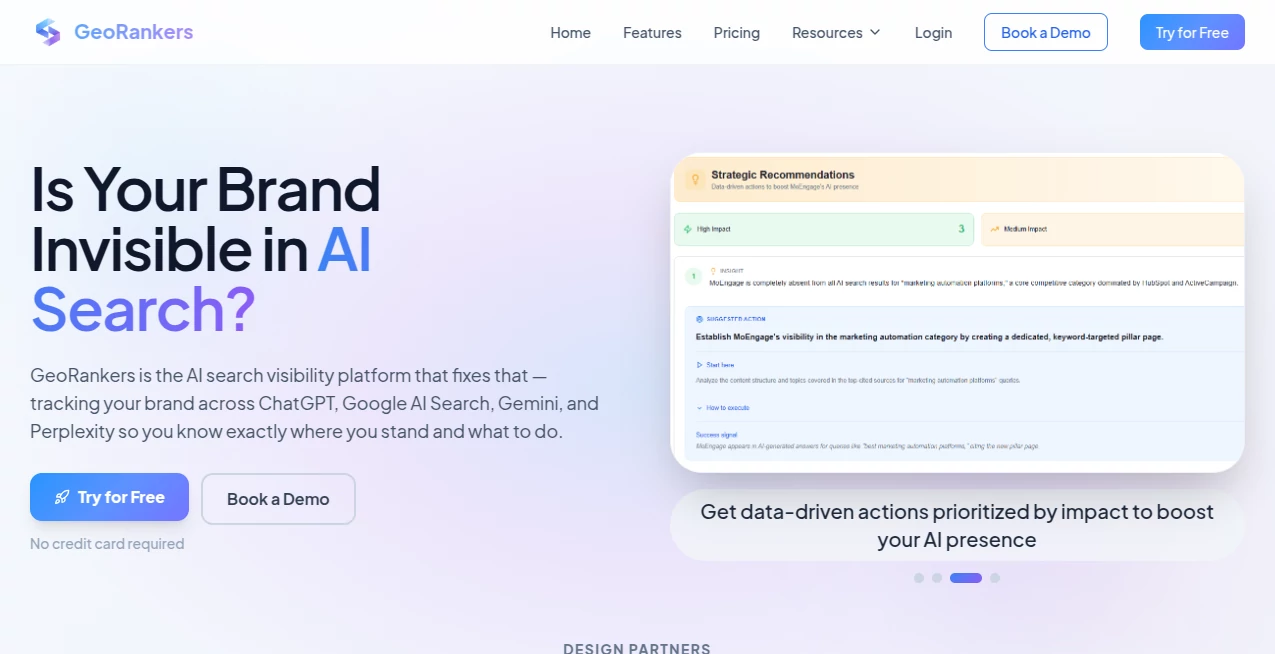
What is GeoRankers?
AI search is changing the way people discover software, services, and brands. Instead of opening several search results and comparing pages manually, buyers can now ask ChatGPT, Gemini, Perplexity, and other AI systems for recommendations, comparisons, and shortlists. That creates a new challenge for businesses: it is no longer enough to rank well in traditional search. A brand also needs to understand how AI systems describe, mention, compare, and recommend it.
This platform is designed around that problem. It gives B2B and SaaS teams a practical way to measure their visibility inside AI-generated answers, understand where competitors are appearing, identify important gaps, and turn those findings into actions. Rather than treating AI visibility as an abstract marketing idea, it presents it as something that can be monitored and improved over time.
Key Features
- AI visibility tracking across major AI search and assistant platforms.
- Analysis of AI-generated answers based on buyer-focused prompts.
- Brand mention and sentiment monitoring.
- Competitor tracking and competitive visibility analysis.
- Keyword and prompt recommendations.
- Source and citation tracking to understand where AI answers get their information.
- Visibility trends that help teams compare performance over time.
- AI-powered recommendations for improving search visibility.
- AI readiness checking for identifying areas that may affect how a brand is understood by AI systems.
- GEO Agent assistance for exploring AI visibility data and possible actions.
- Report exporting for sharing insights with marketing and business teams.
User Interface
The interface is built around the information marketers actually need when investigating AI visibility. Instead of forcing users to interpret a large collection of disconnected metrics, the platform organizes visibility, mentions, competitors, prompts, sources, recommendations, and trends into a central workspace.
This makes the workflow easier to follow. A marketer can move from discovering a visibility problem to investigating the prompts behind it and then reviewing recommended actions. For teams that regularly report search performance to clients or executives, having these elements in one place can save a considerable amount of manual work.
Accuracy & Performance
One of the strongest aspects of the platform is its focus on actual AI-generated responses rather than simply estimating what an AI model might say. It models buyer-oriented queries, captures responses from supported AI platforms, and analyzes how brands appear within those answers.
The results can include visibility scores, mentions, sentiment, rankings, prompts, and cited sources. This gives teams a more useful picture than a simple yes-or-no check of whether a company was mentioned. AI recommendations can then help turn the findings into practical optimization tasks.
Capabilities
The platform is particularly useful for understanding the difference between being mentioned and being recommended. A company may appear in an AI answer without being presented as the strongest option. Looking at competitors, sentiment, citations, and the context around mentions provides a more complete view of how AI systems perceive a brand.
Its broader intelligence workflow follows a clear path: model realistic queries, capture AI responses, interpret the signals, identify gaps, and recommend actions. That approach makes it useful not only for SEO specialists but also for founders, content teams, demand-generation marketers, and agencies working with B2B brands.
Security & Privacy
Privacy matters when a platform is used for business intelligence. The service terms state that customer data is not sold to third parties. The platform is intended for lawful internal business use, with access provided through subscription plans.
Businesses should still review the current terms and internal data policies before entering confidential or sensitive information. As with any cloud-based marketing platform, responsible account management and careful handling of proprietary information remain important.
Use Cases
For a SaaS company, one useful starting point is to investigate what happens when potential customers ask AI assistants for the best products in a particular category. The platform can reveal whether the brand appears, which competitors are mentioned more often, and which sources influence those answers.
Marketing teams can also use the data when planning content. If competitors repeatedly appear in AI answers because of particular comparisons, reviews, documentation, or industry resources, those patterns can highlight areas worth investigating.
Agencies have another strong use case. Instead of manually asking AI assistants dozens of questions for every client, they can use structured visibility data to build a repeatable monitoring process and identify changes over time.
Founders and product marketers can benefit as well. Sometimes the problem is not lack of online presence but unclear positioning. If AI systems consistently misunderstand a product or associate it with the wrong category, the resulting insights can help the team improve its messaging and supporting content.
Pros and Cons
- Pros: Focused specifically on AI search visibility rather than traditional rankings alone.
- Pros: Tracks major AI platforms and provides a centralized visibility dashboard.
- Pros: Combines competitor tracking, source analysis, mentions, sentiment, and recommendations.
- Pros: Useful for B2B SaaS companies, marketing teams, founders, and agencies.
- Pros: Includes a GEO-focused AI assistant for exploring insights and possible actions.
- Cons: The most advanced capabilities are aimed at businesses with ongoing AI visibility monitoring needs.
- Cons: Higher-volume teams may need a larger plan as their number of tracked answers, competitors, seats, and analyses grows.
- Cons: Some integrations listed on higher plans are currently marked as roadmap features.
Pricing Plans
A seven-day free trial is available without requiring a credit card. The Launch plan starts at $41 per month when billed quarterly and includes more than 450 AI answers analyzed, tracking for five competitors, one seat, weekly scheduled runs, keyword recommendations, historical runs, visibility trends, and access to the GEO Agent.
The Grow plan costs $129 per month when billed quarterly. It increases the analysis allowance to more than 1,100 AI answers, supports up to ten competitors and three seats, and provides additional scheduled and on-demand runs along with broader reporting capabilities.
Enterprise pricing is customized for organizations with larger requirements. It includes custom analysis volumes, competitor tracking, seats, scheduling, history, GEO Agent usage, an agent-ready MCP-compatible API, faster support, and a dedicated account manager.
For agencies managing several clients, dedicated agency pricing is also available, with volume discounts, multi-client dashboards, white-label reporting, and dedicated account management.
How to Use It
- Create an account and start the available trial.
- Add your website and provide the information required for the first analysis.
- Define the competitors and keywords or prompts you want to monitor.
- Run an analysis to see how AI platforms present your brand.
- Review visibility, mentions, sentiment, prompts, competitors, and cited sources.
- Use the recommendations to identify content, positioning, or authority gaps.
- Repeat analyses regularly to monitor changes and measure progress.
Comparison with Similar Tools
Traditional SEO platforms are excellent for tracking search rankings, backlinks, technical issues, and organic traffic. AI visibility platforms address a different layer of discovery. Instead of asking only where a webpage ranks, they ask whether an AI system includes a brand in an answer, how it describes the company, which competitors it recommends, and which sources appear to influence the response.
This makes the platform a useful complement to traditional SEO software rather than a direct replacement for every SEO function. A modern marketing team can use conventional SEO data to understand search performance while using AI visibility intelligence to understand what happens when the same buying journey moves into conversational search.
The distinction becomes especially important for SaaS categories where customers frequently ask AI assistants to compare products. In those situations, being visible in an AI-generated shortlist can influence consideration before a prospect ever reaches a traditional search results page.
Conclusion
AI search is becoming an important part of the discovery process, and businesses need better ways to understand what happens after a customer asks an AI assistant for a recommendation. This platform provides a focused environment for measuring that visibility and connecting the results to practical marketing actions.
Its combination of AI answer monitoring, competitor intelligence, source tracking, sentiment analysis, recommendations, and GEO-focused assistance makes it particularly relevant to B2B SaaS companies that want to understand how AI systems perceive their brand. For teams already investing in SEO and content but looking for a clearer picture of their presence in AI-generated answers, it offers a compelling additional layer of search intelligence.
Frequently Asked Questions (FAQ)
What does this platform do?
It measures how brands, products, and content appear in AI-generated search answers and helps businesses identify ways to improve their visibility.
Which AI platforms can be tracked?
The current platform supports analysis across ChatGPT, Google AI Search, Gemini, and Perplexity, with the exact availability depending on the plan and analysis configuration.
Is it useful for traditional SEO?
It is primarily focused on AI search visibility and GEO rather than replacing traditional SEO software. It can complement conventional SEO workflows by showing how a brand appears inside AI-generated answers.
Can competitors be tracked?
Yes. Competitor tracking is included in the platform, with the number of competitors depending on the selected plan.
Does it provide recommendations?
Yes. The platform analyzes visibility signals and provides recommendations intended to help teams identify gaps and prioritize actions that may improve their presence in AI search.
Is there a free trial?
Yes. A seven-day free trial is currently available without requiring a credit card.
Who can benefit most from it?
B2B SaaS companies, marketing teams, SEO and GEO specialists, product marketers, founders, and agencies can all benefit from monitoring how AI systems discover and recommend their brands.
AI SEO Assistant , AI Research Tool , AI Analytics Assistant .
These classifications represent its core capabilities and areas of application. For related tools, explore the linked categories above.

GeoRankers Alternatives Product

The #1 Compa…

Ecom Tool AI

Greek Numero…

Fig0

Goodnotes

Geoleaper

Domain Rank …

Semantic SEO…

Arobis AI Vi…
