
GMCFix.com
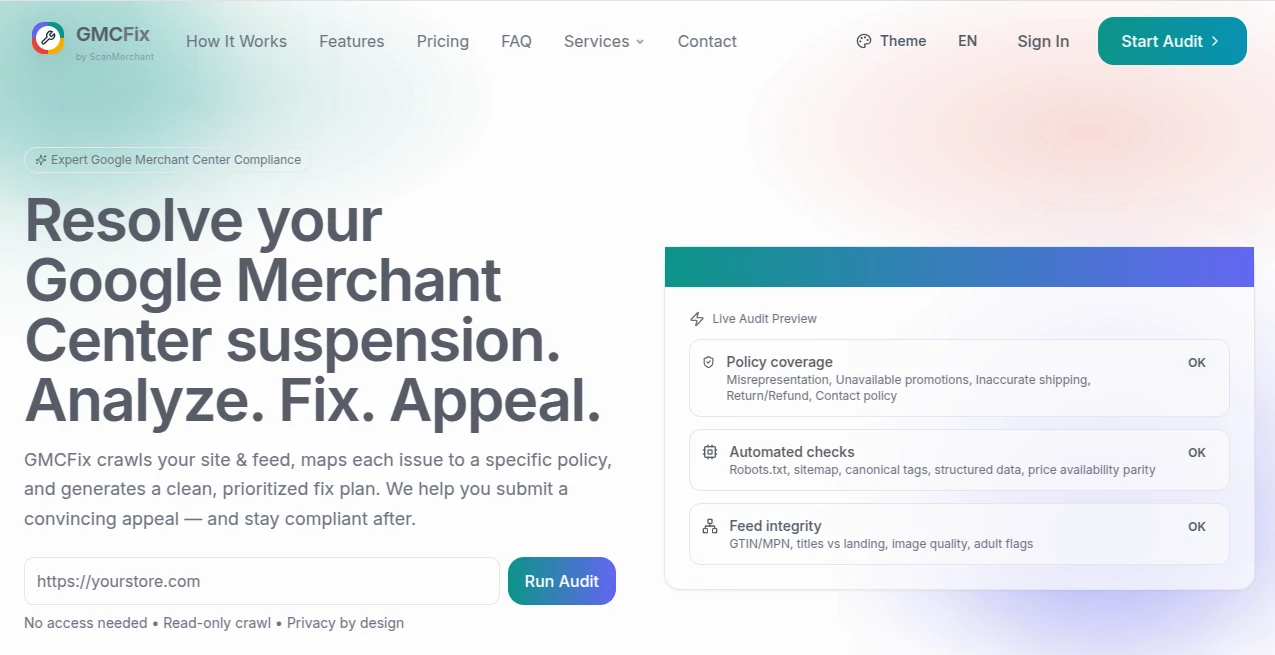
What is GMCFix.com?
Getting suspended from Google Merchant Center is one of the most frustrating things that can happen to an e-commerce store. Your products disappear from Google Shopping overnight, revenue drops, and the email you receive from Google is almost deliberately vague — "misrepresentation," "policy violation," "inaccurate product data." No specifics. No clear path forward. Just a suspension and a clock ticking on your revenue.
Most merchants respond by guessing. They change a few things, submit an appeal, get rejected, and repeat the cycle for weeks. Some hire consultants who charge thousands of dollars for advice that turns out to be generic. Others simply give up on Google Shopping entirely.
There's a better way. This AI-powered compliance audit platform was built specifically for Google Merchant Center reinstatement — not as a side feature, but as the entire product. It crawls your store and your product feed, maps every issue to a specific Google policy, and produces a clean, prioritized fix plan you can actually act on. Trusted by over 20 stores with a 4.9/5 rating, and delivering results within 24 hours.
Key Features
User Interface
The experience is deliberately straightforward. You start an audit without adding anyone to your Merchant Center account — the crawler operates in read-only mode, which means no permissions headaches and no security concerns about handing over access to a third party. For merchants who've already had their trust in the system shaken by a suspension, this matters more than it might seem.
The audit dashboard is structured around action, not information overload. Each finding is grouped by violation type, linked to the specific URL where the problem was detected, and paired with a screenshot as evidence. There's no ambiguity about where to look or what to fix. The language throughout is plain English — or German, Spanish, Italian, or French if you prefer — not Google policy citations that require a legal degree to parse.
Accuracy & Performance
The core audit engine runs automated checks across several categories simultaneously: robots.txt and sitemap configuration, canonical tags, structured data validity, price and availability parity between your site and your product feed, GTIN and MPN accuracy, image quality flags, return and refund policy completeness, contact information visibility, and shipping accuracy. That's a broad surface area, and covering it manually would take days.
What makes the approach particularly effective is the feed-to-site parity checking. One of the most common suspension triggers — price mismatches between your product feed and your live site — is easy to miss when you're managing hundreds of products. The platform catches these automatically. One merchant quoted on the site found three price mismatches they had completely overlooked; their appeal went through on the first submission.
Delivery is within 24 hours for all plans, with a standard one-business-day turnaround for Basic users and two-day delivery for Max and Plus plans.
Capabilities
The platform covers more than ten suspension types, with particular depth around misrepresentation — the most common and most confusing suspension reason Google issues. This category includes unclear business information, fake scarcity messaging, conflicting policies across different pages, and price discrepancies. Each of these is checked explicitly, not inferred from a general scan.
- Policy-aligned violation reports: Every issue is mapped to a specific Google policy with proof and exact remediation steps. You know not just that something is wrong, but which rule it violates and how to fix it.
- Edit-ready content templates: The fix list includes plug-and-play drafts for refund policies, contact pages, shipping information, and product-level copy — not instructions to "update your policies," but actual text you can paste in and adjust.
- Reinstatement appeal support: Beyond the fix list, the service prepares an appeal package and advises on timing, evidence, and sequencing to avoid common rejection patterns. Getting the fixes right is only half the battle — framing the appeal correctly matters too.
- Multilanguage support: Policy drafts and interface elements are available in English, German, Spanish, Italian, and French, which is genuinely useful for merchants operating in European markets where Google's policies interact with local consumer protection requirements.
- Enterprise-level scanning: The Plus plan extends to 5,000 URLs and adds SSL certificate verification, server error detection, malware security scanning, and GMC-to-website data matching — the kind of technical depth that large catalog stores actually need.
Security & Privacy
The read-only crawl approach is the foundation of the privacy model. No Merchant Center access is required at any point in the process — the crawler works entirely from your public-facing store and product feed URLs. This means your Google account credentials, your ad spend data, and your internal account structure stay completely private.
The service is operated by Online Mega Stores, a registered company in Poland (VAT: PL9571022554), and is explicitly independent from Google LLC. That independence is worth stating clearly: this is a third-party compliance analysis service, not an official Google partner program, which means the analysis is based on documented policy knowledge rather than any special relationship with Google's review teams.
Use Cases
The most direct use case is obvious: you've received a suspension notice and you need to understand what's actually wrong before you waste time on a rejected appeal. But there are several other scenarios where this kind of audit is genuinely valuable.
- Post-suspension reinstatement: The primary scenario. You've been suspended, Google's email is vague, and you need a concrete fix list before submitting an appeal. This is what the service was built for.
- Pre-launch compliance check: New stores setting up Google Shopping for the first time can run an audit before submitting their account for review, catching policy issues before they trigger a suspension.
- Feed parity maintenance: Established merchants who've updated pricing, changed return policies, or switched fulfillment providers can use an audit to verify their feed and site are still in sync before problems surface.
- Multi-market expansion: Merchants expanding into European markets can use the multilanguage policy templates to ensure their localized stores meet regional requirements without starting from scratch on compliance documentation.
- Agency and freelance use: E-commerce consultants and digital marketing agencies managing Google Shopping for clients have an affiliate program available, making this a service that can be added to existing client engagements.
Pros and Cons
What works in its favor:
- No Merchant Center access required — the read-only crawl model removes a significant trust barrier
- One-time payment with no subscriptions — you pay for what you need, when you need it
- Coverage of 10+ suspension types with specific policy mapping, not generic advice
- Edit-ready content templates that save hours of writing compliance copy from scratch
- 24-hour delivery is a meaningful commitment for merchants losing revenue by the day
- Multilanguage support for European markets is a genuine differentiator
- The combination of AI analysis and human expert review reduces the false positive rate that pure automation tools often suffer from
Points to consider:
- No reinstatement guarantee — the service produces the best possible fix plan and appeal package, but final decisions rest with Google's review team
- The Basic plan is capped at 100 URLs, which may be limiting for stores with large collections or blog content that affects compliance signals
- Results are delivered asynchronously rather than in real-time, so there's a waiting period between starting the audit and receiving your fix list
- Not suitable for suspensions caused by issues outside the platform's scope, such as payment disputes or trademark violations
Pricing Plans
All plans are one-time payments with no recurring fees — a pricing model that makes sense for a service you need when something goes wrong, not on a monthly basis.
- Basic — $49 (originally $99): Covers stores with up to 100 pages. Includes the full violation report, exact website and GMC setting instructions, one-business-day delivery, standard support, and PDF and CSV downloads. The right starting point for most small to mid-sized stores.
- Max — $99 (originally $199): Everything in Basic, extended to 500 URLs, with two-day delivery and priority support. Suitable for medium-sized stores with larger product catalogs or multiple collection pages.
- Plus — $399 (originally $599): The enterprise option, covering up to 5,000 URLs. Adds generic and dysfunctional page scanning, SSL certificate verification, server error detection, malware security scanning, GMC-to-website data matching, and dedicated support. Built for large stores where surface-level checks aren't enough.
For the size of problem being solved — a suspension that can cost thousands in lost revenue per day — the pricing is modest. Even the Plus plan at $399 pays for itself within hours of reinstatement for any meaningful volume store.
How to Use GMCFix
The process is built around three stages, and none of them require you to hand over account access:
- Step 1 — Start the audit: Enter your store URL and product feed. The crawler begins mapping your site and flagging policy violations with exact URLs and screenshots. No Merchant Center credentials are needed at this stage or any other.
- Step 2 — Receive your fix list: Within 24 hours (one business day for Basic, two days for Max and Plus), you receive a detailed violation report with edit-ready content templates for policies, product descriptions, and GMC settings. Each fix is tied to a specific policy violation with evidence.
- Step 3 — Implement and appeal: Apply the fixes to your store and feed. The service then prepares your reinstatement appeal package and advises on timing and sequencing — because submitting an appeal before all fixes are properly indexed can result in a quick rejection even if everything is technically correct.
Merchants who follow all three stages and implement the fixes completely report reinstatement times ranging from 72 hours to one week, depending on Google's review queue and the severity of the original suspension.
Comparison with Similar Tools
The market for Google Merchant Center help broadly falls into three categories: general e-commerce consultants, Google's own support resources, and specialized tools like this one.
General consultants can be effective, but the cost is high, turnaround is slow, and quality varies significantly. Many charge $500 to $2,000 for advice that amounts to reading the same Google policy documentation you already have access to. The one-time audit pricing here is a fraction of that, with faster delivery and a more structured output.
Google's own support is notoriously difficult to reach for standard merchant accounts, and the guidance provided is often circular — pointing back to policy pages that don't explain what specifically triggered the suspension in your case.
Other automated tools in the compliance space tend to focus on either feed management (Feedonomics, DataFeedWatch) or general technical SEO auditing (Screaming Frog, Semrush). None of these are built around the specific logic of Google Merchant Center policy compliance. They'll tell you about missing alt tags and slow page speed, but they won't map your return policy language to a specific misrepresentation flag or identify that your shipping table conflicts with your feed's handling time values.
The combination of policy-specific coverage, feed-to-site parity checking, and reinstatement appeal support in a single, affordable package is genuinely difficult to find elsewhere.
Conclusion
A Google Merchant Center suspension isn't just a technical problem — it's a revenue problem, often an urgent one. The tools merchants typically turn to weren't built for it, and the advice available is often expensive, generic, and slow.
This platform was built specifically for this problem and nothing else. The read-only crawl model, the policy-specific violation mapping, the edit-ready templates, and the appeal package support represent a genuinely more systematic approach than anything else available at this price point. The 4.9/5 rating across 20+ stores suggests the approach works in practice, not just in theory.
If your store is suspended and you're trying to figure out what actually went wrong, starting with a thorough audit before submitting another appeal is the right move. And if you're not suspended yet — checking your feed-to-site parity and policy completeness before a problem surfaces is the kind of maintenance that prevents the worst-case scenario entirely.
Frequently Asked Questions (FAQ)
Do you need access to my Google Merchant Center account?
No. The entire audit runs on a read-only crawl of your public-facing store and product feed. You don't need to add anyone to your GMC account at any point in the process.
Can reinstatement be guaranteed?
No service can guarantee reinstatement — final decisions are made by Google's review team, not by any third party. What the audit guarantees is a thorough, policy-aligned fix list and a well-structured appeal package that gives you the best realistic chance of success.
How long does the audit take?
Standard delivery is within one business day for Basic plan users, and two days for Max and Plus plans. All plans have a 24-hour delivery target.
What suspension types are covered?
More than ten suspension types are covered, with particular depth on misrepresentation — the most common category. This includes unclear business information, fake scarcity messaging, conflicting policies, and price discrepancies between your site and feed.
Is this an official Google service?
No. This is an independent compliance analysis service with no affiliation to Google LLC or Alphabet Inc. Google and Google Merchant Center are trademarks of Google LLC.
What languages are supported?
The platform and policy templates are available in English, German, Spanish, Italian, and French.
Is there an affiliate program?
Yes. Agencies and consultants managing Google Shopping accounts for clients can join the affiliate program — details are available on the website.
AI SEO Assistant , AI Research Tool , AI Analytics Assistant , AI E-commerce Assistant .
These classifications represent its core capabilities and areas of application. For related tools, explore the linked categories above.

GMCFix.com Alternatives Product

ModelsLab

Empiriolabs …

Sourcetable

Serplux

Jasper

RankPeak

Roipad

Sellerview.ai

AiDisco