


















Haystack
What is Haystack?
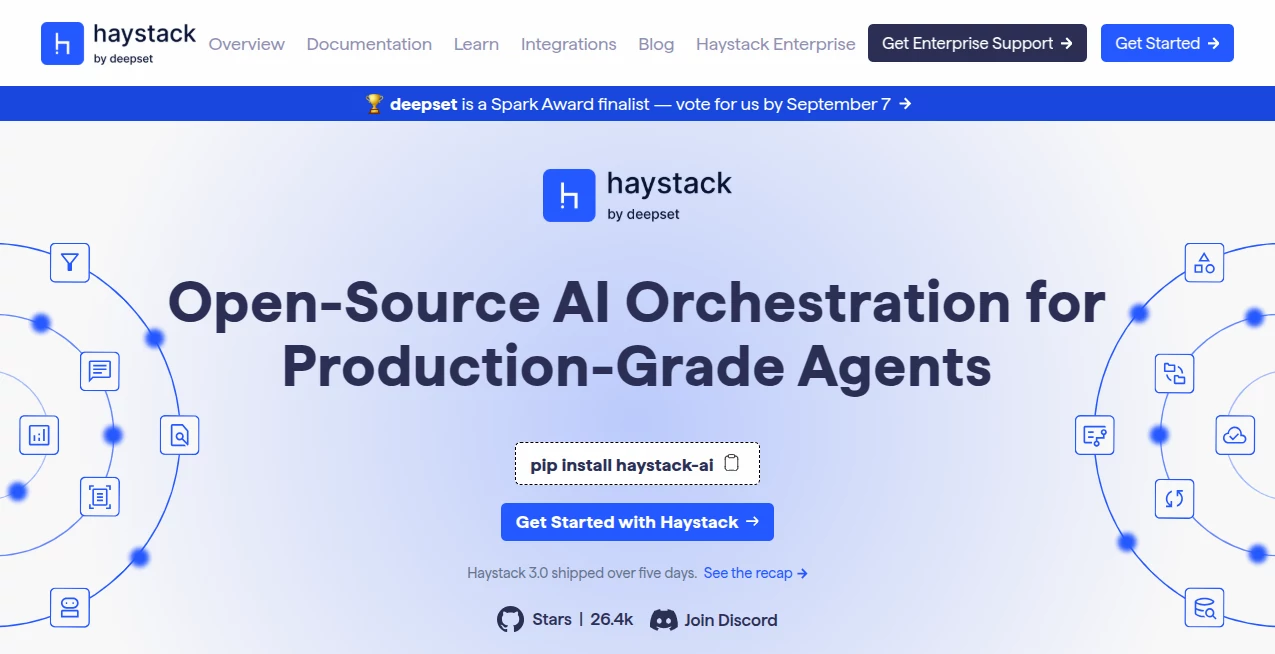
Haystack is an open-source AI orchestration framework designed for developers and teams building production-ready applications with large language models. It brings together reusable components, pipelines, document stores, agents, tools, and integrations so developers can assemble sophisticated AI workflows without being locked into a single model provider or infrastructure choice.
The framework is particularly well suited to retrieval-augmented generation (RAG), AI agents, semantic search, conversational applications, multimodal systems, and content generation. Instead of forcing developers into one predefined workflow, it provides building blocks that can be connected and customized around the requirements of a project.
Key Features
- Open-source framework for building LLM-powered applications.
- Composable pipelines built from reusable components.
- Support for production-oriented AI agents and tool calling.
- Advanced RAG workflows with different retrieval and generation strategies.
- Integrations with services and technologies including OpenAI, Anthropic, Mistral, Hugging Face, Weaviate, Pinecone, and Elasticsearch.
- Support for multimodal AI applications involving text, images, and audio.
- Cloud-agnostic and Kubernetes-ready pipeline architecture.
- Tools for creating, testing, debugging, and optimizing complex AI workflows.
User Interface
This is primarily a developer-focused framework rather than a conventional consumer AI application with a point-and-click interface. Most work is performed through code, components, pipelines, and integrations. That approach may feel different if you are accustomed to standalone AI websites, but it gives engineering teams considerably more control over how information moves through an application.
The modular structure is one of its strongest practical advantages. A developer can replace a retrieval component, model provider, document store, or processing step without rebuilding the entire application from scratch.
Accuracy & Performance
Performance depends heavily on the models, retrievers, data sources, prompts, and pipeline architecture selected by the developer. The framework itself does not promise a universal accuracy score because it is intended to orchestrate complete AI systems rather than provide one fixed model.
For RAG applications, this flexibility is especially useful. Teams can experiment with retrieval strategies, generation models, document processing, and self-correction workflows to improve the quality of responses. Pipelines can also be inspected and optimized, making it easier to identify where an AI application is producing weak results.
Capabilities
The framework covers a broad range of AI development scenarios. Developers can build RAG applications, autonomous and tool-using agents, conversational systems, multimodal applications, semantic search experiences, and content-generation workflows.
Its component-based architecture also makes it practical for connecting different parts of an existing technology stack. For example, a team might combine one model provider with a separate vector database, custom retrieval logic, and proprietary business tools. This freedom is valuable for organizations that want to maintain control over their architecture.
Security & Privacy
Because it is an open-source framework rather than a hosted consumer chatbot, data handling largely depends on how the application is deployed and which external services are connected. Teams can design their own infrastructure and deployment model instead of being required to send all application data through a single hosted platform.
For organizations with strict operational requirements, the ecosystem also provides enterprise-oriented deployment, access control, governance, and support options. Developers should still review the privacy and security policies of every model provider, database, API, or external service connected to their pipeline.
Use Cases
- RAG applications: Build question-answering systems that retrieve relevant information before generating responses.
- AI agents: Create agents capable of reasoning, using tools, maintaining context, and handling multi-step workflows.
- Enterprise search: Combine retrieval systems with language models to create more useful search experiences.
- Conversational AI: Develop customized assistants and chat-based applications around proprietary data.
- Multimodal applications: Work with different types of information, including text, images, and audio.
- Content generation: Build controlled generation workflows using customizable prompts and processing pipelines.
- Research and knowledge systems: Connect documents, retrieval systems, models, and custom tools into a single workflow.
Pros and Cons
Pros
- Open-source and highly customizable.
- Strong focus on production-grade AI applications.
- Excellent flexibility for RAG and agentic workflows.
- Large ecosystem of model, database, and infrastructure integrations.
- Modular architecture makes individual components easier to replace or test.
- Suitable for teams that want control over their AI stack.
Cons
- Primarily aimed at developers rather than casual users.
- Building sophisticated applications requires programming knowledge.
- Final performance depends heavily on the models and infrastructure chosen.
- Complex projects can require substantial engineering and deployment work.
Pricing Plans
The core framework is open source and can be installed as a Python package, making it accessible for developers who want to build and run their own applications. There is no conventional per-user subscription required simply to use the open-source framework.
For organizations that need additional assistance, enterprise support and platform offerings are available. Enterprise pricing is tailored to the organization and its requirements rather than presented as a single standard public subscription price.
How to Use the Framework
- Install the framework in a Python development environment.
- Choose the language model, document store, retriever, or external services required for your application.
- Create reusable components for individual processing tasks.
- Connect those components into a pipeline.
- Add retrieval, generation, memory, or tool-calling logic when required.
- Test the pipeline with representative data and queries.
- Monitor the results and adjust components, prompts, and retrieval strategies.
- Deploy the finished application using infrastructure appropriate for your workload.
Comparison with Similar Tools
Compared with simpler AI application builders, this framework places considerably more emphasis on engineering control and transparent orchestration. It is less about generating an application from a few prompts and more about giving developers the pieces required to construct the application themselves.
It is also a strong option when an organization wants to work with multiple AI providers. Rather than designing an application around one vendor, developers can combine different models, databases, retrieval technologies, and custom components. For teams building serious RAG or agent systems, that flexibility can become a significant advantage as the project grows.
Conclusion
For developers building serious AI applications, this framework offers a thoughtful balance between flexibility and production-oriented architecture. Its open-source foundation, modular components, broad integrations, and strong focus on RAG and AI agents make it particularly interesting for teams that need more control than a typical hosted AI tool provides.
It is not intended to be the easiest option for someone who simply wants to type a prompt and receive an answer. Its value becomes much clearer when you need to design an AI workflow around your own data, models, retrieval systems, tools, and infrastructure. For those projects, having individual building blocks that can be inspected, replaced, and optimized can save considerable effort over time.
Frequently Asked Questions (FAQ)
What is this framework mainly used for?
It is mainly used to build production-ready AI applications, including RAG systems, AI agents, semantic search, conversational applications, multimodal workflows, and content-generation systems.
Is it open source?
Yes. The core framework is open source and can be installed and used by developers for building their own AI applications.
Does it support different AI models?
Yes. Its integration-focused architecture allows developers to work with multiple model providers and open-source technologies rather than being restricted to one AI provider.
Can it be used for RAG?
Yes. RAG is one of its major use cases, with support for different retrieval and generation strategies and customizable pipelines.
Is it suitable for beginners?
It can be learned by beginners with Python and AI development experience, but it is primarily designed for developers. Someone without programming experience may find a no-code AI platform easier to start with.
Can it be deployed in production?
Yes. The framework is designed for production-oriented workloads, with serializable, cloud-agnostic pipelines and deployment options suitable for modern infrastructure.
Can it work with proprietary company data?
Yes. It can be used to build applications around private documents and other data sources, particularly through RAG and retrieval-based architectures. The actual privacy of that data depends on the application's deployment and the external services connected to it.
Does it support AI agents?
Yes. Agent capabilities include standardized tool calling and flexible workflows for applications that need reasoning, tools, memory, and multi-step decision-making.
What programming language is commonly used?
The framework is primarily used within Python-based development environments and can be installed as a Python package.
Is there enterprise support?
Yes. Enterprise support and platform options are available for organizations that need additional deployment guidance, engineering support, governance, security controls, or assistance operating AI systems at scale.
AI Knowledge Management , AI Research Tool , Large Language Models (LLMs) , AI Developer Tools .
These classifications represent its core capabilities and areas of application. For related tools, explore the linked categories above.

Haystack Alternatives Product

Vibe Code Pi…

Project Genie

Emergent
NotebookVault

Geekflare AI

LocalRAG!

Medialyst

IntoTheBlock

Crawlly AI
