











Mo
What is Mo?
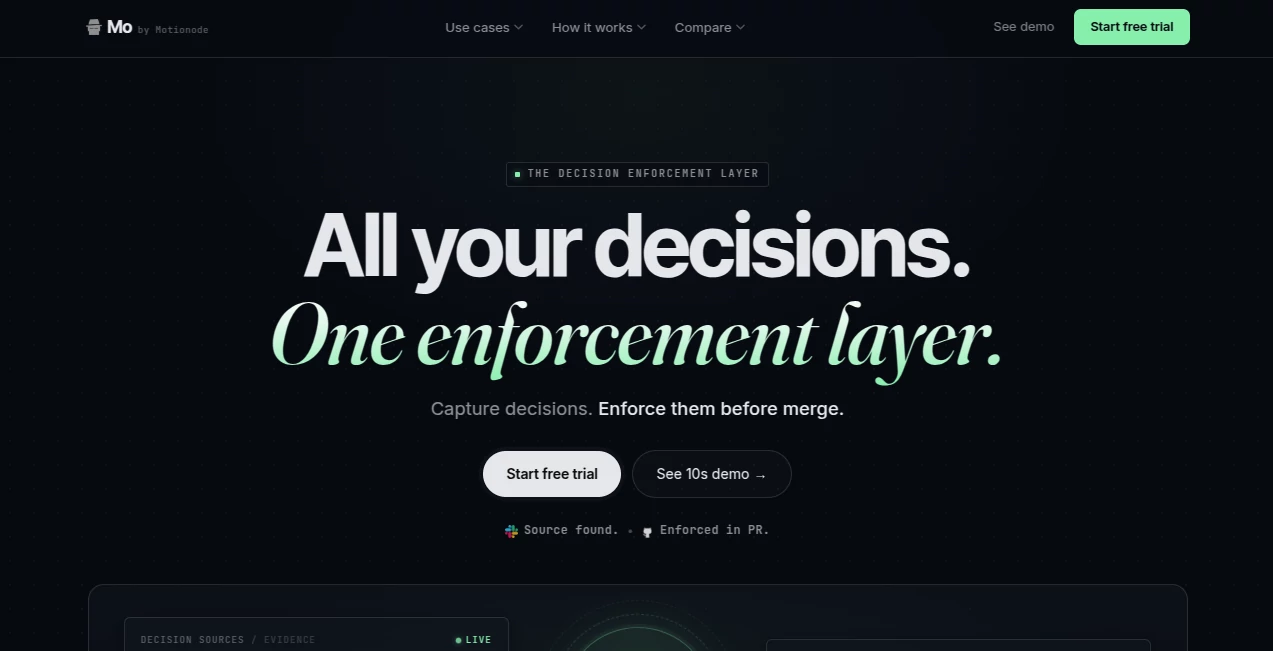
Modern software teams make hundreds of important decisions throughout the development lifecycle. Product requirements, security policies, pricing rules, onboarding flows, and business logic are often discussed in chat platforms or project management tools, yet those decisions can easily be forgotten before code reaches production. This platform solves that problem by transforming approved decisions into enforceable development rules that are automatically verified before every merge.
Instead of introducing another workflow, it integrates naturally with the tools engineering teams already rely on. Conversations, documents, issue trackers, and collaboration platforms become trusted sources of truth, while every pull request is checked against those approved decisions. The result is greater consistency, fewer costly mistakes, and stronger collaboration between product managers, developers, and stakeholders.
For organizations that care about governance, compliance, and product quality, this solution provides a practical way to ensure that what was agreed upon is exactly what gets shipped.
Key Features
User Interface
The platform offers a clean and intuitive experience that focuses on clarity rather than complexity. Decisions can be captured directly from existing collaboration tools, reviewed through a centralized dashboard, and linked to development workflows without requiring teams to learn an entirely new system. Every detected conflict is presented with clear context, making reviews straightforward.
Accuracy & Performance
Instead of performing traditional code reviews, the platform compares code changes against previously approved business and product decisions. This additional validation layer helps identify rule violations that conventional static analysis or syntax checkers cannot detect. Checks are performed during the pull request process, allowing developers to resolve issues before deployment.
Capabilities
- Capture approved decisions from collaboration platforms.
- Convert discussions into enforceable development rules.
- Verify pull requests against business requirements.
- Monitor pricing logic and onboarding workflows.
- Detect permission and access-control changes.
- Validate compliance-related modifications.
- Maintain traceability between discussions and source code.
- Support GitHub, GitLab, and Bitbucket repositories.
- Import documents containing technical or business requirements.
- Provide detailed conflict reports before code is merged.
Security & Privacy
Security is built into the verification process. Rather than storing entire repositories, the platform analyzes pull request differences to determine whether approved decisions have been respected. Every decision remains versioned with an auditable history, giving engineering teams greater confidence during compliance reviews and internal governance processes.
Use Cases
- Prevent accidental pricing changes before release.
- Protect permission and authorization logic.
- Ensure onboarding experiences remain consistent.
- Enforce compliance and regulatory requirements.
- Verify business rules across development teams.
- Improve collaboration between product managers and engineers.
- Create an audit trail for product decisions.
- Reduce production bugs caused by misunderstood requirements.
Pros and Cons
- Pros
- Fits naturally into existing development workflows.
- Supports multiple collaboration and version-control platforms.
- Provides excellent traceability from decision to deployment.
- Improves software governance without adding unnecessary complexity.
- Helps prevent expensive business logic mistakes.
- Cons
- Most valuable for collaborative software teams rather than individual developers.
- Requires initial integration with communication and repository platforms.
- Teams should consistently approve and document important decisions to maximize effectiveness.
Pricing Plans
A free trial is available without requiring a credit card, making it easy for teams to evaluate the workflow. Paid plans are offered on a per-project monthly basis and include higher usage limits, additional decision checks, and advanced enforcement capabilities for production environments.
How to Use Mo
Begin by connecting your preferred code repository together with one or more collaboration platforms. Capture important business or technical decisions from conversations or uploaded documentation, then approve them as official rules. Whenever a pull request is created, the platform automatically compares incoming code against those approved decisions and highlights any conflicts before the merge is completed. This creates a reliable quality gate without disrupting the existing development process.
Comparison with Similar Tools
Traditional code review assistants primarily focus on code quality, syntax, and potential security vulnerabilities. Continuous integration tools verify builds and automated tests. This platform addresses a completely different challenge by validating business decisions, product rules, and organizational policies against code changes. It effectively fills the gap between product discussions and software delivery, giving engineering teams confidence that approved requirements remain intact throughout development.
Conclusion
Development teams often lose valuable context between planning discussions and production deployments. This solution closes that gap by transforming approved decisions into automated verification rules that operate directly within the development workflow. By connecting conversations, documentation, and source code, it helps organizations deliver more consistent software while reducing costly mistakes. For teams seeking stronger governance, better collaboration, and reliable enforcement of business requirements, it offers a refreshingly practical approach.
Frequently Asked Questions (FAQ)
What problem does this platform solve?
It ensures that approved business, product, and technical decisions are automatically verified before code is merged into production.
Can it work with existing development tools?
Yes. It integrates with popular collaboration platforms, issue trackers, and Git repositories, allowing teams to continue using their existing workflows.
Who benefits the most from this platform?
Software engineering teams, product managers, DevOps professionals, and organizations that need stronger governance and traceability throughout the software development lifecycle.
Does it replace code review tools?
No. It complements traditional code review solutions by enforcing business decisions instead of focusing only on code quality or syntax.
Is there a free trial?
Yes. Users can evaluate the platform through a free trial before upgrading to a paid subscription.
AI Project Management , AI Testing & QA , AI Developer Tools , AI DevOps Assistant .
These classifications represent its core capabilities and areas of application. For related tools, explore the linked categories above.

Mo Alternatives Product
Timestamp Ro…

CloudByte PMS

Workik
AgentOne

ABC Dynamic …

GOLANG COLLE…

Startup Read…
langextract.…
Vurge