
















What is ABC Dynamic Environment?
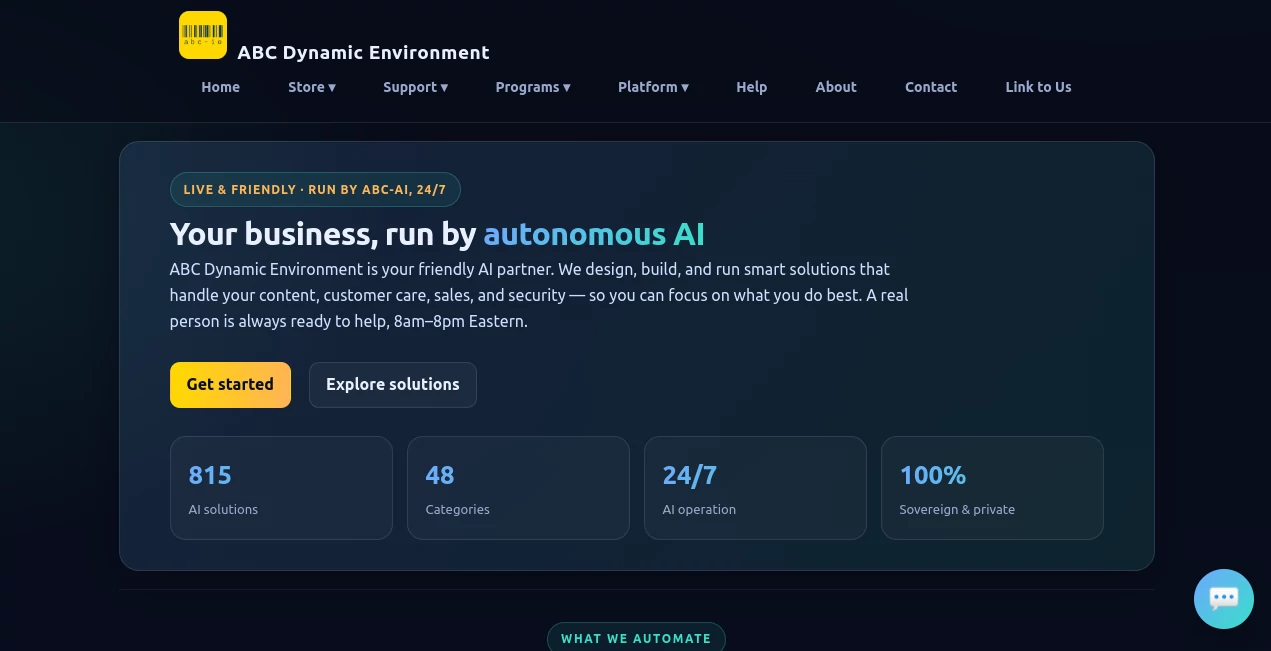
ABC Dynamic Environment is an AI-powered business automation platform designed for companies that want to put repetitive operations on autopilot without giving up human oversight. Instead of offering a single-purpose AI feature, it brings together a large catalog of autonomous solutions covering areas such as content, customer support, e-commerce, cybersecurity, business operations, and AI orchestration.
The platform currently presents 801 AI solutions across 48 categories, giving businesses a broad selection of ready-to-use options. What makes the approach interesting is the combination of autonomous operation with human approval. Businesses can let AI handle routine work while keeping people involved when decisions involving billing, releases, or outreach need approval.
Key Features
- Access to a catalog of 801 AI solutions across 48 categories.
- 24/7 autonomous operation for supported business workflows.
- Solutions covering marketing, customer support, e-commerce, business operations, security, development, and connectivity.
- Multi-agent AI workflows designed to coordinate different tasks.
- Human approval for important actions instead of completely unattended automation.
- Redundant infrastructure designed to provide automatic failover.
- Live validation options before purchasing a solution.
- Hands-on guidance and educational resources for learning how the platform works.
User Interface
The experience is built around a solution catalog rather than a complicated collection of isolated tools. Users can browse available solutions, explore what each one is intended to accomplish, and choose an option that fits a particular business requirement.
This catalog-style approach is useful for teams that know the business problem they want to solve but do not necessarily want to assemble an automation stack from scratch. The site also provides educational material explaining the autonomous operator, solution catalog, authorization process, and other parts of the system.
Accuracy & Performance
Performance is approached from an operational perspective. The platform states that its AI solutions operate continuously, with two redundant nodes running on its infrastructure. Automatic failover is designed to help keep services available if one node encounters a problem.
For businesses, this is an important distinction. The value is not simply in generating an AI response quickly; it is in keeping an automated workflow running consistently. The availability of live validation also gives prospective customers an opportunity to see how a solution behaves before committing to it.
Capabilities
The range of available capabilities is one of the strongest aspects of the platform. Content and marketing solutions can assist with articles, advertising, social media, SEO, and email workflows. Customer-facing solutions cover chat, ticket handling, lead qualification, translation, and voice-based assistance.
There are also solutions for e-commerce operations, including product listings, recommendations, inventory forecasting, dynamic pricing, and fraud prevention. On the technical side, the catalog includes development automation, code generation, testing, API-related services, AI infrastructure, model hosting, data pipelines, and other engineering workflows.
For larger organizations, the multi-agent approach can be particularly useful because several AI-driven processes can be coordinated rather than treated as completely separate tasks.
Security & Privacy
Security and operational control are emphasized throughout the platform. The infrastructure is described as sovereign and operated on its own servers rather than depending on a Big Tech infrastructure provider. The platform also uses redundant nodes and automatic failover as part of its continuity approach.
Another notable feature is human-in-the-loop authorization. Important activities such as billing, releases, and outreach can require human approval. This provides an additional layer of control for businesses that are not comfortable allowing an autonomous system to make every decision without review.
Use Cases
This platform can be useful for businesses looking to automate repetitive operational work without building every workflow internally.
- Marketing teams: Automate content creation, social media publishing, SEO workflows, advertising tasks, and personalized email campaigns.
- Customer support: Handle customer questions, classify support tickets, qualify leads, and provide multilingual assistance.
- E-commerce businesses: Automate product listings, recommendations, pricing workflows, inventory forecasting, and customer personalization.
- Development teams: Use AI for code generation, code review, testing, debugging, API development, and software maintenance.
- Business operations: Automate bookkeeping, reporting, project management, data workflows, and operational analytics.
- Security teams: Support threat detection, vulnerability scanning, phishing protection, security monitoring, and compliance-related processes.
Pros and Cons
Pros
- Very broad selection of AI business solutions.
- 801 solutions covering 48 categories.
- Designed for continuous 24/7 operation.
- Human approval remains part of important workflows.
- Redundant infrastructure supports service continuity.
- Useful combination of AI automation and business operations.
- Educational resources help users understand the system.
Cons
- The large number of solutions may feel overwhelming for users looking for a single simple AI tool.
- Pricing varies depending on the selected solution and engagement.
- Businesses may need to evaluate individual solutions carefully before choosing the right implementation.
- The platform is more focused on business automation and managed AI solutions than casual consumer AI use.
Pricing Plans
Pricing is structured around individual solutions rather than a single universal subscription that unlocks everything. The catalog includes different types of paid engagements, with prices depending on the service, complexity, and requirements.
Examples shown in the catalog include monthly services for development, infrastructure, support, and security, while some specialized services use one-time, hourly, per-session, or custom pricing. The platform also states that each solution is a scoped paid engagement and that customers receive a perpetual license to the delivered work.
Because the catalog contains hundreds of different solutions, businesses should review the pricing of the specific service they need rather than assuming one fixed platform-wide rate.
How to Use the Platform
Getting started is relatively straightforward. First, browse the solution catalog and identify the workflow or business problem you want to automate. The available solutions range from marketing and customer support to software development, infrastructure, security, and business operations.
After selecting a suitable solution, users can explore the available information or try a live validation where offered. Once the appropriate service is selected, the AI operation can run continuously while human approval remains available for actions that require additional oversight.
This makes the platform particularly appealing to businesses that want automation without completely removing people from the decision-making process.
Comparison with Similar Tools
Many AI platforms specialize in one area, such as writing, image generation, customer service, coding, or workflow automation. This platform takes a considerably broader approach by combining many business functions within a single solution catalog.
Compared with a traditional collection of standalone SaaS products, the main advantage is the possibility of having autonomous workflows managed as part of a larger operational environment. Compared with completely autonomous AI systems, the human-approval model offers an additional level of control.
The result is better suited to organizations looking for managed AI operations rather than someone simply searching for a chatbot or a single content-generation utility.
Conclusion
Businesses interested in practical AI automation will find a surprisingly broad range of possibilities here. With 801 solutions spanning 48 categories, the platform goes beyond the typical single-purpose AI tool and focuses on putting complete business processes into operation.
The combination of autonomous 24/7 operation, redundant infrastructure, human oversight, and a wide solution catalog makes it an interesting option for companies exploring a more operational approach to AI. It is especially worth considering when the goal is not just to experiment with AI, but to use it as part of everyday business workflows.
Frequently Asked Questions (FAQ)
What is this AI platform used for?
It is designed to automate business workflows using AI. Its solutions cover areas including marketing, customer support, e-commerce, cybersecurity, development, business operations, connectivity, and AI infrastructure.
How many AI solutions are available?
The platform currently lists 801 AI solutions organized across 48 categories.
Can the AI solutions operate continuously?
Yes. The platform describes its solutions as capable of 24/7 autonomous operation, with redundant infrastructure supporting continuous availability.
Does a human remain involved?
Yes. Human-in-the-loop authorization is part of the platform's approach. Certain actions, including billing, releases, and outreach, can require human approval.
Does it offer AI solutions for developers?
Yes. The catalog includes solutions for code generation, code review, testing, debugging, API development, software maintenance, AI agents, model infrastructure, and other development workflows.
Is there a single fixed subscription price?
No. Pricing depends on the individual solution. The catalog includes monthly, one-time, hourly, session-based, and custom pricing depending on the service.
Can businesses test a solution before purchasing?
The platform provides live validation options for prospective customers, allowing them to see a solution in action before making a purchase decision.
Is the infrastructure designed for reliability?
Yes. The platform states that its AI operations run on two redundant nodes and use automatic failover to improve continuity.