
















Huntli
Verified Blue CheckMark
Verified Blue CheckMark products are featured above free or unverified listings.
This badge indicates authenticity and builds trust, giving your product higher visibility across the platform.
Upgrade to get verified
Verified Blue CheckMark products are featured above free or unverified listings. This badge indicates authenticity and builds trust, giving your product higher visibility across the platform.
Upgrade to get verified
What is Huntli?
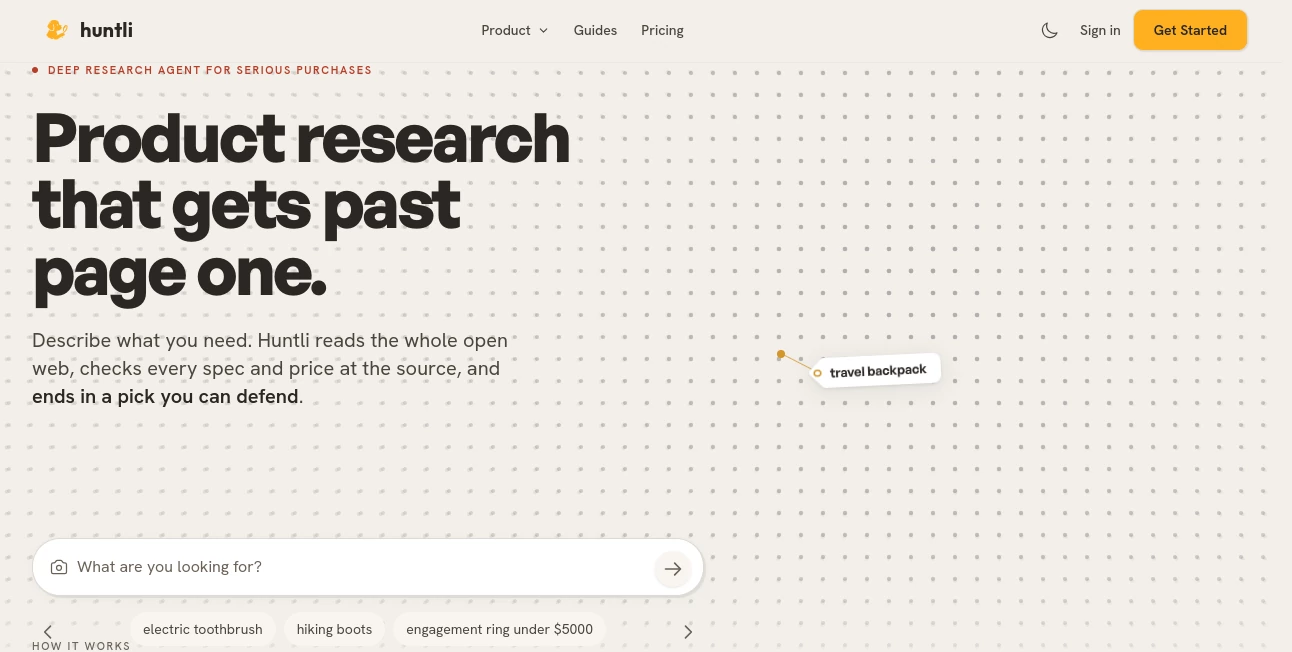
Shopping online sounds simple until you actually have to choose between dozens of similar products, conflicting reviews, changing prices, and retailers you have never heard of. Huntli takes a different approach. Instead of treating shopping as a simple keyword search, it works more like a research assistant that investigates products before making a recommendation.
You can describe what you want in plain language, including your budget, preferences, intended use, or specific requirements. The system searches the open web, checks retailer pages, verifies product information, and compares the options it finds. This makes it particularly useful for purchases where spending a little more time researching can prevent an expensive mistake.
Another appealing part is the ability to decide how recommendations should be judged. You can use predefined shopping personas such as Budget Hunter, Maximizer, Eco-Conscious, Used & Recycled, or Luxury & Premium, or create your own priorities. The result feels less like browsing a shopping catalog and more like having someone narrow the field according to the way you actually buy things.
Key Features
- Real-time product research across the open web
- Retailer verification for pricing, availability, and shipping information
- AI-powered comparisons based on value, specifications, and user sentiment
- Custom shopping personas that change how products are evaluated
- Shopping Stashes for saving and organizing research
- Shareable read-only Stash links for friends, family, or colleagues
- Side-by-side product comparisons with category-level scoring
- Product identification from uploaded or captured photos
- Support for multiple regions and local currencies
- Product URL and category-page research
User Interface
The interface is built around a conversational shopping experience rather than a complicated collection of filters. You start by describing what you need, and the system turns that description into a research task. This is especially convenient when your requirements are difficult to express with standard shopping filters.
Research can then be organized into Shopping Stashes. A Stash acts as a workspace for a particular purchase, allowing products to be collected, compared, and revisited later. The ability to share a read-only Stash is also practical when a buying decision involves someone else. For example, a person researching a camera kit can send the shortlist to a partner without asking them to repeat the entire research process.
Recent updates have also focused on usability, including keyboard and screen-reader support, more consistent pricing throughout the interface, rebuilt navigation, and better handling of searches interrupted by a reload or dropped connection.
Accuracy & Performance
One of the strongest ideas behind the service is live verification. Rather than depending entirely on a static product database, it searches the web in real time and visits retailer pages to verify details such as price, stock, and shipping. That matters because shopping information can become outdated surprisingly quickly.
The comparison system evaluates products across value for money, specifications and features, and user sentiment from reviews. The weighting changes according to the selected shopping persona. Someone focused on price may therefore receive a different recommendation from someone who cares more about maximum specifications or premium quality.
The scoring is also designed to be transparent. Instead of simply presenting a mysterious winner, the comparison can show why one product performs better in particular areas. This makes the recommendations easier to inspect before making a final purchase.
Capabilities
The platform goes beyond ordinary product discovery. You can paste a product link and have the exact product, brand, model, and variant identified. Category and deals pages can also be turned into researchable product lists, making it easier to select several items for further comparison.
Image-based product discovery is another useful capability. A photo can be uploaded or captured from a device, after which the system can identify the product and continue the conversation with follow-up requests. For example, after showing a product, you can ask for something similar at a lower price without starting the research from scratch.
For more involved purchases, side-by-side comparisons provide detailed specifications, category-level scores, and a clear recommendation. Multi-region support is useful for shoppers who want prices from different markets, while budget tracking and completeness information can help with larger projects such as building a gaming PC.
Security & Privacy
The service publishes a privacy policy covering account information, usage data, and technical information such as IP address, browser type, and device details. Account and saved data are stored on servers within the European Union, while some service providers involved in AI processing and product research may process information outside the European Economic Area.
Conversational search processing uses Google's Gemini API, and the privacy policy states that search queries and AI responses may be temporarily stored for up to 55 days for functions such as maintaining conversation context. The company also states that this data is not used by Google to train its models.
Users should still avoid entering information into a shopping assistant that they would not want processed by third-party service providers. For normal product research, however, the published privacy documentation gives users a useful overview of what information is collected and why.
Use Cases
Finding the right product: Instead of opening multiple shopping tabs, describe the product you need and include your budget, preferred features, and intended use. The research process can then narrow the available choices.
Comparing expensive purchases: Cameras, laptops, headphones, gaming components, appliances, and other higher-value products often require careful comparison. The detailed scoring makes it easier to understand the trade-offs between competing options.
Building a complete setup: Shopping Stashes are useful for projects involving several products. A gaming PC build, for example, can contain multiple components while keeping the research and budget in one place.
Finding alternatives: If you already know a product you like, you can provide its URL or image and investigate similar options, including cheaper alternatives.
Collaborative buying decisions: A Stash can be shared through a read-only link, which makes it convenient when another person needs to review the shortlist before a purchase.
Shopping across regions: Multi-region retailer coverage and local currency display can help international shoppers understand what products and prices are available in different markets.
Pros and Cons
- Pros: Real-time web research instead of relying solely on a static catalog.
- Pros: Product prices, availability, and retailer information are checked at the source.
- Pros: Personalized scoring based on different shopping priorities.
- Pros: Useful Stash system for organizing longer buying decisions.
- Pros: Supports product research through text, links, and images.
- Pros: Core features are available for free without requiring a credit card.
- Cons: Free accounts have a weekly search allowance, so heavy users may encounter a fair-use limit.
- Cons: Product availability and prices can still change after verification because retailer information is dynamic.
- Cons: Recommendations should be treated as research assistance rather than a substitute for checking important product details before purchasing.
Pricing Plans
The core service is currently free to use. Users can access AI-powered search, product comparisons, Shopping Stashes, vendor verification, shopping personas, and multi-region functionality without entering a credit card.
Free accounts include a weekly search allowance intended to cover normal shopping activity. Heavy users may eventually reach a fair-use cap. According to the current pricing information, if a paid plan is introduced in the future, it is intended to increase the usage allowance rather than lock core features behind a subscription.
The platform also uses affiliate links. When a user purchases through a participating retailer, the service may receive a commission. The company states that these relationships do not influence product rankings or recommendations.
How to Use the Tool
- Start by describing the product you want in natural language.
- Include important requirements such as budget, size, features, brand preferences, use case, or other constraints.
- Select a shopping persona such as Budget Hunter, Maximizer, Eco-Conscious, or Luxury & Premium, or define your own priorities.
- Let the system search the web and verify relevant products and retailer information.
- Review the recommendations, product details, pros and cons, prices, and comparison scores.
- Save promising options to a Shopping Stash if you want to continue researching later.
- Compare products side by side when you have narrowed your choices.
- When you are ready to buy, follow the verified retailer link provided for the selected product.
Comparison with Similar Tools
Traditional price comparison websites are mainly designed to answer one question: where can I find this product at a certain price? That can be useful, but it leaves much of the research to the shopper.
This approach is broader. Instead of simply presenting a list of prices, it tries to understand the shopper's requirements, discover products across the open web, verify retailer information, analyze specifications and reviews, and explain the trade-offs between different choices.
The persona system is another notable difference. A budget-focused shopper and someone looking for the highest possible specifications may reasonably choose different products. By changing the weighting of the recommendation system, the same product set can be evaluated according to different priorities.
It is therefore better viewed as an AI shopping research assistant than as a conventional price comparison engine. That distinction becomes particularly valuable when the purchase involves many competing products or several criteria that need to be balanced.
Conclusion
Huntli is an appealing option for shoppers who are tired of opening endless tabs before making a purchase. Its combination of conversational search, live retailer verification, transparent product scoring, personalized shopping personas, and organized research Stashes creates a more structured way to investigate products online.
The strongest part of the experience is the emphasis on research rather than simply displaying search results. Whether you are looking for headphones under a certain budget, assembling a gaming PC, comparing cameras, or trying to find a better alternative to a product you already know, the workflow is designed to reduce the amount of manual comparison involved.
Because the core experience is free, there is little barrier to trying it on a real purchase. For anyone who prefers to understand why one product is a better fit before clicking the checkout button, this is a particularly useful addition to the modern shopping toolkit.
Frequently Asked Questions (FAQ)
What is this tool?
It is an AI-powered shopping research assistant that helps users discover, compare, and evaluate products using information gathered from the open web and retailer sources.
Is it free to use?
Yes. The core features are currently free, including AI search, product comparisons, Shopping Stashes, vendor verification, shopping personas, and multi-region support. Free accounts have a weekly search allowance.
How does it verify product prices?
The system searches the web in real time and visits retailer pages to verify information such as pricing, availability, and shipping rather than depending entirely on a static product database.
Can I compare two products?
Yes. Products can be compared side by side with specification breakdowns, category-level scores, and a recommendation explaining the main differences.
Can I use a product image for research?
Yes. Users can upload or capture a photo of a product, and the system can identify the brand, model, and variant before continuing the research conversation.
What are Shopping Stashes?
Shopping Stashes are personal research workspaces where users can save products, organize a purchase decision, compare options, and continue their research later. Stashes can also be shared through read-only links.
Can I customize the recommendations?
Yes. Several shopping personas are available, including Budget Hunter, Maximizer, Eco-Conscious, Used & Recycled, and Luxury & Premium. Users can also create custom shopping priorities.
Does the service use affiliate links?
Yes. The service may earn a commission when a user purchases through an affiliate retailer. The company states that affiliate relationships do not influence rankings or recommendations.
Does it work in different countries?
Yes. The platform supports multiple regions and displays prices in local currencies, helping users research products from retailers across different markets.