
Hype Stack
What is Hype Stack?
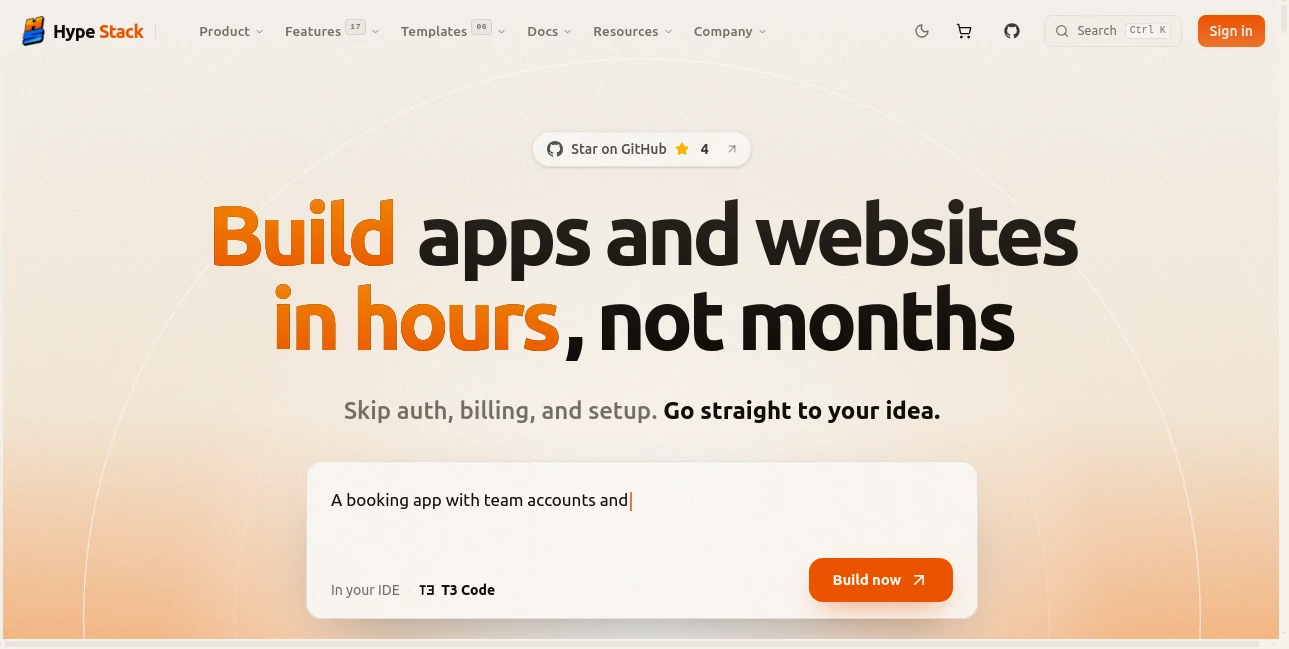
Hype Stack is a production-ready full-stack application starter designed for developers, solo founders, freelancers, startups, and teams who want to move from an idea to a working product without spending weeks rebuilding the same foundation. Instead of starting with an empty repository, you get a structured application stack with the frontend, backend, database, administration, mobile application, browser extension, testing, CI, and local infrastructure already connected.
The project takes a particularly interesting approach to modern AI-assisted development. Its codebase includes rules and conventions designed to help coding agents understand the architecture before making changes. That means tools such as Cursor, Claude Code, Copilot, Codex, and other supported AI editors can work inside a predictable project structure rather than generating disconnected pieces of code.
Another major advantage is ownership. The core starter is open source and MIT licensed, while additional feature packs can add capabilities such as authentication, organizations, billing, teams, and notifications. The generated code remains inside your repository, giving developers the freedom to inspect, modify, and extend it.
Key Features
- Full-stack application starter with frontend and backend already connected
- React 19 frontend and Hono backend architecture
- PostgreSQL database setup with migrations and typed queries
- Admin panel for managing application data and business operations
- Expo-based mobile application support
- Browser extension foundation
- Desktop application support
- Docker-based local development infrastructure
- CLI-based project creation and deployment
- AI editor rules for modern coding assistants
- End-to-end typing between backend routes and frontend SDKs
- Authentication, billing, organizations, teams, and notifications through feature packs
- Multilingual application architecture using typed Paraglide messages
- Design-system tokens for centralized visual customization
User Interface
The interface foundation is built around a modern React-based application stack, with reusable components and a centralized design system. Colors, typography, and border-radius settings can be controlled through shared design tokens, making it easier to keep the application consistent when the product's visual identity changes.
The starter also goes beyond a single web screen. A typical project can include the customer-facing frontend, an administrative application, mobile interfaces, and a browser extension. This makes the foundation especially useful for products that need several connected interfaces rather than a simple landing page.
Accuracy & Performance
For a development framework, performance is less about generating an answer and more about how quickly the development environment can detect and respond to changes. The stack uses tools such as Nx, TypeScript, React, TanStack, Hono, Tailwind CSS, Prisma, PostgreSQL, Docker, and Rust-based development tooling.
The project highlights Rolldown, oxlint, and Lightning CSS as part of its Rust-based toolchain and reports significantly faster feedback during development. End-to-end types also help catch incorrect API usage during compilation instead of allowing certain mistakes to reach production.
For example, when a backend method changes, the connected frontend SDK can expose the resulting type error directly in the editor. That simple feedback loop can save considerable debugging time on larger applications.
Capabilities
The starter provides a broad foundation for building SaaS products and other application-based projects. Its core architecture connects the frontend, backend, database, administration layer, and supporting services, while optional packs add more complete business functionality.
Authentication can cover registration, login, OAuth, sessions, and password recovery. Billing support includes Stripe checkout, subscriptions, customer portals, and webhooks. Database functionality is prepared around PostgreSQL, with migrations and typed database access available from the beginning.
AI-assisted development is another strong part of the platform. The repository includes rules for different coding environments, helping an AI coding assistant understand conventions covering areas such as frontend development, backend work, testing, theming, data fetching, and commits.
Deployment is also handled through the CLI. The documented workflow can provision the application's web services and supporting components on supported hosting providers, while mobile and browser-extension components follow their respective release processes.
Security & Privacy
One of the more important differences is that the generated application code is kept in the developer's own repository rather than being hidden behind a proprietary application platform. This gives teams direct visibility into the source code and lets them decide where their application and data should run.
The platform itself provides development infrastructure and application building blocks rather than forcing users into a hosted runtime. Developers remain responsible for configuring production environments, secrets, authentication providers, databases, access controls, and other security requirements appropriately for their application.
Use Cases
- Building SaaS applications from an existing full-stack foundation
- Launching startup MVPs without rebuilding authentication and infrastructure from scratch
- Creating applications with web, mobile, desktop, and browser-extension interfaces
- Developing products with subscription billing and customer accounts
- Building internal business applications with administration tools
- Working with AI coding assistants on a structured and documented codebase
- Helping freelance developers deliver client applications faster
- Creating projects that need full ownership of their source code
- Experimenting with new product ideas while keeping a conventional developer-friendly repository
Pros and Cons
Pros
- Free and open-source core starter
- MIT licensing for the core project
- Full ownership of generated application code
- Frontend, backend, database, admin, mobile, and extension foundations in one project
- Strong support for AI-assisted development
- End-to-end TypeScript architecture
- CLI-based scaffolding and deployment workflow
- Optional feature packs reduce repetitive implementation work
- Suitable for both solo builders and development teams
Cons
- It is primarily an application development stack rather than a simple website builder
- Developers still need to understand the underlying technologies to customize a serious production application
- Premium feature packs require additional licensing
- Hosting and production infrastructure remain the developer's responsibility
- The large technology stack may feel excessive for a very small CRUD application or static website
Pricing Plans
The core starter is available for free and is described as free forever. It includes the CLI, base full-stack template, Rust-based development tooling, free packs, open-source access, and community support.
For developers who need additional functionality, the Solo plan provides access to premium packs and templates for 12 months, including newly released packs and templates during that period. It is aimed at independent professionals and solo founders.
The Ultimate plan is designed for teams and companies. It includes access to premium packs and templates, support for unlimited team members, custom pack development, architectural mentoring, and priority support.
The pricing structure is therefore quite straightforward: start with the open-source foundation at no cost, then purchase additional access when your project requires more advanced modules or templates.
How to Use
Getting started is designed to be straightforward for developers familiar with Node.js-based projects. The documented prerequisites include Node.js 20 or newer, pnpm 9 or newer, and Docker for the recommended local database and caching infrastructure.
After installing the required tools, the CLI can create a new project from the starter. Dependencies are then installed through pnpm, while Docker can launch the local PostgreSQL and Valkey services. Environment files are provided for the backend, frontend, and mobile application, allowing the project to be configured before development begins.
Once the application is running, developers can use the available development commands to start services, build the project, run TypeScript checks, lint the codebase, manage database migrations, and work with individual applications inside the monorepo.
The real benefit becomes apparent when the project is paired with an AI coding assistant. Instead of asking an agent to invent an architecture from scratch, developers can describe the feature they want while the existing repository conventions guide the implementation.
Comparison with Similar Tools
Traditional boilerplates generally provide a starting point for developers, but many leave authentication, billing, administration, mobile support, and other important pieces to be implemented manually. AI app builders take a different route by allowing users to describe an application and generate it inside a managed platform.
This solution sits somewhere between those approaches. It provides the speed and structure of a serious application starter while keeping the source code in the developer's repository. Unlike a hosted AI app builder, it does not require the entire product to live inside someone else's platform.
It is particularly appealing to developers who enjoy AI-assisted programming but still want a conventional codebase that another engineer can understand later. The built-in rules, typed architecture, tests, linting, and established project conventions make the transition from AI-generated work to human development much less uncomfortable.
Conclusion
Building a serious application usually involves far more than creating the first attractive interface. Authentication, billing, databases, administration, testing, deployment, mobile clients, integrations, and developer tooling can consume a surprising amount of time before the product's actual idea receives attention.
Hype Stack addresses that problem with a practical foundation rather than trying to hide the development process. Its open-source core, broad application structure, AI-friendly conventions, typed architecture, and optional feature packs make it a strong choice for developers who want to spend more time building their product and less time repeating boilerplate work.
For an experienced developer, it can function as a serious starting point for a new SaaS product. For someone experimenting with AI-assisted development, it provides a more structured environment in which coding agents can operate. The result is a useful middle ground: fast enough for modern product development, but still recognizably a real codebase that you own and can change.
Frequently Asked Questions (FAQ)
Is the core starter free?
Yes. The core starter is presented as free forever and is open source under the MIT license.
Does it support AI coding assistants?
Yes. The project includes rules and conventions for several AI coding environments, including Cursor, Claude Code, Copilot, Codex, and other supported editors.
Can I own and modify the source code?
Yes. The project is designed around full code ownership. The generated application lives in your repository and can be inspected, modified, extended, or handed to another developer.
Can I build mobile applications?
Yes. The application structure includes an Expo-based mobile application alongside the web, backend, administration, and browser-extension components.
Does it include authentication?
Authentication is available through the feature system. The available authentication functionality includes common requirements such as login, signup, OAuth, sessions, and password recovery.
Does it support payments?
Yes. A premium billing feature provides Stripe checkout, subscriptions, customer portals, and webhooks.
Which database does it use?
PostgreSQL is part of the standard stack, with local development infrastructure, migrations, and typed database access prepared for the project.
Is it suitable for a simple website?
Not necessarily. The project is intended primarily for applications rather than simple marketing sites or blogs. A static-site framework can be a better choice when there is no need for a full application backend.
Can I deploy the applications myself?
Yes. The approach is self-hosting friendly, and the CLI includes a deployment workflow for supported hosting environments. The developer remains in control of the hosting environment.
Who is it best suited for?
It is a strong fit for solo founders, freelancers, startups, agencies, developers, and teams that want a structured full-stack foundation while using AI coding assistants to accelerate development.
AI Website Builder , AI No-Code & Low-Code , AI Developer Tools , AI App Builder .
These classifications represent its core capabilities and areas of application. For related tools, explore the linked categories above.

Hype Stack Alternatives Product

Ideavibes AI

Website Clon…

ModelsLab

BootstrapKing

Beacons
axiom.ai

AI Complianc…

Scillus

ShipAhead