

















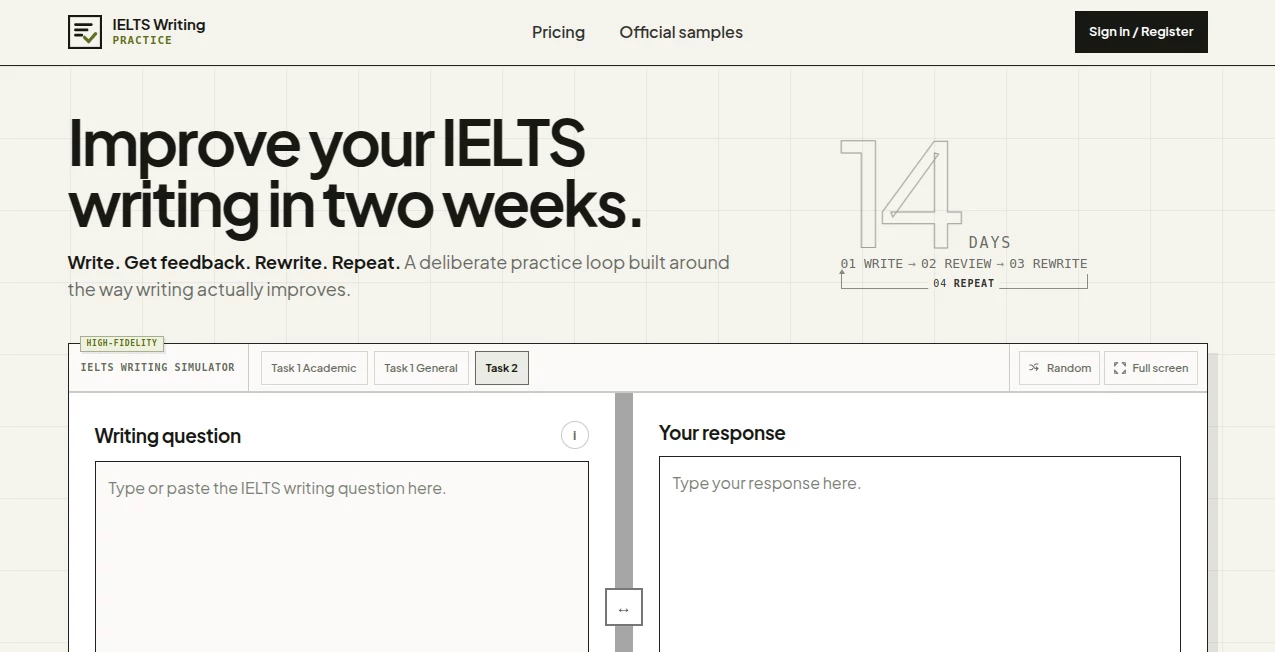
What is IELTS Writing Practice?
IELTS writing can be difficult to improve when practice ends with a score and little explanation. IELTS Writing Practice takes a more practical approach: write an answer, review the feedback, rewrite it, and repeat the process. The platform is built around deliberate practice rather than simply collecting model answers or memorizing impressive vocabulary.
It provides a focused writing simulator for both Academic and General Training candidates. Users can practise Task 1 Academic, Task 1 General Training, and Task 2 while working with realistic time and word-count requirements. The aim is simple: make writing practice feel closer to the real exam and make every attempt useful for the next one.
Key Features
- Practice for Academic Task 1, General Training Task 1, and Task 2.
- A realistic writing environment with a 40-minute timer for Task 2.
- Detailed feedback across the four IELTS Writing assessment criteria.
- Inline corrections that identify the exact wording that needs attention.
- A question library covering 16 major IELTS Writing question types.
- Support for opinion, discussion, problem-solution, advantages and disadvantages, two-part, and positive-or-negative essays.
- Academic Task 1 practice covering charts, graphs, tables, maps, processes, and mixed charts.
- General Training Task 1 practice covering formal, semi-formal, and informal letters.
- Official IELTS writing resources and Cambridge sample materials for additional study.
User Interface
The writing simulator keeps the experience deliberately focused. Candidates can choose the type of task they want to practise, enter a full-screen writing environment, and concentrate on the response without unnecessary distractions. The word counter and timer help recreate the pressure of an actual computer-based writing session.
One particularly useful detail is that the timer starts when the first word is entered. That makes practice feel less artificial than simply starting a countdown before the candidate is ready. For someone who tends to spend too much time planning, this can be a good way to build a more realistic sense of pacing.
Accuracy & Performance
The platform reports a mean absolute scoring error of 0.53 Band in its published comparison, with 74.2% of evaluated results falling within half a Band of the official score. These figures are presented by the service as evidence of the consistency of its scoring system.
More importantly for daily practice, feedback is not limited to a single number. Reviews cover Task Achievement or Task Response, Coherence and Cohesion, Lexical Resource, and Grammatical Range and Accuracy. Corrections can point directly to wording problems, explain the issue, and suggest a clearer alternative.
For example, instead of simply being told that grammar needs work, a candidate might see a subject-verb agreement error highlighted alongside the corrected form and an explanation of why the correction is necessary. That kind of feedback is much easier to act on during the next rewrite.
Capabilities
The platform is designed around a repeatable writing routine: write, review, rewrite, and repeat. This is especially useful for students who have already written many IELTS essays but still feel unsure about why their scores are not improving.
The question library covers 16 question types across Task 1 and Task 2. Academic candidates can work with visual-data tasks such as bar charts, line graphs, pie charts, tables, maps, processes, and mixed charts. General Training candidates can practise different types of letters, while Task 2 includes several of the essay structures commonly encountered in IELTS preparation.
Users can also paste their own question into the simulator, which makes the tool useful beyond its built-in question library. The draft remains in the browser while writing, allowing candidates to focus on producing and reviewing a complete response.
Security & Privacy
Privacy is an important consideration when submitting personal writing for automated evaluation. The service describes its writing reviews as private and provides account-based access for submitted responses. Candidates should still review the current privacy policy and terms before entering sensitive personal information into any online learning platform.
The service also makes an important distinction about scoring: the estimated Band score is intended for practice and is not an official IELTS result. This is worth keeping in mind when using the feedback to plan exam preparation.
Use Cases
This platform is particularly useful for IELTS candidates who need regular writing practice but do not have access to a teacher every time they finish an essay. A student preparing for an exam in a few weeks can use timed sessions to build speed, then study the corrections and rewrite the same response with greater accuracy.
It can also help candidates identify recurring problems. Someone who repeatedly loses marks because of grammar may notice the same types of errors appearing across several reviews. Another candidate might discover that the main weakness is not vocabulary at all, but unclear paragraph development or weak task response.
Teachers and tutors can also use the practice environment as an additional resource for independent student work, especially when learners need more writing repetitions between lessons.
Pros and Cons
- Pros: Focused IELTS Writing simulator with realistic timing and word limits.
- Pros: Supports both Academic and General Training writing.
- Pros: Detailed feedback based on the four IELTS Writing criteria.
- Pros: Inline corrections make individual mistakes easier to understand.
- Pros: Covers a broad selection of IELTS question types.
- Pros: Includes access to official-style learning resources and Cambridge materials.
- Cons: Detailed scoring and corrections require a paid plan.
- Cons: The estimated Band score should not be treated as a guaranteed prediction of the official exam result.
- Cons: The platform is specifically focused on Writing rather than providing a complete preparation system for every IELTS skill.
Pricing Plans
The service currently offers two paid options. The Unlimited Monthly plan costs $14.99 per month and provides unlimited private writing reviews, with support for Academic and General Training tasks. The subscription renews automatically each month.
The Annual Pass costs $39.99 as a one-time payment and provides 12 months of access with unlimited private writing reviews. Unlike the monthly option, it does not automatically renew.
For candidates who plan to practise frequently over several months, the one-time annual option can be particularly attractive because it combines extended access with no recurring renewal.
How to Use IELTS Writing Practice
- Choose whether you want to practise Academic Task 1, General Training Task 1, or Task 2.
- Select a question from the available practice library or use your own question.
- Write your response while following the suggested IELTS time and word limits.
- Submit the completed response for evaluation.
- Review the estimated Band score and the breakdown for each assessment criterion.
- Study the individual corrections and explanations rather than looking only at the overall score.
- Rewrite the response using the feedback.
- Repeat the process with new questions to identify patterns and measure improvement.
Comparison with Similar Tools
Many online IELTS resources concentrate on sample essays, vocabulary lists, or generic grammar correction. This platform takes a narrower approach by putting the writing process itself at the centre of the experience.
Its strongest difference is the combination of timed writing, IELTS-specific scoring criteria, detailed corrections, and rewriting. A general writing assistant may tell you that a sentence sounds better in another form, but IELTS preparation requires more than polished English. Candidates also need to address the task properly, organize ideas clearly, use vocabulary appropriately, and demonstrate suitable grammatical range and accuracy.
For that reason, the service is best viewed as a specialised IELTS Writing practice environment rather than a general-purpose writing assistant. It is particularly compelling for learners who already understand the basic IELTS format and want a structured way to practise repeatedly.
Conclusion
IELTS Writing Practice offers a straightforward answer to one of the most frustrating parts of IELTS preparation: knowing that you need to practise writing, but not knowing what to do with each finished essay.
The write-review-rewrite-repeat approach gives every attempt a purpose. With timed tasks, Academic and General Training support, 16 question types, criterion-based scoring, and precise corrections, the platform can turn isolated essay practice into a more organized routine.
It will not replace an official IELTS examination or guarantee a particular Band score, but it can be a valuable training companion for candidates who want more writing repetitions and clearer feedback between study sessions.
Frequently Asked Questions (FAQ)
What types of IELTS Writing tasks can I practise?
You can practise Academic Task 1, General Training Task 1, and Task 2. Academic Task 1 includes visual tasks such as graphs, charts, tables, maps, processes, and mixed charts, while General Training Task 1 includes formal, semi-formal, and informal letters.
Does the platform provide an IELTS Band score?
It provides an estimated practice Band score along with scores for the individual IELTS Writing criteria. The result is designed to guide preparation and should not be considered an official IELTS result.
What criteria are used to review writing?
Reviews cover Task Achievement or Task Response, Coherence and Cohesion, Lexical Resource, and Grammatical Range and Accuracy.
Can I practise under a time limit?
Yes. The simulator is designed around realistic IELTS writing conditions. Task 2, for example, uses a 40-minute writing limit and a recommended minimum of 250 words.
Does it support both Academic and General Training?
Yes. Both IELTS formats are supported, including their relevant Task 1 formats and the shared Task 2 essay practice.
How much does it cost?
The Unlimited Monthly plan is $14.99 per month. The Annual Pass costs $39.99 as a one-time payment and provides 12 months of access without automatic renewal.
Can I use my own IELTS question?
Yes. The simulator allows users to paste their own question in addition to practising with questions from the platform's library.
Is this an official IELTS service?
No. The service clearly states that its estimated scores are for practice and that the platform is independent rather than an official IELTS examination service.