


















Infomaniak
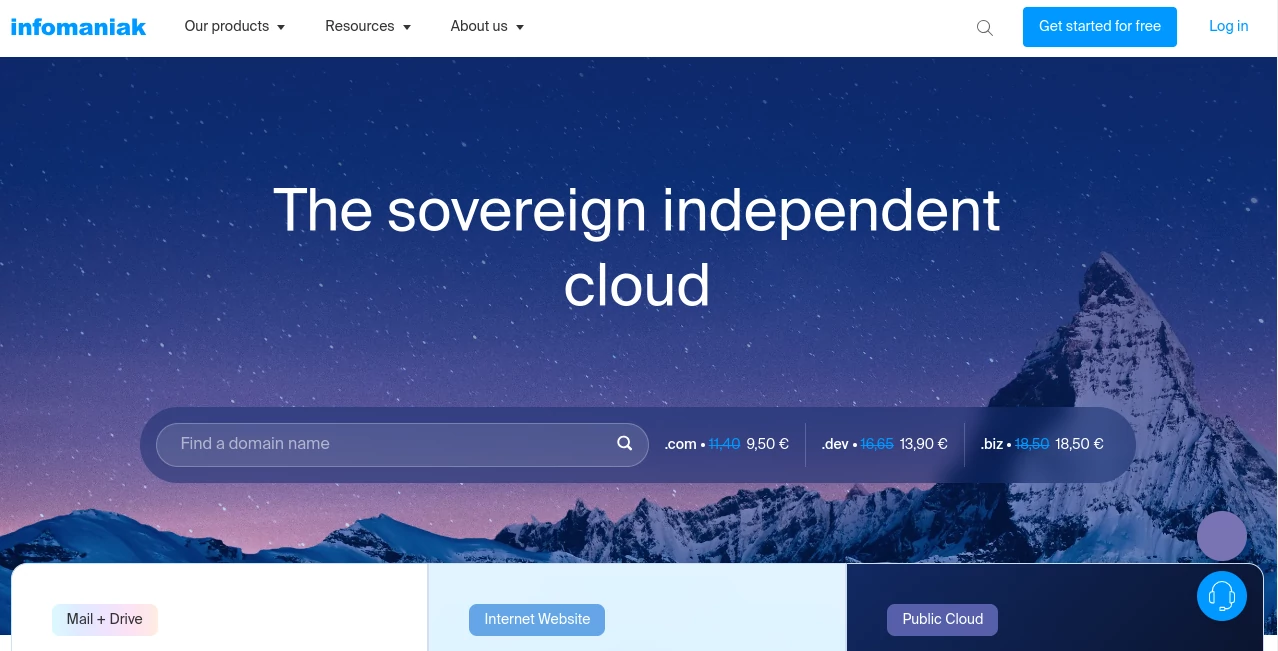
What is Infomaniak?
Infomaniak brings together cloud infrastructure, collaboration software, web services, and artificial intelligence under a distinctly European approach. Its AI offering is built around privacy, digital sovereignty, and open-source technology, making it particularly interesting for users and developers who want modern AI capabilities without sending sensitive information to external public-cloud platforms.
The AI ecosystem includes a general-purpose assistant called Euria as well as developer-focused AI Services. Euria is integrated into productivity applications for tasks such as writing, summarising, translating, and working with documents, while AI Services provides OpenAI-compatible APIs for integrating language models and other AI capabilities into applications.
Key Features
- Sovereign AI infrastructure: AI services are hosted on infrastructure located in Switzerland, giving organisations greater control over where their information is processed.
- Open-source models: The platform provides access to several open-source models and technologies rather than relying exclusively on proprietary AI systems.
- OpenAI-compatible APIs: Developers can use familiar API standards when connecting AI models to their own applications.
- LLM assistants: AI models can handle tasks such as answering questions, summarising content, translating text, analysing information, and assisting with workflows.
- Semantic search: Embedding-based capabilities can be used to compare, group, index, and retrieve information from datasets.
- Function calling and MCP: Developers can connect AI systems with databases, APIs, code, and other services to create more useful automated workflows.
- Speech recognition: Whisper-based functionality can transcribe audio and support applications involving voice data.
- AI inside productivity software: AI capabilities are integrated into email, chat, website creation, and cloud file management features.
User Interface
The user experience depends on which part of the ecosystem you use. Euria is designed for everyday interaction and can be accessed through a dedicated interface as well as integrated productivity applications. Developers working with AI Services have a more technical experience centred around API keys, model selection, requests, and consumption tracking.
The broader platform follows a unified approach, so users can move between email, file storage, collaboration, cloud infrastructure, and AI services without having to assemble everything from unrelated providers. For a small business owner, that can make the overall setup feel considerably less fragmented.
Accuracy & Performance
Performance naturally varies according to the selected model and the task being performed. The platform uses multiple open-source models, including technologies such as Mistral, DeepSeek, Llama, Granite, and Whisper, allowing different models to be suited to different workloads.
For practical tasks such as summarisation, translation, text generation, document analysis, and transcription, the range of available models provides useful flexibility. As with any generative AI system, important factual, legal, financial, or medical information should still be reviewed by a human before it is relied upon.
Capabilities
The AI capabilities go beyond a conventional chatbot. Developers can build multimodal assistants, semantic search systems, content-generation workflows, and applications that connect AI with external functions. The platform also supports voice transcription and provides GPU infrastructure for customised AI workloads.
For everyday users, the integrated assistant can help rewrite messages, draft emails, correct text, adjust tone, summarise documents, translate content, and interact with files. In cloud storage, users can ask questions about supported documents and extract useful information without manually reading every page.
Security & Privacy
Privacy is one of the strongest reasons to consider this platform. The company's AI infrastructure is hosted in Switzerland, and its AI Services documentation states that queries are not stored or used to train models or improve the services. This is particularly relevant for organisations handling confidential business information.
The company also positions its infrastructure around Swiss data protection requirements and GDPR compliance. Its AI services are designed around digital sovereignty, while its data centres use renewable energy and energy-recovery systems. The combination of privacy and infrastructure control gives the service a different character from many mainstream AI platforms.
Use Cases
- Business productivity: Draft emails, rewrite messages, summarise information, and prepare everyday business content.
- Document analysis: Ask questions about reports and other supported files, extract information, translate content, or create summaries.
- AI application development: Connect open-source language models to websites, software, internal tools, and business applications.
- Semantic search: Build systems that search and organise large collections of documents or other structured information.
- Customer-facing assistants: Create AI-powered assistants capable of understanding requests and interacting with connected services.
- Audio transcription: Convert recordings into text for notes, media indexing, accessibility, or other workflows.
- Web development: Combine cloud infrastructure, hosting, domains, and AI capabilities when building digital products.
- Privacy-sensitive projects: Build AI workflows where keeping data within European infrastructure is an important requirement.
Pros and Cons
- Pros: Strong focus on data sovereignty and privacy.
- Pros: AI infrastructure hosted in Switzerland.
- Pros: Access to multiple open-source AI models.
- Pros: OpenAI-compatible APIs simplify integration for developers.
- Pros: AI is integrated into email, chat, cloud storage, and other productivity services.
- Pros: Flexible options for both everyday users and developers.
- Pros: Strong environmental focus across its infrastructure.
- Cons: Some AI functionality has usage and file-size limits.
- Cons: The developer-oriented services may require technical knowledge to use effectively.
- Cons: AI availability can vary depending on the user's country and the specific service.
Pricing Plans
The pricing depends on which AI product or service you use. Euria is offered as a free AI assistant within the productivity ecosystem, while the developer-oriented AI Services model follows a usage-based approach.
AI Services provides 1 million free credits to get started, after which usage is billed according to consumption. Language-model usage is measured through tokens, while certain services such as transcription can use different billing measurements. This approach can be attractive for developers because they can begin experimenting without committing to a large fixed subscription.
Other products in the wider ecosystem, including cloud hosting, storage, collaboration, and business services, have their own pricing structures. Prices can change, so users should check the current offer before choosing a plan.
How to Use the Platform
- Create an account and choose the AI or productivity service that matches your requirements.
- For general AI tasks, open the assistant and enter a question, instruction, or piece of content you want to work with.
- For document-based work, upload or access a supported file and ask the assistant to summarise, translate, analyse, or extract information from it.
- For development projects, create an API key and select an appropriate AI model.
- Connect the API to your application using the compatible API interface.
- Monitor your usage and adjust the selected model or workload according to your project's requirements.
- Review generated results before using them in important business or professional decisions.
Comparison with Similar Tools
Many AI platforms focus primarily on the model itself, while this ecosystem takes a broader approach by combining AI with cloud infrastructure, collaboration software, storage, hosting, and communication services. That can be valuable for companies that would rather keep several parts of their digital environment under one provider.
Another notable difference is the emphasis on sovereignty. Instead of treating data location as a secondary technical detail, the platform makes Swiss infrastructure, privacy, and independence central parts of its AI offering. Developers also benefit from OpenAI-compatible APIs, which can reduce friction when experimenting with alternative models.
The trade-off is that users looking exclusively for the largest selection of specialised AI applications may find dedicated AI platforms more focused on individual use cases. The stronger argument here is control, integration, and European infrastructure rather than simply having the biggest catalogue of AI features.
Conclusion
Infomaniak is an interesting choice for anyone who wants AI capabilities while placing a high value on privacy, infrastructure control, and European data sovereignty. Its combination of a general-purpose assistant, integrated productivity features, open-source models, developer APIs, and cloud infrastructure makes it more than a standalone AI chatbot.
For businesses, developers, and privacy-conscious users, the ability to keep AI processing within Swiss infrastructure can be a meaningful advantage. The usage-based developer model is also a practical way to experiment with AI without immediately committing to a large subscription. It may not be the perfect fit for every AI workflow, but for users who care about where their data goes and how their AI infrastructure is operated, it deserves serious consideration.
Frequently Asked Questions (FAQ)
What is Euria?
Euria is a sovereign AI assistant designed for general users and integrated into the productivity ecosystem. It can help with writing, rewriting, summarising, translation, document-related tasks, and other everyday AI workflows.
Is the AI hosted in Europe?
Yes. The company's AI services and Euria infrastructure are hosted on its own infrastructure in Switzerland.
Can developers use the AI through an API?
Yes. AI Services provides OpenAI-compatible APIs that allow developers to integrate supported AI models into their own applications.
Which AI models are available?
The platform uses multiple open-source models and technologies. Depending on the service, available technologies include models such as Mistral, DeepSeek, Llama, Granite, and Whisper.
Are AI queries stored?
According to the provider's current AI Services documentation, queries are not stored or used to train models or improve the services.
Can the AI analyse documents?
Yes. Integrated AI functionality can interact with supported documents, answer questions about their content, summarise information, translate text, and extract useful details.
Does it support speech-to-text?
Yes. AI Services includes Whisper-based speech recognition for transcribing audio into text.
Is there a free option?
Yes. Euria is available as a free AI assistant, while AI Services provides 1 million free credits before moving to usage-based billing.
Is it suitable for developers?
Yes. Developers can use APIs, open-source models, semantic search, function calling, and other AI capabilities to build custom applications and automated workflows.
Can the AI be used for sensitive business data?
The service is specifically designed around data sovereignty and privacy, with AI processing hosted in Switzerland. Nevertheless, organisations should always review the provider's current terms, security documentation, and compliance requirements before processing highly sensitive information.
AI Knowledge Management , AI Productivity Tools , AI Speech Recognition , AI Developer Tools .
These classifications represent its core capabilities and areas of application. For related tools, explore the linked categories above.

Infomaniak Alternatives Product

MeetAssist

photo to URL

wigoo

CodeSpy AI

GameClick.io

AllInOneTools

Fish Voice

BulkPicTools

Reverse Imag…
