
isgen.ai
What is isgen.ai?
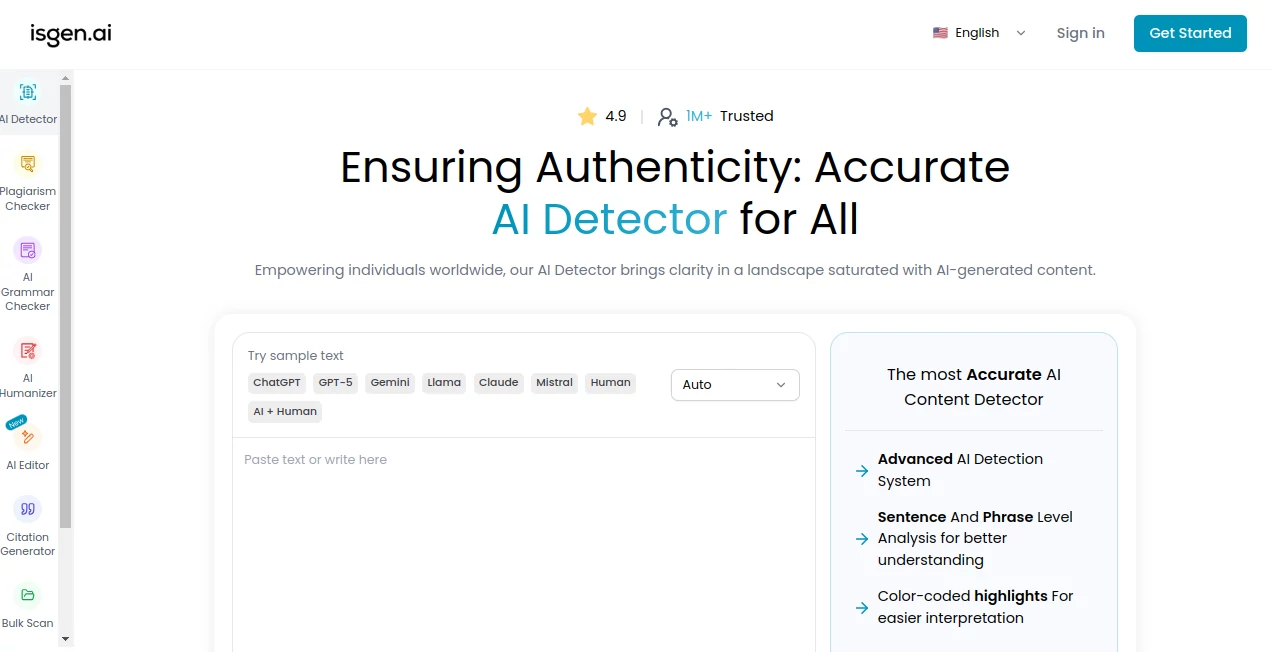
AI-generated content has become part of everyday writing, but knowing where human writing ends and machine-generated text begins is not always straightforward. Isgen brings AI detection, plagiarism checking, proofreading, editing, and humanization features together in one practical workspace. It is designed for educators, students, content creators, writers, and anyone who needs a clearer view of how a piece of text was produced.
One of its strongest advantages is its multilingual approach. The platform supports more than 80 languages, making it useful for international teams, multilingual publishers, and academic environments where English is only one part of the workflow. Instead of returning a single number and leaving users to guess what it means, the system provides sentence-level and phrase-level insights that make the result easier to examine.
The overall experience is particularly appealing for people who regularly move between writing and verification. A writer can draft and edit content, check its AI score, review language issues, and improve sections that sound unnatural without having to keep several unrelated tools open.
Key Features
- Advanced AI detection for identifying AI-generated writing.
- Support for more than 80 languages.
- Sentence-level and phrase-level AI analysis.
- Color-coded results for easier interpretation.
- Plagiarism checking for content originality.
- AI Editor for drafting, editing, proofreading, detection, and humanization.
- AI Humanizer for users who want to make robotic-sounding text more natural.
- AI Proofreader for grammar, spelling, punctuation, and other writing issues.
- AI Citation Generator for creating citations more conveniently.
- Batch file uploads and bulk scanning on eligible plans.
- Shareable and downloadable reports.
- Document history on paid plans.
User Interface
The interface is built around a straightforward workflow: provide text or upload a document, start the scan, and then examine the results. The main detection area keeps the process simple, while the detailed analysis gives users more information when they need it.
The color-coded highlighting is especially useful when reviewing longer documents. Rather than reading a report full of technical terminology, users can move through the document and see which sentences or phrases contributed to the result. This makes the platform feel more like a review workspace than a simple pass-or-fail checker.
The integrated editor is another practical touch. Writers can draft, edit, proofread, check an AI score, and humanize text in the same environment. For someone working on several articles in a day, avoiding constant tab switching can make a noticeable difference.
Accuracy & Performance
The detection system uses an ensemble of AI systems and language-understanding algorithms to analyze writing. Its analysis goes beyond looking at the document as one large block of text. The platform first evaluates the overall content and then provides more granular sentence and phrase-level analysis.
This approach is useful because an entire document does not always have a single writing origin. A student might write most of an assignment personally but use an AI assistant for a few paragraphs. Similarly, an editor may combine material from several sources. Sentence and phrase insights give users a better opportunity to investigate these differences instead of relying entirely on one overall percentage.
The service states that its detection system is designed to work across more than 80 languages and includes models such as ChatGPT, GPT-5, Claude, Gemini, DeepSeek, and others. As with any AI detector, results should be treated as an analytical signal rather than absolute proof of authorship.
Capabilities
The platform covers considerably more than AI detection. Its plagiarism checker can be used alongside AI analysis when originality matters, while the proofreading and editing features help users improve the underlying writing.
The AI Editor brings several of these functions into one workflow. Users can draft content, edit it, proofread it, monitor an AI score, and humanize passages that feel overly mechanical. This combination makes it useful for content teams as well as individual writers.
For larger workloads, paid plans add batch uploads and bulk scanning. The higher tier also supports large document scanning, unlimited monthly words, detailed analysis, document history, and priority support. These options make the service suitable for users who need to check content regularly rather than occasionally.
Security & Privacy
When reviewing academic papers, unpublished articles, business documents, or other original writing, privacy naturally becomes an important consideration. Users should review the platform's current terms and privacy documentation before uploading sensitive or confidential material, particularly when working with client documents or unpublished research.
From a workflow perspective, document history and downloadable or shareable reports can make it easier to keep track of previous checks. However, organizations handling confidential information should always evaluate the applicable data policies and internal requirements before adopting any online content-analysis service.
Use Cases
- Educators: Review student submissions for potential AI-generated passages and investigate unusual sections more closely.
- Students: Check assignments before submission and review passages that may appear overly machine-generated.
- Content creators: Examine articles and other published material for AI signals and originality issues.
- Editors: Review AI scores, language quality, and potentially problematic passages during the editing process.
- Publishers: Add an additional content-verification step to editorial workflows.
- International teams: Analyze writing across a wide range of supported languages.
- Researchers: Review documents for originality and investigate sections that require additional attention.
- Writers: Use the integrated editor, proofreader, and humanizer while working on new drafts.
Pros and Cons
- Pros: Supports more than 80 languages.
- Pros: Provides sentence-level and phrase-level AI insights.
- Pros: Combines AI detection with plagiarism checking and writing tools.
- Pros: Includes an integrated editor for drafting, editing, proofreading, and AI-score checking.
- Pros: Paid plans offer batch uploads and bulk scanning.
- Pros: Shareable and downloadable reports are available.
- Cons: The most advanced features require a paid subscription.
- Cons: Different plans have different limits for detection and humanization.
- Cons: AI detection results should be reviewed in context rather than treated as definitive proof.
Pricing Plans
The platform currently offers several subscription options designed around different types of users. The Academic plan costs $8 per month when billed annually and includes 350,000 detection words per month, advanced AI detection, plagiarism checking, detailed analysis, an AI Editor, batch uploads, and 15 days of document history.
The Writing plan costs $15 per month when billed annually and focuses on AI humanization and writing improvement. It includes 50,000 humanizer words per month, an AI Proofreader, AI Editor, Citation Generator, batch uploads, and 30 days of document history.
The Ultimate plan costs $24 per month when billed annually and combines the broader feature set. It includes unlimited words, AI detection, plagiarism checking, grammar checking, AI humanization, AI editing, proofreading, citation generation, bulk and large-document scanning, batch uploads, 30 days of document history, and priority support.
Annual billing currently advertises a 40% saving compared with the monthly option. Users can also change plans, while unused monthly words do not carry over to the following month.
How to Use Isgen
- Paste your text into the detection area or upload a document.
- Select the appropriate language from the supported options.
- Start the AI detection scan.
- Review the overall Human, AI, and Mixed breakdown.
- Open the detailed analysis to inspect individual sentences and phrases.
- Review the highlighted sections and their AI Impact scores.
- If necessary, edit or proofread the content using the integrated writing tools.
- Use the available report options when you need to save or share the results.
Comparison with Similar Tools
Many AI detectors concentrate almost entirely on producing an AI probability score. This platform takes a broader approach by combining detection with plagiarism checking, proofreading, editing, citation generation, and humanization.
The detailed sentence and phrase analysis is also an important distinction. Instead of simply telling a user that a document has a particular AI score, it helps identify the parts of the document that influenced the result. This can be particularly useful in academic or editorial situations where a reviewer needs to understand why a section deserves further attention.
Its multilingual support is another strong point. With more than 80 supported languages, it can be considered by international teams that find English-only detection tools too restrictive. The right choice will ultimately depend on the languages, document volume, reporting requirements, and writing features a user needs.
Conclusion
For users who want more than a basic AI checker, this platform offers a well-rounded content verification and writing environment. Its combination of multilingual detection, detailed sentence and phrase analysis, plagiarism checking, proofreading, editing, and humanization makes it useful across academic, editorial, and professional workflows.
The strongest part of the experience is the level of detail available after a scan. Seeing which sections contribute to an AI result is much more actionable than receiving a single percentage. Add the integrated editor and the ability to work with larger batches on premium plans, and the service becomes a practical option for anyone who regularly reviews or produces written content.
It is not a substitute for human judgment, especially when the consequences of an AI-detection result are significant. Used as a review and investigation tool, however, it can give writers, educators, editors, and organizations a useful extra layer of insight into the content they handle.
Frequently Asked Questions (FAQ)
What does the AI detector check?
It analyzes written content to estimate whether passages are likely to be AI-generated or human-written. Results can include Human, AI, and Mixed classifications, with additional sentence and phrase-level insights.
How many languages are supported?
The platform states that its AI detector supports more than 80 languages, making it suitable for multilingual content workflows.
Does it include a plagiarism checker?
Yes. Plagiarism checking is available on the Academic and Ultimate plans, allowing users to combine originality checks with AI-content analysis.
Does it have an AI humanizer?
Yes. AI Humanizer functionality is included with the Writing and Ultimate plans. The feature is intended to help make text sound more natural and less robotic.
Can I upload documents instead of pasting text?
Yes. Document uploads are supported, and eligible plans also include batch file uploads and bulk scanning for users working with multiple documents.
Is there a free way to try it?
The platform provides a free starting experience for its AI Editor and detection workflow, while advanced usage limits and additional tools are available through its paid plans.
AI Detector , AI Plagiarism Checker , AI Grammar Checker , AI Content Detector .
These classifications represent its core capabilities and areas of application. For related tools, explore the linked categories above.

isgen.ai Alternatives Product

GPTZero

AI ATS Check…

Reverse Vide…

Spell Checki…

Rephrazy

ieltswriting…

EditForge

AHelp

StealthGPT