















Joryio
Verified Blue CheckMark
Verified Blue CheckMark products are featured above free or unverified listings.
This badge indicates authenticity and builds trust, giving your product higher visibility across the platform.
Upgrade to get verified
Verified Blue CheckMark products are featured above free or unverified listings. This badge indicates authenticity and builds trust, giving your product higher visibility across the platform.
Upgrade to get verified
What is Joryio?
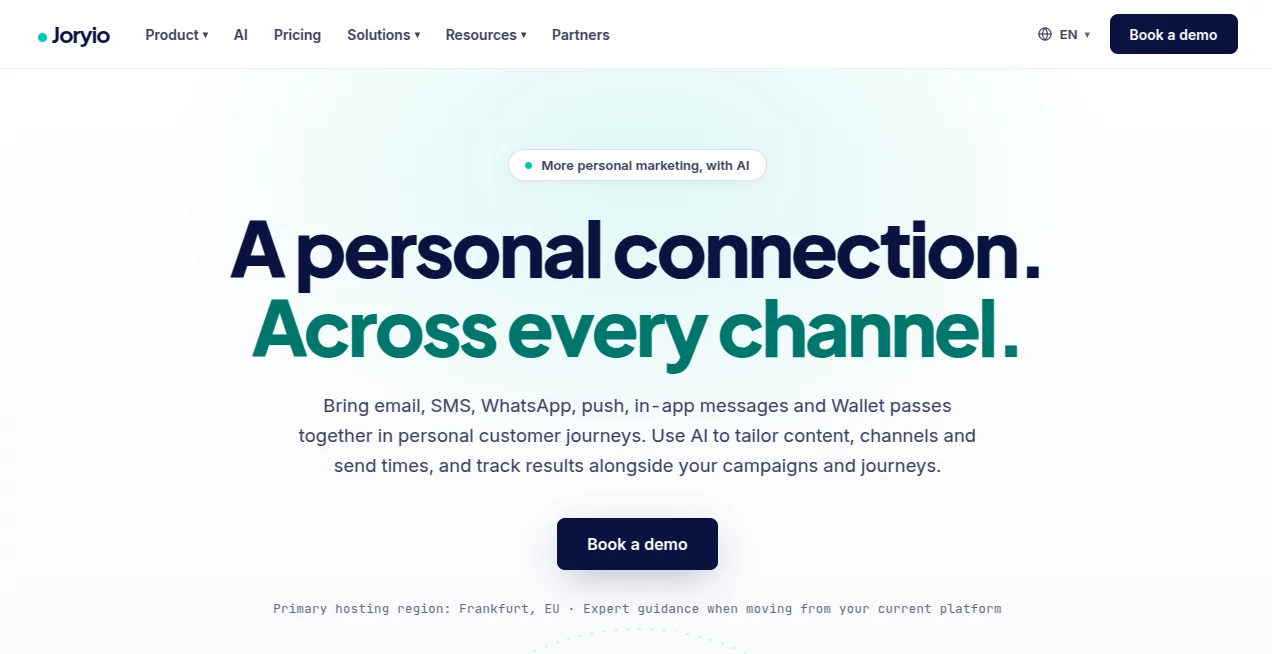
Modern marketing is about more than sending a large number of messages. Businesses need to understand what customers care about, recognize when they are ready to engage, and communicate through channels they actually use. Joryio brings these activities together in one platform, combining AI-powered personalization, customer messaging, analytics, and data streaming.
Instead of managing separate tools for campaigns, customer journeys, and performance reports, marketing teams can coordinate their work in a shared environment. The platform supports email, SMS, WhatsApp, push notifications, in-app messages, Viber, and digital wallet passes. This makes it particularly useful for businesses that want consistent communication throughout the customer lifecycle.
Another notable advantage is its emphasis on measurable results. Teams can track customer behavior, examine conversion funnels, and compare campaign performance against control groups. The goal is not simply to send more messages, but to understand which interactions encourage customers to return, purchase, or remain engaged.
Key Features
User Interface
The platform brings campaigns, customer journeys, audience segments, and analytics into a unified workspace. Marketing teams can organize communication flows without constantly switching between unrelated applications.
Its journey-building approach helps teams connect different actions in a logical sequence. For example, a business could welcome a new customer by email, wait for a specific interaction, and then send a relevant follow-up through another channel. Conditions and timing can be adjusted to match the company's marketing strategy.
AI-assisted drafting adds another practical layer. Users can describe the audience or outcome they want in ordinary language and receive a draft journey, segment, or message to review. This reduces repetitive setup work while allowing the team to retain control over the final result.
Accuracy & Performance
Rather than relying on generic promises about AI accuracy, the platform focuses on campaign measurement and customer-level data. Teams can review funnels, retention, revenue attribution, and other performance indicators alongside the campaigns that generated them.
AI can help select appropriate content, channels, offers, and sending times according to customer activity and the rules established by the business. Personalized delivery times can account for individual activity patterns and time zones while respecting configured quiet hours.
Control groups and campaign experiments provide a more useful way to assess whether personalization is producing meaningful improvements. Reports can also filter detected bot activity from email opens, helping teams avoid treating every recorded interaction as genuine customer engagement. Actual results will depend on data quality, audience behavior, campaign design, and the quality of the underlying offer.
Capabilities
The platform combines several capabilities that are often spread across separate marketing and analytics products.
- Multichannel messaging: Coordinate email, SMS, WhatsApp, Viber, push notifications, in-app messages, webhooks, advertising audiences, and digital wallet passes.
- AI content generation: Prepare message drafts, campaign content, and templates that follow a business's preferred tone and vocabulary.
- Customer segmentation: Build audiences from customer attributes, purchases, preferences, and behavioral events.
- Automated customer journeys: Create conditional workflows that respond to sign-ups, purchases, inactivity, and other meaningful customer actions.
- Personalized recommendations: Present relevant products based on catalog information, previous activity, and customer preferences.
- Marketing analytics: Examine conversion funnels, retention, purchase patterns, and attributed revenue.
- Monitoring and alerts: Identify unusual changes in campaign results, event streams, and message delivery.
- Data streaming and integrations: Connect existing business systems and send event data to supported data warehouses.
- Developer support: Use REST API access and SDKs for web, iOS, Android, Unity, and React Native integrations.
AI agents can also be configured with specific instructions, permitted data, and expected outputs. Depending on the feature, businesses can use supported AI providers through the platform or connect their own provider accounts. This flexibility is helpful for teams that need more control over how AI fits into existing processes.
Security & Privacy
Customer communication requires careful handling of personal information and consent. The platform includes tools for managing communication preferences, opt-outs, quiet hours, and message-frequency limits. These controls help teams align campaigns with customer choices instead of treating every contact as automatically eligible for every message.
The primary hosting region for the platform and its core databases is Frankfurt, Germany. Access-management options include multifactor authentication and passkeys, with additional single sign-on and access restrictions available according to the plan. AI connections can use encrypted credentials, and supported features provide controls over the data supplied to agents.
Businesses should still review the applicable data-processing terms, subprocessors, retention requirements, and international transfer arrangements before importing customer information. Available safeguards do not automatically guarantee compliance with every privacy law or eliminate the need for appropriate consent and internal policies.
Use Cases
The combination of messaging, automation, and analytics makes the platform suitable for several business scenarios.
- Online stores: Follow up on abandoned carts, recommend relevant products, communicate order updates, and reconnect with customers who have not purchased recently.
- SaaS companies: Guide new users through onboarding, explain useful features, encourage product adoption, and introduce upgrades when customers approach relevant usage limits.
- Subscription businesses: Identify customers showing signs of inactivity, create retention campaigns, and measure whether re-engagement efforts improve renewals.
- Marketing agencies: Coordinate customer journeys and campaign reporting while maintaining consistent messaging across multiple channels.
- Customer loyalty programs: Use digital wallet passes to communicate membership benefits, points, and relevant offers.
- Data-driven marketing teams: Connect behavioral events with audience segmentation and revenue reporting to make campaign decisions using a broader view of customer activity.
- AI application developers: Build onboarding and retention messages that respond to product usage, helping users discover features and return to the application.
Consider a subscription service with many people who register but never complete their first project. The team could create an onboarding journey that sends a helpful email, checks whether the customer has returned, and follows up with an appropriate in-app message. Performance reports would then help the team determine whether the sequence improves activation instead of relying on assumptions.
Pros and Cons
Pros
- Combines customer messaging, automation, analytics, and data streaming in one platform.
- Supports a broad selection of communication channels.
- Uses AI to assist with campaign drafts, segmentation, content, and personalization.
- Allows teams to review AI-generated drafts before applying changes.
- Provides control groups and experiments for evaluating campaign performance.
- Includes customer consent and communication-preference management.
- Offers API access and SDKs for integrating with existing applications.
- Provides expert assistance for businesses migrating from established marketing platforms.
Cons
- The starting subscription price may be too high for freelancers, small websites, and businesses with limited marketing budgets.
- Message delivery charges are separate from platform fees, making total costs dependent on channel selection and sending volume.
- Setting up useful customer journeys requires reliable event tracking and a clear understanding of customer behavior.
- Businesses with simple email requirements may find the range of features unnecessary.
- Advanced AI capabilities, access controls, and support options vary by subscription tier.
- Organizations may need technical assistance to configure integrations, migrate data, and validate their reporting.
Pricing Plans
The pricing model is based on engaged profiles rather than the total number of contacts stored or events tracked. An engaged profile is a customer profile that receives at least one successfully delivered message during a billing month. Messaging delivery costs are billed separately from the platform subscription.
- Growth: Starts at $490 per month for 25,000 engaged profiles. Higher published tiers include $690 for 50,000 profiles, $990 for 100,000 profiles, and $1,690 for 250,000 profiles. This plan includes AI-personalized sending times and alerts, one data-streaming destination, and standard support.
- Scale: Starts at $1,690 per month for 100,000 engaged profiles. Published tiers include $2,290 for 250,000 profiles, $3,490 for 500,000 profiles, and $4,990 for one million profiles. It adds the full set of AI features, unlimited data-streaming destinations, expanded access controls, and priority support with onboarding assistance.
- Enterprise: Custom pricing for organizations with more than one million engaged profiles. The pricing page indicates that arrangements start at around $60,000 per year. Enterprise features include higher AI usage limits, SAML, SCIM, audit-log exports, and options for dedicated customer success and customized service agreements.
Actual platform fees adjust according to the number of engaged profiles, including volumes between the published tiers. Longer contractual commitments may qualify for negotiated discounts. Businesses should also budget for message delivery, which varies by channel and destination country. Checking the current pricing terms and requesting a tailored quote is advisable before committing.
How to Get Started
Getting useful results from the platform begins with a clear marketing objective and reliable customer data. A structured setup can help teams avoid unnecessary complexity.
- Step 1: Define your goal. Decide whether the immediate priority is onboarding, customer retention, abandoned-cart recovery, repeat purchases, or another measurable outcome.
- Step 2: Connect your systems. Integrate your website, application, online store, or data warehouse using the supported connections, APIs, and SDKs.
- Step 3: Review customer data. Check that profiles, purchase events, preferences, and activity records are accurate and that communication permissions are handled correctly.
- Step 4: Build an audience. Create a segment based on meaningful conditions, such as customers who completed a purchase but have not returned within a specified period.
- Step 5: Draft a journey. Use the available workflow tools and AI assistance to prepare messages, timing rules, and follow-up conditions. Review every generated draft before activating it.
- Step 6: Test the experience. Confirm that messages arrive correctly, links work, opt-outs are respected, and each journey follows the intended conditions.
- Step 7: Measure and improve. Monitor conversions, retention, delivery, and revenue attribution. Use experiments and control groups where appropriate to evaluate whether changes are actually helping.
Starting with one well-defined journey is usually more practical than automating every marketing activity at once. Once the first workflow is reliable, the team can expand to additional channels and customer segments.
Comparison with Similar Tools
Choosing a marketing platform depends on the channels a business uses, the complexity of its customer journeys, its reporting requirements, and the systems already in place. The following comparison highlights general differences between this platform and several established alternatives.
- Klaviyo: Often considered by ecommerce businesses that want customer segmentation, email and SMS marketing, and commerce-focused automation. It can be a natural fit for stores seeking a specialized ecommerce marketing ecosystem.
- Braze: A customer-engagement platform suited to organizations coordinating sophisticated messaging and lifecycle campaigns across digital channels. It is worth evaluating for larger teams with complex engagement requirements.
- Customer.io: Known for behavior-driven messaging and automated customer journeys. It can be relevant to SaaS businesses and product teams that want communication triggered by user activity.
- HubSpot: Combines marketing automation with CRM and broader sales and service capabilities. Businesses looking for a wider customer-management ecosystem may prefer to evaluate its integrated approach.
- Joryio's approach: The distinguishing proposition is the combination of multichannel customer messaging, AI-assisted personalization, analytics, and data streaming, with platform fees based on engaged profiles. This can appeal to teams seeking to connect campaign execution and measurement in the same environment.
These products have different feature sets, pricing structures, and integration options, so the comparison should be treated as a starting point rather than a definitive ranking. Before migrating, compare the channels you actually need, total delivery costs, data-export options, reporting requirements, and the work involved in transferring existing customer journeys.
Conclusion
Joryio brings together several important parts of modern customer engagement: communication, behavioral data, AI-assisted decisions, and campaign measurement. Its multichannel approach can help businesses replace disconnected workflows with coordinated journeys that respond to what customers actually do.
The strongest value lies in connecting personalization with measurable outcomes. Rather than generating messages for their own sake, teams can use customer activity to decide what to send, when to send it, and how to evaluate the result. Draft approvals, consent controls, and configurable rules also help keep automation aligned with business requirements.
The main consideration is cost. With subscriptions starting at $490 per month and delivery charges billed separately, the platform is better suited to established businesses and growing teams with a meaningful customer-engagement budget than to users seeking a basic free email tool. For organizations that need advanced journeys, multiple messaging channels, and connected analytics, it is a compelling option to evaluate.
Frequently Asked Questions (FAQ)
What does the platform do?
It combines multichannel customer messaging, AI-assisted marketing, automated journeys, analytics, audience segmentation, and data streaming. Businesses can use it to personalize communication and measure customer engagement.
Which communication channels are supported?
Supported channels include email, SMS, WhatsApp, Viber, push notifications, in-app messages, webhooks, advertising audiences, and digital wallet passes. Availability and setup requirements may vary by integration and use case.
Can AI create complete marketing campaigns?
AI can draft campaign content, customer segments, and journeys based on user instructions and workspace data. Users can review and edit these drafts before approving changes. Activated journeys can also use AI for personalization within configured rules.
How much does it cost?
The Growth plan starts at $490 per month, while Scale starts at $1,690 per month. Enterprise pricing is customized. Messaging delivery is charged separately, so the total cost depends on the number of engaged profiles and the channels used.
Does the platform charge for every stored contact?
Platform fees are based on engaged profiles, which are profiles that receive at least one successfully delivered message during the billing month. Contact storage and event tracking are included subject to fair-use limits. The exact billing rules should be reviewed before choosing a plan.
Can it integrate with an existing application?
Yes. Supported integration options include REST API access and SDKs for web, iOS, Android, Unity, and React Native. The platform also supports connections with selected ecommerce systems, analytics products, advertising platforms, and data warehouses.
Is customer data protected?
The platform provides consent-management tools, access controls, and security-related features. Its core platform and databases are hosted in Frankfurt, Germany. Businesses should review the privacy policy, data-processing agreement, subprocessors, and applicable legal obligations before processing personal data.
Is it suitable for a small business?
It may suit a small business with an established customer base and a budget for advanced marketing automation. However, the starting subscription price and separate messaging charges may be difficult to justify for a very small operation with basic communication needs.
How can a business evaluate whether it is working?
Teams can examine conversion funnels, retention, revenue attribution, message delivery, and campaign results. Experiments and control groups can help distinguish the contribution of personalization from changes that might have occurred without the campaign.