


















K-Dense
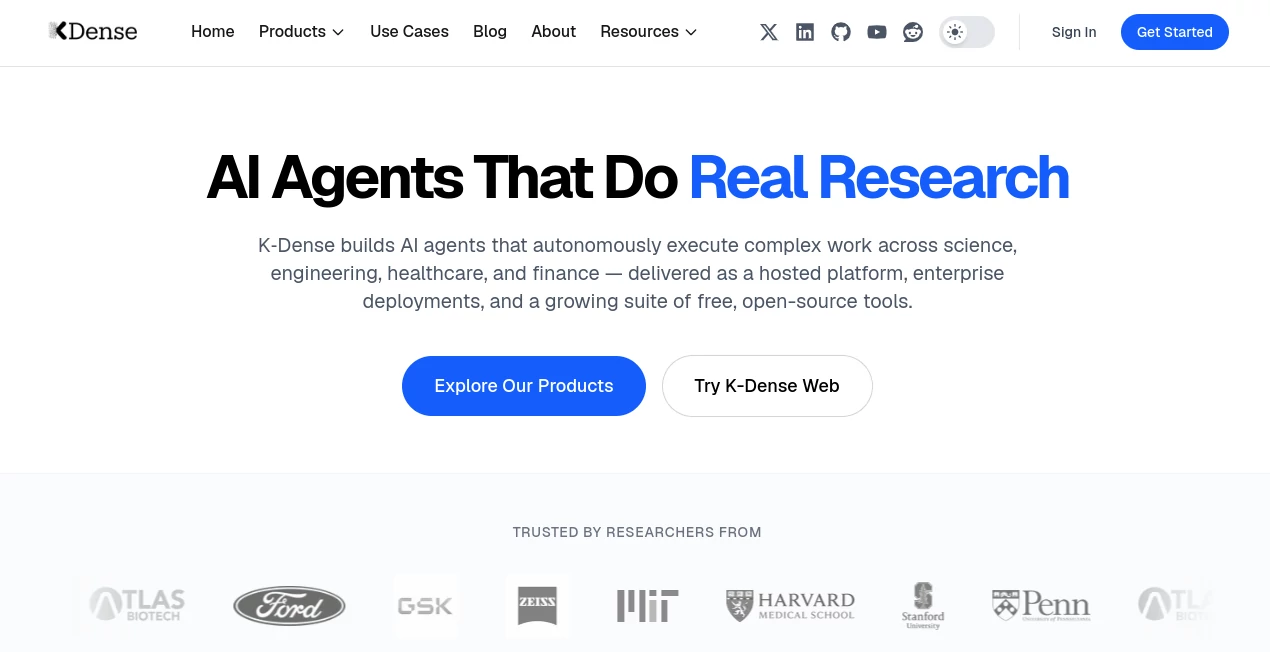
What is K-Dense?
K-Dense is built for a different kind of AI experience: one where the system does more than answer a question. It can take a research goal, break it into smaller tasks, work through data and sources, perform analysis, and turn the results into useful reports and visualizations. The platform is aimed at complex work across science, engineering, healthcare, finance, and other research-heavy fields.
For someone who spends hours collecting papers, cleaning datasets, comparing findings, or preparing research reports, this approach can be particularly useful. Instead of treating every task as a separate chat, the platform is designed to handle the workflow from beginning to end.
Its hosted research environment has access to more than 250 databases, hundreds of thousands of on-demand tools, and support for more than 200 scientific data formats. That combination makes it especially interesting for researchers who need more than general-purpose AI answers.
Key Features
- Autonomous multi-step research workflows
- Access to more than 250 scientific and specialized databases
- Support for more than 200 scientific data formats
- On-demand tools for research and analysis
- Deep research and literature review with cited sources
- Data analysis, modeling, and visualization
- Publication-ready reports, figures, and tables
- Support for science, engineering, healthcare, finance, and market research
- Integration with external tools through the Model Context Protocol
- Open-source research tools and scientific agent skills
User Interface
The experience is centered around describing what you want to accomplish rather than manually assembling a long chain of individual tools. Users can upload data or explain a research objective, after which the agent plans and executes the required steps.
This workflow can be particularly helpful when the project involves several stages. For example, a researcher might provide spreadsheets and ask for statistical analysis, relevant references, visualizations, and a structured report. Instead of repeatedly switching between different applications, the work can remain within one research environment.
The overall design feels more appropriate for serious research than a conventional chatbot. The goal is not simply to produce a quick paragraph, but to help move a project from raw information toward a finished research deliverable.
Accuracy & Performance
Research accuracy depends heavily on the quality of the underlying data, methodology, and human verification, so the platform does not remove the need for expert judgment. Its advantage is the structured way it approaches complex tasks, including planning, analysis, source gathering, and validation.
The platform highlights reproducibility and documented methodology as important parts of its approach. Its own reported figures include a 107× median time compression across a 67-case audit, while its infrastructure provides access to a large collection of research databases and scientific formats.
Real-world feedback also points to substantial time savings. Researchers featured by the company describe workflows that would normally take days or even weeks being completed through automated analysis and reporting. These experiences are encouraging, although important scientific conclusions should always be reviewed by a qualified human.
Capabilities
The strongest part of the platform is the breadth of work it can coordinate. It can perform deep research, analyze datasets, investigate scientific literature, work with bioinformatics and genomics tasks, support drug-discovery research, and produce professional reports and visual outputs.
Its capabilities also extend beyond traditional scientific research. Financial analysis, market research, competitive intelligence, healthcare data, engineering analysis, and other technical workflows are supported.
The ecosystem is another notable advantage. Alongside the hosted research environment, there are open-source projects for local AI-assisted research, scientific writing, specialist research skills, and multi-agent workflows. This gives technically minded users more flexibility in how they build their research setup.
Security & Privacy
Data security is an important consideration for research projects, particularly when datasets contain confidential information. Uploaded data is encrypted in transit and at rest, and the service states that it does not train AI models on user data.
Users retain ownership of their generated outputs, while sessions can be deleted through the interface. Organizations with stricter requirements can use enterprise options that include additional security controls, private deployments, audit logging, and custom deployment arrangements.
For sensitive research, however, users should still review the applicable security documentation and organizational requirements before uploading confidential or regulated information.
Use Cases
Scientific Research: Researchers can investigate questions, collect relevant literature, analyze datasets, and produce structured research outputs without manually coordinating every stage.
Bioinformatics: The platform is designed to support genomics, biological datasets, cancer research, molecular analysis, and other computational biology workflows.
Healthcare Research: Clinical and healthcare-related data analysis can benefit from automated research workflows, particularly when multiple sources and analytical steps are involved.
Financial Analysis: Analysts can use the system for financial research, modeling, investigation, and structured analysis of complex information.
Market Research: Competitive intelligence and market investigations can involve large quantities of scattered information. An autonomous research workflow can help bring those pieces together into a more coherent result.
Academic Writing: Researchers preparing papers, literature reviews, reports, grant proposals, or posters can benefit from research-backed writing and citation-focused workflows.
Pros and Cons
- Pros: Excellent fit for complex research tasks
- Pros: Access to 250+ databases and a large collection of specialized tools
- Pros: Supports more than 200 scientific data formats
- Pros: Can automate multi-step analysis instead of only answering questions
- Pros: Generates reports, figures, and tables
- Pros: Strong focus on scientific and technical workflows
- Pros: Includes useful open-source projects for users who prefer local workflows
- Cons: Advanced research workflows consume credits
- Cons: The pricing can be significant for individuals with frequent heavy workloads
- Cons: Results still require human review, particularly for important scientific or financial decisions
Pricing Plans
The hosted service uses a credit-based pricing model. The Personal option works on a pay-as-you-go basis, allowing users to purchase credits without committing to a monthly subscription. The Instant effort level is free, while more advanced research runs consume credits.
The Plus plan costs $199 per month and includes 300 credits refreshed each month. An annual option is available for $1,799 per year.
The Team plan costs $499 per month and provides 800 monthly credits shared across the team, with unlimited seats. The annual Team option costs $4,499 per year.
Organizations that require private deployments, custom integrations, additional security controls, dedicated support, or specialized infrastructure can choose an Enterprise arrangement with custom pricing.
Academic laboratories and eligible nonprofit research organizations can also apply for the research grant program, which offers the annual Team plan at a substantial discount.
How to Use K-Dense
- Create an account and open the hosted research workspace.
- Describe the research question, business problem, or analytical objective you want to solve.
- Upload relevant datasets or provide the information required for the task.
- Allow the AI agent to break the project into smaller research and analysis steps.
- Review the sources, methodology, calculations, and intermediate results when appropriate.
- Use the generated reports, tables, figures, and other outputs as the foundation for your final work.
- Verify important findings before using them in publications, business decisions, or other high-stakes applications.
Comparison with Similar Tools
General-purpose AI assistants are excellent for conversation, brainstorming, summarization, and quick explanations. Research-oriented work can be different. A serious project may require source discovery, code execution, data analysis, repeated refinement, and a final report.
This platform distinguishes itself by focusing on that complete workflow. Rather than requiring the user to orchestrate every step manually, its research agent can plan and execute multi-stage tasks. Access to specialized scientific databases and data formats also gives it a more focused role than a standard conversational assistant.
It is not necessarily a replacement for every AI research product. Someone looking for a simple chatbot may find a general assistant faster for everyday questions. But for projects involving datasets, literature, scientific analysis, and professional deliverables, an autonomous research workflow can be considerably more useful.
Conclusion
For researchers and technical professionals dealing with complicated projects, the biggest appeal here is not simply the AI itself. It is the attempt to automate the tedious coordination surrounding research: finding information, processing data, running analysis, checking results, and preparing polished outputs.
The combination of specialized databases, scientific data support, autonomous workflows, research-focused tools, and open-source projects makes this a compelling option for people who regularly work with complex information.
It is best approached as a research partner rather than an unquestionable authority. The system can dramatically reduce the amount of manual work involved, but expert review remains essential when the results affect publications, scientific conclusions, healthcare, or financial decisions.
Frequently Asked Questions (FAQ)
What is K-Dense?
It is an AI agent platform designed to autonomously execute complex research and analytical workflows across areas such as science, engineering, healthcare, and finance.
Can it analyze scientific datasets?
Yes. The platform supports more than 200 scientific data formats and can perform multi-step data analysis, modeling, and visualization as part of larger research workflows.
Does it perform literature research?
Yes. It can conduct deep research and literature reviews using cited sources and specialized research databases.
Is there a free option?
The hosted platform includes a free Instant effort level for direct answers. More advanced research runs use credits. There are also free and open-source research tools that can be run locally.
Is my data used to train AI models?
The service states that it does not train AI models on data uploaded to its hosted platform. Data is encrypted in transit and at rest, and users retain ownership of their outputs.
Does it support teams?
Yes. The Team plan provides a shared pool of monthly credits, unlimited seats, and access to the full hosted feature set. Enterprise customers can also request custom integrations and security controls.
Can it create research reports?
Yes. The platform can generate professional reports, figures, and tables, making it useful for turning research and analysis into more presentable deliverables.
Should researchers trust its results without checking them?
No. AI-generated research outputs should always be reviewed and verified, especially before they are used in academic publications, scientific conclusions, healthcare decisions, or other high-stakes contexts.
AI Knowledge Management , AI Education Assistant , AI Research Tool , AI Developer Tools .
These classifications represent its core capabilities and areas of application. For related tools, explore the linked categories above.

K-Dense Alternatives Product

Where Is Thi…

Lynote

LocalRAG!

PTEcorepract…

Velokey

CloudByte PMS

Blackbox AI

TutuoAI

NotebookVault
