


















LandingBoost
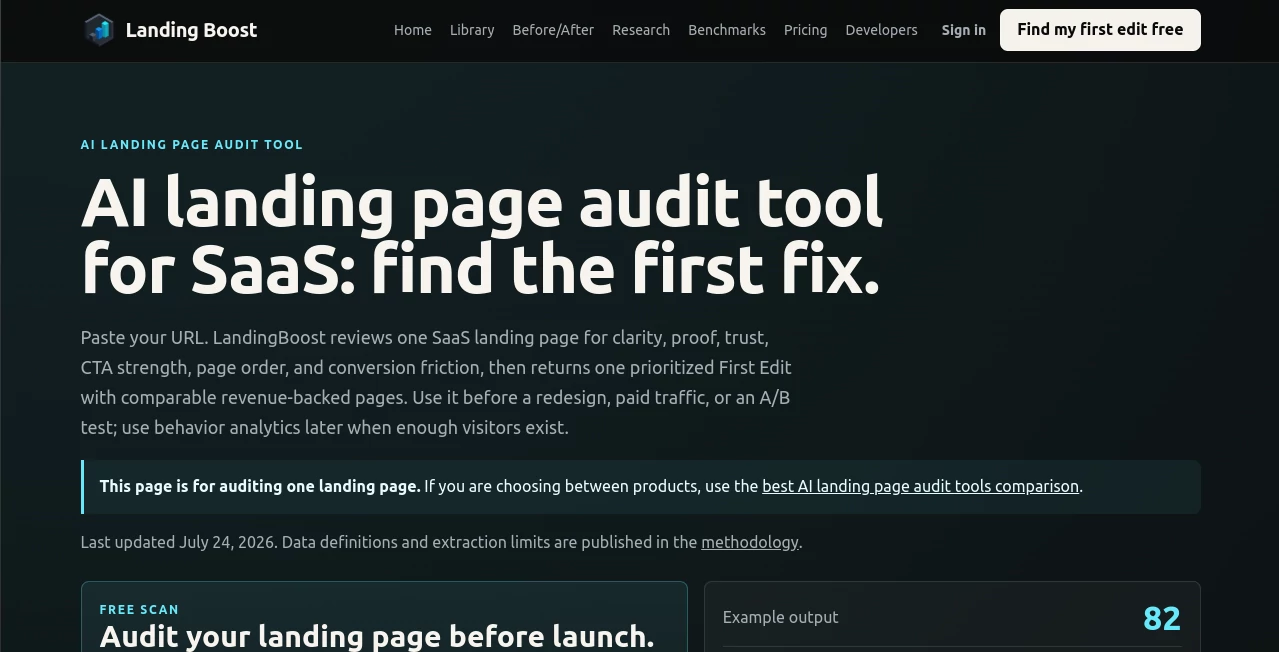
What is LandingBoost?
Landing pages often lose potential customers for reasons that are surprisingly easy to overlook. A headline may sound good but fail to explain the product quickly. A call-to-action may be visible but not convincing. Testimonials may exist, yet appear too far from the moment when a visitor needs reassurance.
LandingBoost is built around a simple idea: instead of giving SaaS founders a long list of things to improve, identify the most important conversion problem and decide what should be changed first. The tool analyzes a live landing page and evaluates areas such as clarity, relevance, trust, proof, CTA strength, page order, and conversion friction.
This makes it particularly useful before launching paid traffic, redesigning a website, or spending time on an A/B test. Rather than immediately changing ten different sections, founders can start with one focused improvement and then rescan the page to see how the score changes.
The approach is also backed by a growing collection of landing page references and benchmark data. One published analysis of 2,048 scans found that trust was the first bottleneck on 81.3% of analyzed landing pages, showing why credibility and proof can be such important conversion factors.
Key Features
- AI landing page audit: Reviews a live SaaS landing page and looks for conversion issues across important visitor-facing elements.
- Prioritized first edit: Instead of presenting dozens of equally weighted recommendations, the system identifies the main bottleneck and suggests a practical first change.
- Clarity analysis: Checks whether visitors can quickly understand who the product is for and what outcome it provides.
- Trust and proof evaluation: Looks at testimonials, credibility signals, numbers, logos, privacy cues, and other evidence that can reduce hesitation.
- CTA analysis: Reviews whether the primary action is clear, specific, appropriate for the visitor's stage, and easy to understand.
- Page-order review: Examines whether the sequence of sections addresses important objections before asking visitors to take action.
- Conversion-friction analysis: Highlights elements that may make the journey toward the next click unnecessarily difficult.
- Revenue-backed references: Recommendations can be compared with examples from other landing pages rather than relying only on generic conversion advice.
- Rescanning: Users can scan a page again after making changes and observe how its score and individual areas move.
User Interface
The interface follows a straightforward workflow. The user starts by entering a landing page URL and requesting a scan, so there is no complicated setup process or lengthy configuration before seeing the initial assessment.
The results are organized around a score, individual conversion areas, the primary bottleneck, and the recommended next edit. This is a useful design choice for busy founders. You can quickly see whether the problem is related to trust, clarity, action, or another part of the page without digging through a massive report.
The example results also make the recommendation easy to interpret. Instead of simply saying that trust is weak, the system can suggest moving existing outcome proof closer to the CTA. That difference matters because a diagnosis becomes much more useful when it points toward an actual page change.
Accuracy & Performance
The value of an automated landing page audit depends heavily on the quality of its evaluation criteria. This platform focuses on conversion signals that are directly visible on the page, including messaging, proof, trust, CTA wording, section order, and friction.
Its benchmark layer adds another useful dimension. Recommendations can be supported by comparable SaaS landing pages and reference examples, giving founders something more concrete to consider than a generic score.
It is important to understand what an AI audit can and cannot tell you. The analysis is a diagnostic starting point, not a replacement for real visitor behavior. Once a page receives enough traffic, analytics, recordings, qualitative research, and controlled experiments can provide additional evidence about how people actually interact with it.
Capabilities
The strongest capability is its ability to turn a broad landing page review into a single decision. A founder who sees a page with weak messaging, insufficient proof, an unclear CTA, and several design problems could easily spend days trying to fix everything at once.
Instead, the audit is designed to answer a more useful question: what should be fixed first?
The scoring system evaluates four main conversion dimensions: clarity, relevance, trust, and action readiness. These areas help create a more practical picture of whether a visitor is likely to understand the offer, believe it, and know what to do next.
The tool is particularly suited to SaaS products, AI products, developer tools, lead-generation products, SEO products, and other digital businesses where the landing page plays an important role in turning visitors into signups or customers.
Security & Privacy
Landing page auditing naturally requires the system to process the URL and information available on the page. The service states that scan data is stored, and high-scoring pages may appear on its public leaderboard with the domain and score only. The full scan remains private according to the product information provided on the website.
For businesses working with sensitive or confidential landing pages, it is sensible to review the current privacy policy and terms before submitting a page. This is especially important when a page contains information that is not intended for public analysis.
Use Cases
SaaS founders preparing for launch: A new product can be reviewed before advertising money is spent. Finding a weak value proposition or missing trust signal early can prevent avoidable conversion problems.
Teams preparing paid campaigns: Sending paid visitors to a page that has not been reviewed can make advertising performance harder to interpret. An audit can provide a useful pre-campaign checkpoint.
AI product companies: AI products often require visitors to understand a new concept quickly. Reviewing clarity, proof, and CTA strength can help make the first interaction easier.
Landing page redesigns: Before completely rebuilding a page, teams can identify the existing bottleneck and make a smaller, more focused change first.
Conversion optimization: When a founder has several possible improvements in mind, the prioritized recommendation can help determine which change deserves attention first.
Low-traffic websites: When there is not yet enough behavioral data for reliable experimentation, a structured page audit can provide a useful starting hypothesis.
Pros and Cons
- Pros: Focuses on finding the first conversion improvement rather than overwhelming users with a long checklist.
- Pros: Evaluates important conversion factors including clarity, trust, proof, CTA strength, page order, and friction.
- Pros: Uses comparable landing page references to support recommendations.
- Pros: Offers a free initial scan, making it easy to test the approach before paying.
- Pros: Rescanning makes it possible to review progress after implementing changes.
- Cons: It is primarily focused on landing-page diagnosis rather than visitor behavior analytics.
- Cons: It does not replace A/B testing when a website has enough traffic for statistically useful experiments.
- Cons: The strongest use case is SaaS and similar digital products, so it may be less useful for completely different types of websites.
Pricing Plans
The service uses a simple pay-once pricing model rather than recurring subscriptions.
The free scan allows users to evaluate a landing page and see the initial diagnosis. When a user wants the exact recommended edit, supporting reference evidence, and a paste-ready implementation prompt, the individual page option costs $9 per page.
For users working on multiple pages, the Launch Pack costs $49 as a one-time purchase. It includes unlimited scans and rescans, exact edits and prompts for each page, reference evidence, and additional launch-focused features. The pricing page states that there are no recurring charges.
How to Use It
- Open the landing page audit tool.
- Enter the URL of the SaaS landing page you want to evaluate.
- Run the free scan.
- Review the overall score and the four main conversion dimensions.
- Check the primary bottleneck identified by the audit.
- Read the recommended first edit and the reasoning behind it.
- Use the available reference examples to understand how similar pages approach the same conversion issue.
- Make the recommended change on your landing page.
- Run another scan to compare the updated result.
- Once the page is in better shape, use analytics or A/B testing to validate how real visitors respond.
Comparison with Similar Tools
There are several different types of landing page analysis products, and they serve different purposes. General AI page graders can be useful when you want a broad review covering areas such as copy, design, SEO, accessibility, or overall page health.
Behavior analytics platforms take another approach. They become more valuable once visitors are already arriving because they can show clicks, scrolling behavior, recordings, and points where users drop off.
A/B testing platforms are different again. They are designed to measure the effect of competing versions of a page when there is enough traffic and a clearly defined hypothesis.
The main distinction here is the focus on the first conversion edit. It sits naturally before those later stages: diagnose the likely bottleneck, make a focused improvement, rescan the page, and then use real visitor data to validate the hypothesis.
For a founder who looks at a landing page and thinks, “There are ten things I could change, but which one matters most?”, that narrower approach can be much more practical than receiving another large collection of recommendations.
Conclusion
A good landing page audit should do more than point out problems. It should help a business decide what deserves attention first.
This tool takes that approach by examining clarity, relevance, trust, action readiness, proof, CTA strength, page order, and conversion friction, then reducing the findings to a prioritized recommendation. The benchmark references add another useful layer by showing how comparable pages address similar conversion challenges.
For SaaS founders preparing a launch, improving an underperforming page, or deciding what to change before investing in traffic, it offers a practical starting point. The best workflow is simple: scan the page, make one meaningful change, rescan it, and then use real visitor data to confirm whether the improvement actually works.
Frequently Asked Questions (FAQ)
What is an AI landing page audit tool?
An AI landing page audit tool reviews a landing page for potential conversion problems such as unclear messaging, weak proof, trust gaps, CTA friction, and structural issues. It then provides recommendations for improving the page.
Can AI audit my landing page?
Yes. AI can evaluate visible landing page elements such as copy, structure, CTA wording, proof placement, and trust signals. The resulting recommendations are best treated as a starting hypothesis that can later be validated with real visitor data.
What does the audit check?
The analysis focuses on clarity, relevance, trust, action strength, proof placement, CTA wording, page order, and conversion friction. It can also compare the page with relevant landing page references.
Is the tool suitable for SaaS websites?
Yes. SaaS is the primary focus, with additional relevance for AI products, developer tools, lead-generation products, SEO tools, and other founder-built digital products.
Is there a free option?
Yes. Users can run a free scan to receive the initial landing page diagnosis. Paid access is available when a user wants the exact first edit, reference evidence, and implementation prompt.
How much does the paid version cost?
The individual page option costs $9 as a one-time purchase. A Launch Pack is available for $49 as a one-time payment and provides broader scanning and rescan capabilities. There are no recurring charges on the listed paid plans.
Does it replace Google Analytics or other analytics tools?
No. A landing page audit helps form a conversion hypothesis, while analytics tools show what real visitors actually do. Using both at the appropriate stage provides a stronger optimization process.
Should I use it before an A/B test?
Yes. It can be useful before an experiment when you need to decide which page element should be changed first. Once you have sufficient traffic and a clear hypothesis, an A/B test can provide stronger evidence about the impact of that change.
Can I rescan my landing page after making changes?
Yes. Rescanning is part of the workflow, allowing users to compare the page after making an improvement and see whether its score and conversion areas have changed.
Is my landing page scan public?
The service states that scan data is stored and that high-scoring pages may appear on a public leaderboard with the domain and score. The full scan is kept private according to the product information.
What makes this different from a general website grader?
The main difference is the narrower objective. Rather than trying to evaluate every possible aspect of a website, the audit is designed to identify the most important conversion bottleneck and recommend one prioritized edit for a SaaS landing page.
AI Landing Page Builder , AI Digital Marketing Generator , AI Analytics Assistant , AI Advertising Assistant .
These classifications represent its core capabilities and areas of application. For related tools, explore the linked categories above.
LandingBoost details
Website unavailable — View Alternatives
Pricing
- Freemium
Apps
- Web App
Categories

LandingBoost Alternatives Product

BuildrShip

Pixelied

Lebesgue: AI…

Website Audi…

RankingRider

PortBackLinks

PurityRadar

QuickFlip.AI

Ad Suite AI
