

















YesNoMystery
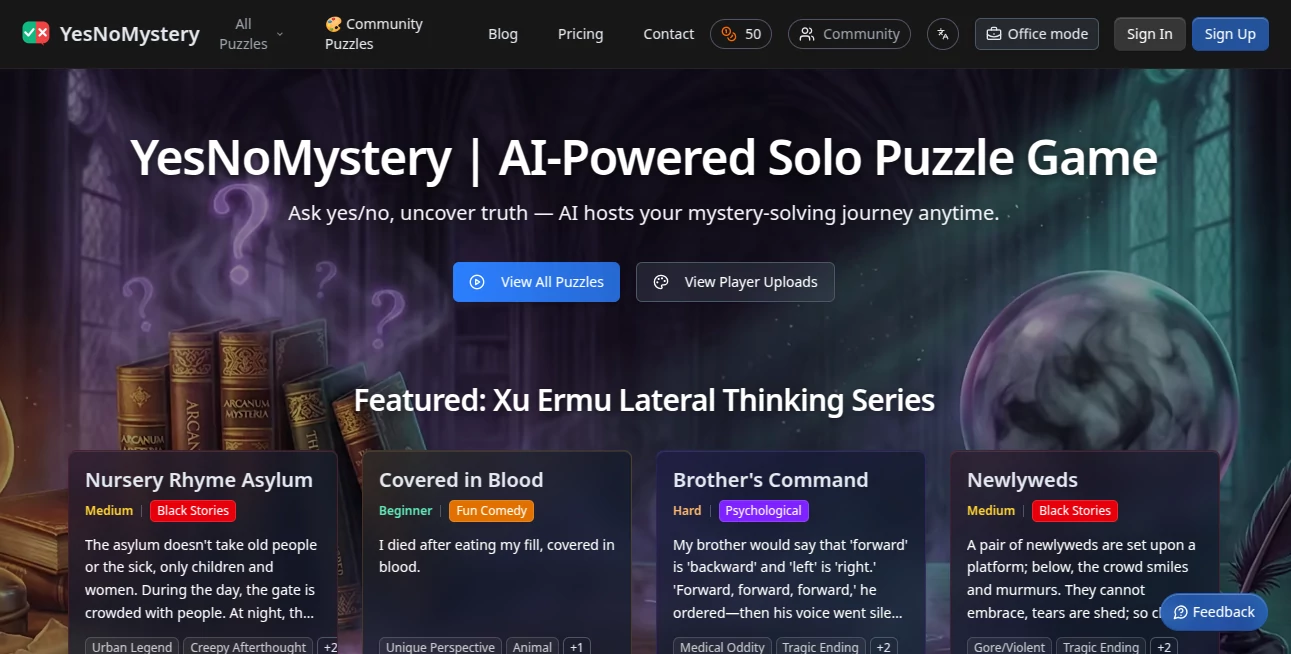
What is YesNoMystery?
YesNoMystery is an AI-powered solo puzzle game built around a simple but surprisingly addictive idea: you are given a mysterious situation, and your job is to discover what really happened by asking yes-or-no questions. Instead of waiting for another person to act as the game host, an AI host guides the investigation and responds as you work through the mystery.
The experience is especially appealing to people who enjoy black stories, logic challenges, psychological mysteries, and puzzles where the obvious explanation is rarely the correct one. The platform currently offers 1,140 puzzles across five main categories and five difficulty levels, giving both casual players and experienced puzzle fans plenty to explore.
Key Features
- AI-powered hosting that responds to investigative yes-or-no questions.
- A large curated library covering mysteries, horror, daily-life situations, psychological stories, and unusual scenarios.
- Progressive hints that help players when they reach a dead end.
- Real-time progress tracking for questions and reasoning paths.
- Answer validation that evaluates proposed solutions and provides feedback.
- Support for playing across phones, tablets, and desktop computers.
- Community-created puzzles alongside the official collection.
- Multilingual puzzle support covering a broad range of international languages.
User Interface
The interface is designed around the puzzle itself rather than unnecessary distractions. Players can browse the mystery library, search for particular puzzles, filter by category, and begin an investigation without needing to understand a complicated game system first.
During a puzzle, the conversation-style format makes the experience feel closer to questioning a game host than filling out a traditional puzzle form. Progress information and clues are also incorporated into the experience, which is useful when a mystery becomes difficult.
Accuracy & Performance
The AI host is built to understand investigative questions and return structured responses such as yes, no, or unknown. The system has also been updated to handle partially correct answers, improve timeout handling, and make AI responses more consistent.
Recent improvements have focused on reliability as well as puzzle quality. Server-backed progress and clue authorization help protect game progress and credit balances, while optimized puzzle pages and dedicated static-content delivery are designed to make browsing and gameplay feel faster.
Capabilities
The main strength is the combination of conversational AI and traditional lateral-thinking puzzles. Instead of simply revealing an answer, the system lets players investigate the scenario step by step.
Players can ask questions, collect clues, test their theories, and eventually submit an explanation. The answer-validation system can assess the reasoning rather than treating the game as a simple right-or-wrong guessing exercise.
The puzzle library is organized into Black Stories, Logic Puzzle, Psychological, Mind Benders, and Fun Comedy categories. Community puzzles add another layer of variety, allowing the library to expand beyond the official collection.
Security & Privacy
The service states that account information, game sessions, chat history, progress statistics, and certain technical information may be collected to operate and improve the platform. It uses HTTPS encryption, encrypted database storage, access controls, and security practices designed to protect stored information.
Payment processing is handled through Stripe, while the privacy policy states that card information is not stored by the service. Users should still review the current privacy policy before providing personal information, particularly because data may be processed in different regions.
Use Cases
This platform works particularly well for solo entertainment. Someone who enjoys detective stories can spend a few minutes investigating a strange scenario, while dedicated puzzle enthusiasts can work through harder mysteries that require several layers of reasoning.
It can also be useful for people looking for a quick mental challenge during a break. Because the puzzles can be played on mobile devices as well as computers, there is no need to reserve a long session for the experience.
Teachers, parents, puzzle communities, and game-night organizers may also find the format interesting. Community-created puzzles provide an opportunity to explore scenarios beyond the official collection and eventually share original ideas with other players.
Pros and Cons
- Pros: AI host for solo play, large puzzle library, multiple difficulty levels, progressive hints, answer validation, community puzzles, multilingual support, and cross-device gameplay.
- Pros: The question-based format encourages players to investigate instead of immediately looking for an answer.
- Cons: Some advanced mysteries can be difficult without using clues, particularly when the hidden explanation depends on an unusual interpretation of the scenario.
- Cons: Paid gameplay uses a credit system, so frequent players may need a subscription or additional credits.
Pricing Plans
The service uses a combination of free access, subscriptions, and one-time credit packs. The Basic plan is listed at $4 per month when discounted from $5, with 1,000 monthly credits. The Plus plan is $7 per month when discounted from $10 and includes 2,500 credits, while the Pro plan is $10 per month when discounted from $20 and includes 6,000 credits.
Annual billing is also available, with the listed annual prices of $48 for Basic, $90 for Plus, and $120 for Pro. For players who prefer not to subscribe, one-time credit packs are available at $5 for 1,000 credits, $10 for 2,000 credits, and $20 for 4,000 credits.
The credit system is used for AI interactions and additional puzzle assistance. Daily free credits are also available, making it possible to try the experience before committing to a paid plan.
How to Use the Platform
- Open the puzzle library and choose a mystery based on its category or difficulty.
- Read the initial scenario carefully and identify details that seem unusual.
- Start asking short yes-or-no questions to investigate the hidden story.
- Use the responses to eliminate possibilities and build a theory.
- If you become stuck, use the available hint system for a controlled nudge rather than immediately revealing the solution.
- Submit your explanation when you believe you understand what happened.
- Review the feedback and continue with another puzzle or explore community-created mysteries.
Comparison with Similar Tools
Traditional lateral-thinking games normally require a friend or moderator who knows the answer and can judge whether questions are relevant. This approach removes that requirement by putting the host inside the game itself.
Compared with conventional logic-puzzle websites, the experience is also more conversational. You are not simply presented with a grid, multiple-choice question, or fixed sequence of clues. Your questions influence how you investigate the scenario, which makes each puzzle feel more like a small detective case.
Compared with general-purpose AI chatbots, the advantage is structure. The AI is being used within a defined puzzle framework, with scenarios, clues, answer validation, progress tracking, and difficulty categories designed specifically around lateral-thinking gameplay.
Conclusion
For anyone who likes mysteries that make you stop and question the obvious, this is an enjoyable twist on the traditional lateral-thinking puzzle. The AI host makes solo play practical, while the growing collection provides enough variety to move from light brain teasers to darker and considerably more challenging investigations.
The strongest part of the experience is its simplicity: read a strange story, ask the right questions, follow the clues, and see whether your theory holds together. With more than a thousand puzzles, community content, multiple languages, and an evolving AI-driven game system, it offers a compelling destination for anyone who enjoys solving mysteries one question at a time.
Frequently Asked Questions (FAQ)
What is a lateral-thinking puzzle?
A lateral-thinking puzzle presents an unusual situation with missing context. Players reconstruct the hidden story by asking questions and looking for connections that are not immediately obvious.
Can I play the puzzles alone?
Yes. The AI host takes the role traditionally handled by another person, allowing players to investigate puzzles independently on desktop or mobile devices.
How does the AI host work?
The AI interprets investigative questions and provides structured responses while helping maintain the intended flow of the mystery. It can also provide hints and evaluate proposed solutions.
Are there different puzzle categories?
Yes. The current collection includes Black Stories, Logic Puzzle, Psychological, Mind Benders, and Fun Comedy, with puzzles spanning several difficulty levels.
Are the puzzles free?
The platform offers free access and daily free credits, while additional AI interactions, hints, and other features can consume credits. Paid subscriptions and one-time credit packs are available for heavier use.
Can users create puzzles?
Community-created puzzles are supported, and published submissions can become part of the community collection. The platform also provides tools and rewards around puzzle creation.
How many puzzles are available?
The current official collection contains 1,140 puzzles, with community-created content providing an additional source of mysteries to discover.
What devices can I use?
The experience is designed to work across desktop computers, tablets, and mobile devices, making it suitable for both longer puzzle sessions and quick challenges.