
Leadpoet
What is Leadpoet?
Finding a prospect is easy. Finding a company that is actually ready to buy is much harder. Leadpoet takes a different approach to B2B prospecting by looking for real buying behavior rather than simply handing sales teams another enormous contact database.
The platform monitors more than 12 sources of real-time demand signals, including job postings, funding announcements, technology changes, community discussions, and competitor activity. It then uses AI to connect those signals with a company's ideal customer profile and identify prospects that appear to be actively dealing with a problem a business can solve.
That distinction matters. A sales representative does not just receive a name and an email address. The platform provides context around why the prospect may be relevant, giving the team something useful to work with before the first message is written.
Key Features
- Real-time monitoring of more than 12 buying-intent signal sources
- AI-powered prospect discovery and ICP matching
- Intent scoring based on observable buying behavior
- Cross-source validation before leads are delivered
- Role and company-level targeting
- Contact information and intent context for qualified leads
- CSV export for sales workflows
- Continuous prospecting through autonomous AI agents
User Interface
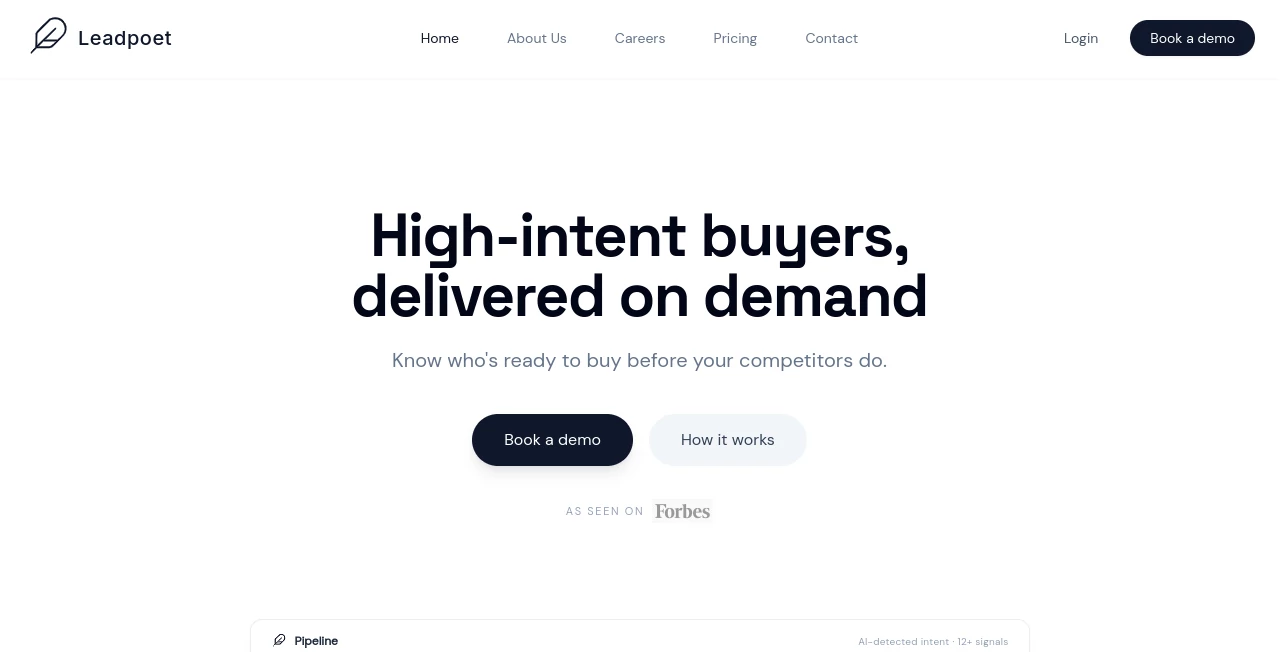
The interface is built around the information a sales team actually needs to act. Instead of forcing users to dig through hundreds of generic records, the experience centers on qualified accounts, buying signals, and the context behind each recommendation.
The site's example pipeline shows information such as the company, contact, detected signal, qualified leads, booked meetings, and conversion rate. A practical example demonstrates how a signal can move from a public statement about a business problem to a matched decision-maker, complete with company context and a confidence score.
For a salesperson, that approach feels considerably more useful than opening another spreadsheet filled with names and hoping a few happen to be interested.
Accuracy & Performance
The strongest part of the platform is its emphasis on validation. Prospects are scored, cross-referenced against multiple signals, matched to the customer's product, and checked for recency before delivery.
The system is designed to recognize patterns rather than rely on a single keyword. For example, a company might be showing several signs of change at once: hiring in a particular department, adopting new technology, raising funding, or discussing a recurring operational problem. When those signals align with an ICP, the resulting prospect becomes much more meaningful.
The company states that every delivered lead is verified before delivery and that its agents operate continuously, allowing prospect discovery to continue without requiring sales representatives to spend hours manually researching the web.
Capabilities
The platform is particularly focused on B2B sales intelligence. Users describe what they sell and the type of customer they want to reach. The system then looks for companies showing signs that they may need that solution and identifies the person likely to own the relevant budget.
Available targeting includes industries such as fintech, infrastructure, SaaS, compliance, and ecommerce, while the underlying approach can be applied to different ICPs. Lead information can include a contact's name, role, company, email address, and the specific intent signals that caused the match.
This makes the tool useful not only for building a prospect list, but also for understanding the reason behind an outreach opportunity.
Security & Privacy
Privacy is addressed at both the account and data-processing level. The company states that customer ICPs, targeting criteria, and lead activity are isolated to individual accounts and that customer targeting information is not resold or shared with competitors.
Its privacy policy also explains that information submitted by customers, such as ICP criteria, prompts, uploaded lists, or internal notes, may be processed as part of providing the service. Businesses evaluating the platform should still review the current privacy policy and applicable agreements to make sure the data-handling model fits their requirements.
Use Cases
One of the clearest use cases is outbound sales. Instead of asking a sales development representative to work through a broad database, the platform can surface companies already displaying signals associated with a potential purchasing need.
It can also be useful for account-based sales teams that have a defined ICP but need help deciding which accounts deserve attention first. A company that has just raised funding, expanded its team, changed its technology stack, or publicly discussed a business challenge may deserve attention sooner than a similar company with no visible signs of change.
For example, imagine a fraud-prevention company targeting fast-growing ecommerce businesses. A prospect publicly discussing rising chargeback rates while simultaneously expanding its transaction volume could be far more interesting than a random ecommerce company pulled from a static database. The platform is designed to connect those dots.
It can also help smaller sales teams where research time is limited. Instead of spending an afternoon searching forums, job boards, company announcements, and social platforms, a salesperson can begin with prospects accompanied by the evidence behind their qualification.
Pros and Cons
Pros
- Focuses on buying intent rather than simple contact volume
- Monitors more than 12 sources of real-time signals
- Provides context behind qualified prospects
- Uses multiple signals to validate opportunities
- Supports role and company-level targeting
- Can reduce the manual research burden for sales teams
- Offers CSV export for downstream workflows
Cons
- The pricing is positioned toward professional B2B sales teams rather than casual users
- The entry plan has a relatively limited account allowance
- Custom integrations are reserved for the highest-tier offering
- Teams looking for a conventional large contact database may prefer a more traditional prospecting platform
- Some functionality, such as continuous intent monitoring, uses the credit system and may require careful planning of usage
Pricing Plans
The pricing structure is based on monthly credits and is designed to scale with the size of a sales pipeline.
- Launch: $100 per month for 200 credits, with up to 20 accounts per month, verified delivery, 12+ monitored signal sources, intent scoring, targeting, CSV export, and email support.
- Accelerate: $500 per month for 1,000 credits and up to 100 accounts per month. It adds priority support and dedicated onboarding.
- Scale: Custom pricing and credit volume for high-volume teams. This tier includes a dedicated account manager and custom integrations.
The credit system distinguishes between different activities. Intent monitoring is listed at 1 credit, while a high-intent account costs 10 credits. The company also states that customers pay for accounts that match their ICP and demonstrate active intent.
How to Use Leadpoet
- Define the type of company and decision-maker you want to reach.
- Provide the system with information about your product and ideal customer profile.
- Allow the AI agents to monitor relevant buying signals across supported sources.
- Review the prospects identified through converging intent signals.
- Examine the company, contact, and context provided with each qualified lead.
- Export relevant accounts when you want to move them into another sales workflow.
- Use the buying context to create more relevant outreach instead of sending generic cold messages.
The real advantage comes from using the information behind a lead. If a prospect has just demonstrated a specific problem, mentioning that context in an appropriate and respectful outreach message is likely to be much more useful than sending a generic introduction.
Comparison with Similar Tools
Traditional sales intelligence products such as large contact databases are excellent when the goal is to search for companies and people using filters. The limitation is that a database record does not necessarily tell you whether that company is actively considering a purchase.
This platform takes the opposite route. Rather than beginning with millions of contacts and asking salespeople to filter them, it begins with observable behavior and then works toward the right account and contact.
That makes the product especially interesting for teams that already know their ICP and care more about timing and relevance than simply increasing the number of prospects in their database. It is less about collecting contacts and more about identifying potential demand.
Conclusion
For B2B sales teams, the difference between a contact and a genuine opportunity can come down to timing. A company may look like a perfect customer on paper but still have no reason to buy today. Another business with the same profile may suddenly become a strong prospect because its circumstances have changed.
This platform is built around finding that second type of opportunity. Its combination of real-time signals, AI-based matching, prospect validation, and contextual lead information gives sales teams a practical way to prioritize accounts that show signs of active demand.
It will not replace good sales messaging or a thoughtful sales process, and teams still need to qualify opportunities themselves. What it can do is make the research stage considerably more focused. For companies selling into a clearly defined B2B market, that can mean less time searching and more time having conversations with people who have a reason to listen.
Frequently Asked Questions (FAQ)
What problem does the platform solve?
It helps sales teams identify prospects that are showing observable buying behavior instead of relying only on static contact databases. The goal is to reduce time spent pursuing companies that have little current interest in a solution.
How does it identify buying intent?
AI agents monitor more than 12 signal sources, including community forums, job postings, technology changes, funding announcements, and competitor-related activity. Multiple signals can be combined to identify patterns associated with an active buying window.
What information comes with a lead?
According to the company, qualified leads can include the contact's name, title, company, email address, and the intent signals that triggered the match. This gives sales teams context before they begin outreach.
Are leads verified?
Yes. The company says leads are cross-referenced, scored against the customer's product fit, and checked for recency before they are delivered.
Can the platform monitor existing accounts?
Yes. The credit system includes an intent-monitoring feature for saved accounts, designed to alert users when a prospect begins showing relevant buying signals.
Is there a free plan?
The current pricing page lists paid Launch and Accelerate plans alongside a custom Scale plan. It does not currently present a standard free plan.
Who is this platform best suited for?
It is best suited to B2B sales teams, outbound teams, account-based sales organizations, and companies with a clearly defined ICP that want to prioritize prospects based on current buying signals.
How is it different from a traditional lead database?
A traditional database primarily helps users find contacts that match selected filters. This approach starts with buying behavior, then matches that behavior to an ICP and identifies the relevant account and contact. The emphasis is therefore on why a prospect may be ready rather than simply whether the prospect exists.
AI Lead Generation , AI Sales Assistant , AI Research Tool , AI CRM Assistant .
These classifications represent its core capabilities and areas of application. For related tools, explore the linked categories above.

Leadpoet Alternatives Product
Dedoctive

Needle

Sparqo AI

Lessie AI

Rate My Prof…

Prelight

Zloth

UPDF AI

Odysseus AI