


















LLM Council
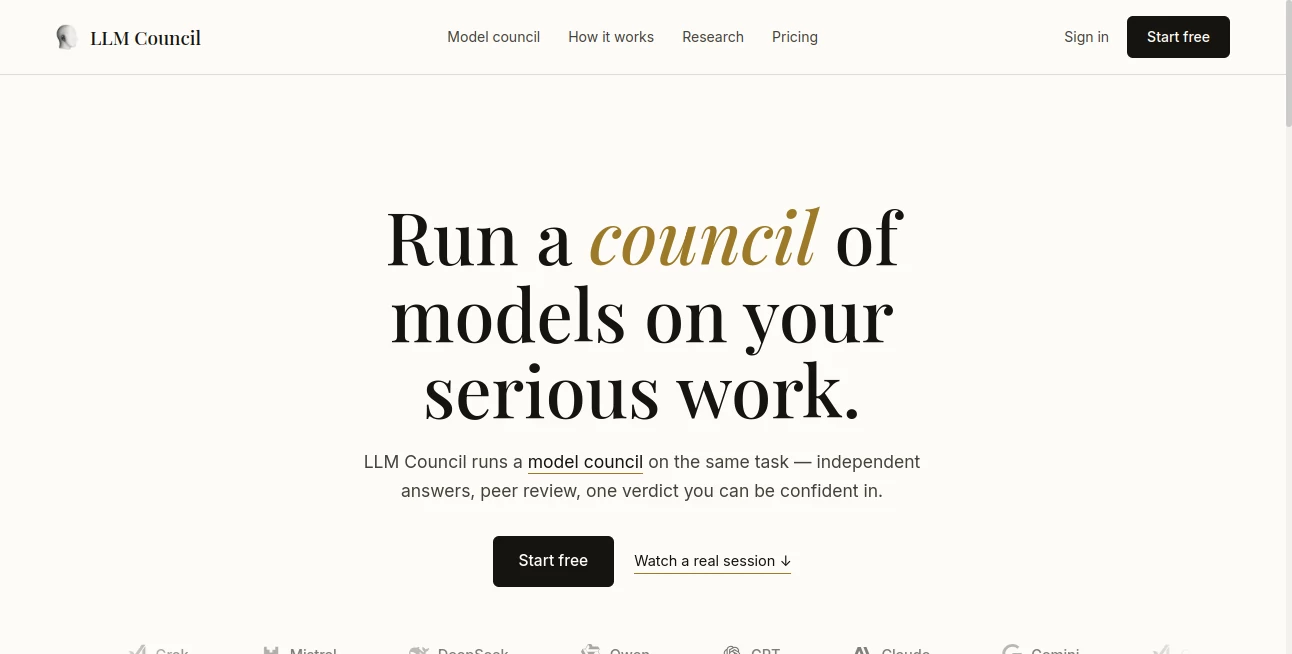
What is LLM Council?
As large language models become deeply embedded into modern applications, the need for structure, oversight, and evaluation has never been more important. This platform is designed to help teams bring clarity and control to how LLMs are tested, monitored, and improved over time.
Instead of treating AI systems as black boxes, it introduces a more disciplined approach where performance, safety, and reliability can be measured in a consistent and meaningful way. Whether you're building AI products or managing enterprise-grade systems, it creates a central layer of understanding between development and real-world deployment.
Key Features
User Interface
The interface is clean, developer-focused, and structured around clarity rather than complexity. Users can easily navigate evaluation dashboards, compare model outputs, and track performance trends without being overwhelmed by unnecessary noise.
Accuracy & Performance
One of the strongest aspects of this platform is its ability to help teams measure model accuracy in a structured environment. It allows comparisons across different prompts, model versions, and evaluation scenarios, helping identify inconsistencies and improvements over time.
Capabilities
The system supports a wide range of LLM-related workflows including benchmarking, prompt testing, response evaluation, and structured reporting. It is particularly useful for teams working on AI applications that require reliability and repeatability in outputs.
Security & Privacy
Security is treated as a core principle, ensuring that sensitive prompts, outputs, and evaluation data remain protected. It is designed with enterprise expectations in mind, making it suitable for teams working with confidential or regulated data environments.
Use Cases
- Evaluating and comparing different LLM models before deployment
- Monitoring AI behavior in production environments
- Improving prompt engineering strategies
- Ensuring compliance and safety in AI-generated outputs
- Supporting research teams with structured LLM testing workflows
Pros and Cons
Pros
- Strong focus on structured LLM evaluation
- Useful for both developers and AI researchers
- Helps improve reliability and consistency of outputs
- Supports scalable testing workflows
Cons
- May require technical understanding to use effectively
- Advanced features could feel complex for beginners
Pricing Plans
Pricing is typically structured around team needs, with flexible options depending on usage scale and enterprise requirements. Some access levels may be available for testing purposes, while advanced capabilities are usually offered through paid plans tailored to organizations.
How to Use the Platform
Getting started is straightforward. Users begin by setting up evaluation projects, defining test prompts, and selecting models to compare. From there, results can be analyzed through dashboards that highlight differences in accuracy, consistency, and response quality.
Over time, teams can refine prompts, track improvements, and build a more reliable AI system by continuously iterating on the evaluation process.
Comparison with Similar Tools
Compared to general-purpose AI development tools, this platform focuses more deeply on evaluation and governance rather than just generation. While many tools help build AI applications, fewer provide structured systems for measuring and improving model behavior over time. This makes it particularly valuable for teams that prioritize reliability and accountability.
Conclusion
In a world where AI systems are rapidly evolving, having a structured way to evaluate and control them is essential. This platform offers a practical solution for teams who want more than just output generation—they want understanding, consistency, and trust in their models. It stands out as a focused environment for improving how language models are used in real applications.
Frequently Asked Questions (FAQ)
What is this platform mainly used for?
It is primarily used for evaluating, testing, and monitoring large language models in a structured way.
Is it suitable for beginners?
While beginners can explore it, it is mainly designed for developers, researchers, and technical teams working with AI systems.
Can it improve model performance?
Yes, by providing structured feedback and comparison tools, it helps teams refine prompts and improve output quality over time.
Does it support enterprise use?
Yes, it is designed with scalability and security in mind, making it suitable for enterprise-level AI workflows.
What makes it different from other AI tools?
Its focus is not just on generating outputs but on evaluating, controlling, and improving language model behavior systematically.
AI Testing & QA , AI Research Tool , Large Language Models (LLMs) , AI Developer Tools .
These classifications represent its core capabilities and areas of application. For related tools, explore the linked categories above.

LLM Council Alternatives Product

Toflow AI
RepoClip

CodeSpy AI

Sourcetable

UPDF AI

PromptBuilder

Standard Com…

Claude and C…
DiRe-RAPIDS