
Market Ontology
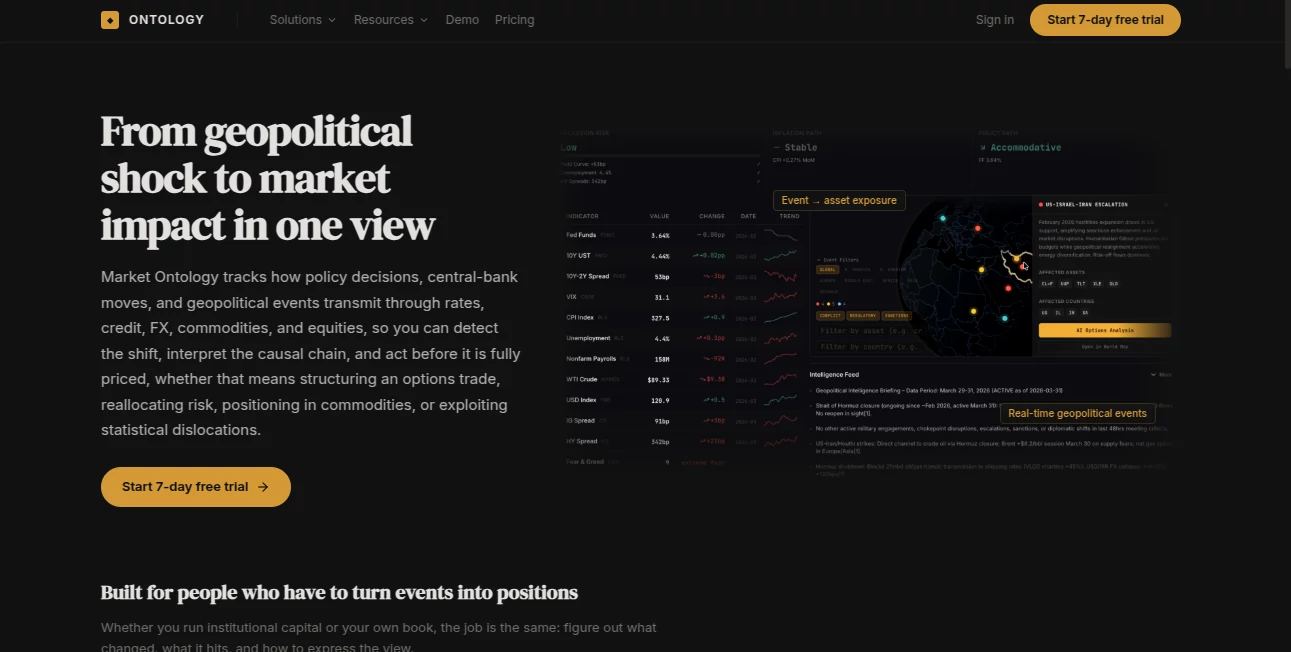
What is Market Ontology?
In a digital world where information is scattered across countless sources, making sense of market behavior can feel overwhelming. This platform is designed to bring clarity to that complexity by organizing market knowledge into structured, meaningful relationships. Instead of dealing with raw, disconnected data, users get a cleaner, more intelligent view of how markets, entities, and signals interact.
What makes it stand out is its focus on structure and understanding rather than just data collection. It helps teams move from guesswork to informed decisions by mapping relationships in a way that feels almost intuitive.
Key Features
User Interface
The interface is designed to feel minimal yet powerful. Users can explore structured insights without getting lost in dashboards overloaded with unnecessary complexity. Navigation is smooth, and the flow between data layers feels natural.
Accuracy & Performance
The system is built around structured knowledge representation, which helps reduce noise and improve relevance. It processes information in a way that prioritizes meaningful connections rather than raw volume, leading to more reliable insights.
Capabilities
It supports advanced market structuring, relationship mapping, and contextual intelligence generation. Instead of treating data points as isolated inputs, it connects them into a broader ecosystem of meaning.
Security & Privacy
Data handling is designed with a strong focus on privacy. Sensitive information is processed with care, and access controls ensure that insights remain protected within authorized environments.
Use Cases
- Market research and competitive analysis
- Building structured knowledge graphs for business intelligence
- Enhancing SEO and content strategy with semantic relationships
- Supporting data-driven decision making in analytics teams
Pros and Cons
Pros
- Transforms complex data into structured insights
- Helps uncover hidden relationships in markets
- Useful for research, SEO, and analytics workflows
- Clean and intuitive experience for exploring data
Cons
- May require some learning for non-technical users
- Advanced capabilities might be more suitable for teams than individuals
Pricing Plans
Pricing details are typically tailored based on usage and organizational needs. Many users start with an evaluation or demo experience before scaling into a custom plan that fits their workflow and data requirements.
How to Use Market Ontology
Getting started is straightforward. Users typically begin by defining the domain or market they want to analyze. From there, the system builds structured relationships between relevant entities. As more data is introduced, the intelligence layer becomes richer and more insightful.
Teams can then explore patterns, extract insights, and integrate findings into their strategy or reporting systems.
Comparison with Similar Tools
Unlike traditional analytics platforms that focus mainly on dashboards and static reports, this approach emphasizes structured understanding. While many tools show what is happening, this one focuses more on why it is happening by connecting underlying relationships.
Conclusion
For teams that want to move beyond surface-level analytics, this platform offers a refreshing approach. It brings order to complex market environments and helps users think in terms of systems rather than isolated metrics. The result is clearer insight, better strategy, and more confident decision-making.
Frequently Asked Questions (FAQ)
What is this tool used for?
It is used to structure and analyze market data in a way that reveals meaningful relationships and insights.
Is it suitable for beginners?
Yes, although it is more powerful when used by teams familiar with data analysis or market research concepts.
Does it replace traditional analytics tools?
Not necessarily. It complements them by adding a deeper layer of structured understanding.
Can it be integrated into existing workflows?
Yes, it is designed to support integration with modern data and research workflows.
Who benefits the most from it?
Marketing teams, analysts, researchers, and strategy professionals gain the most value from it.
AI SEO Assistant , AI Research Tool , AI Analytics Assistant , AI Knowledge Graph .
These classifications represent its core capabilities and areas of application. For related tools, explore the linked categories above.
Market Ontology details
Website unavailable — View Alternatives
Pricing
- Free
Apps
- Web App
Categories

Market Ontology Alternatives Product

Domain Rank …

Surmado

Grok

Rate My Prof…

CoinIQ

CitedSpy

StyleBias

RankPeak

SEOAuthori