
Second Me
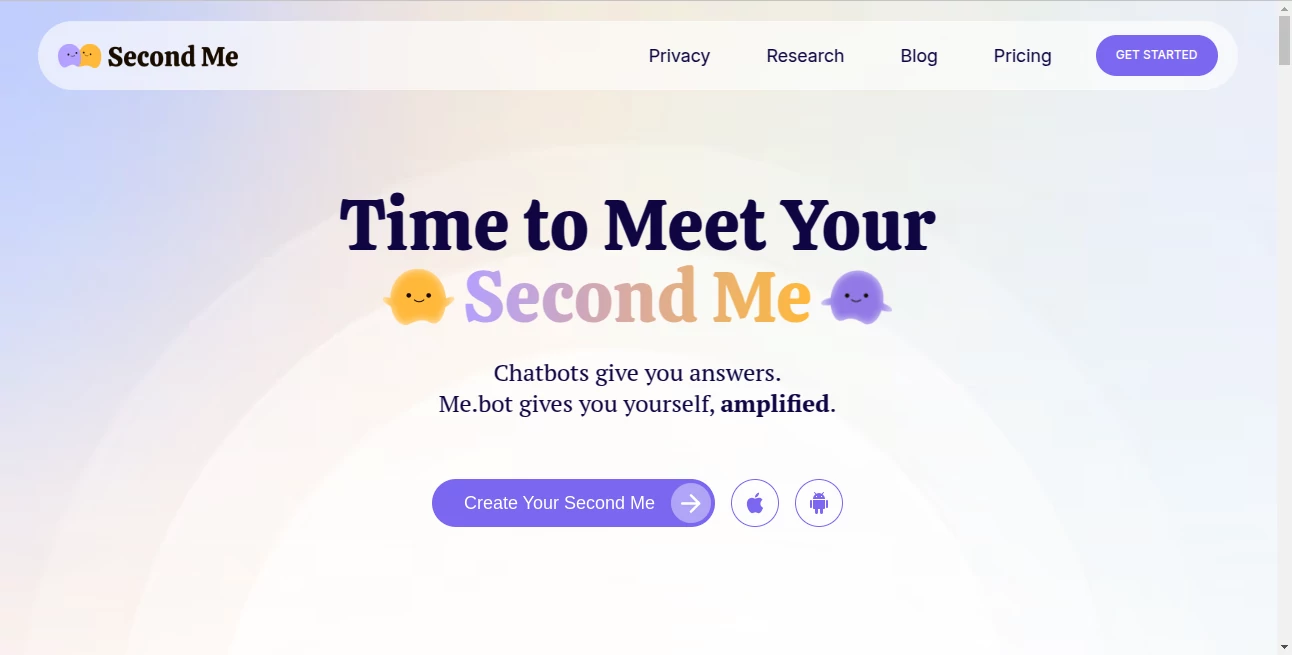
What is Second Me?
Me.bot is a personal AI companion designed to help people capture ideas, organize memories, plan tasks, and turn everyday experiences into useful insights. Instead of treating every conversation as a fresh start, it builds an understanding of the information you choose to share, including notes, voice recordings, images, and other personal content.
The idea is simple but useful: the more context you give it, the more relevant its responses can become. Someone managing a busy work schedule might use it to organize thoughts and prepare for conversations, while a student could use it to connect notes, reflect on progress, and turn scattered ideas into something more structured.
It also goes beyond conventional note-taking. Its personal AI approach is designed around long-term memory, allowing previous information to become part of future conversations rather than disappearing after a single session.
Key Features
- Personal AI memory that connects information from previous interactions.
- Text and voice conversations for capturing thoughts naturally.
- Support for importing notes, audio, and other personal information.
- AI-assisted task planning and organization.
- Tools for reflection, brainstorming, communication preparation, and personal growth.
- Voice and visual presentations created from personal records.
- Customizable AI personality and personal backstory.
- Access through web, iOS, and Android platforms.
User Interface
The experience is built around conversation rather than complicated menus. Users can write down a thought, record a voice note, save an idea, or bring existing information into their personal AI environment. This makes the product particularly appealing to people who do not want to spend time carefully organizing every piece of information themselves.
The interface also supports a more visual and interactive experience through personal AI avatars, voice features, and presentations. For everyday use, the emphasis is on quickly capturing information and returning to it when it becomes relevant.
Accuracy & Performance
One of the more interesting aspects of the platform is its focus on context. Responses can be informed by memories and information previously shared by the user, which can make conversations feel considerably more relevant than a standard chatbot session.
That does not mean every response should be treated as fact. AI systems can still misunderstand context or generate incorrect information, particularly when asked about subjects that require authoritative sources. Its strongest advantage is therefore personalization rather than replacing traditional research or professional judgment.
Capabilities
The platform covers a surprisingly broad range of personal tasks. Users can capture random thoughts, record meetings or voice notes, organize information, brainstorm ideas, prepare for difficult conversations, and receive suggestions based on previous interactions.
Its memory system is especially useful for long-running projects and personal goals. Rather than keeping information as isolated notes, the system is designed to identify relationships between memories and use those connections during later conversations.
Another distinctive capability is turning personal records into talks with voice and visuals. Users can choose an audience and topic, after which the system can help transform their existing ideas into a presentation designed for that particular listener.
Security & Privacy
Privacy is presented as a central part of the product. The company states that personal information is stored and accessed anonymously and that user data is not sold to advertisers. Its privacy architecture also includes end-to-end encryption and confidential computing technologies.
The company describes its approach as a personal data fortress, with technologies intended to keep sensitive information protected. It also states that its services follow USDP and GDPR requirements and that confidential computing is used to strengthen data protection.
Users should still review the current privacy policy before uploading particularly sensitive information, as privacy practices and product capabilities can change over time.
Use Cases
Personal productivity: Use it to capture tasks and ideas as they appear, then turn those thoughts into clearer plans. This can be especially convenient for people who frequently switch between work, study, and personal responsibilities.
Second-brain organization: Notes, recordings, images, and other personal information can become part of a larger knowledge system. Instead of searching through dozens of disconnected notes, users can discuss their stored information conversationally.
Students: Students can use the platform to keep track of learning experiences, project ideas, notes, and personal reflections. The ability to connect previous information can make it useful for longer academic projects.
Professionals: It can help prepare for meetings, organize thoughts, rehearse difficult conversations, and turn accumulated knowledge into clearer communication. The personalized context can be valuable when the same projects or professional goals continue over months.
Creative work: Writers, creators, and other idea-driven users can use it as a brainstorming partner. Old thoughts can become prompts for new ideas, while voice notes make it easy to capture inspiration before it disappears.
Personal reflection: The platform can also be used for journaling and self-reflection. Users can discuss their experiences, moods, goals, and concerns while allowing the AI to connect those conversations with earlier memories.
Pros and Cons
- Pros: Long-term personal memory, multimodal input, conversational organization, voice capabilities, task planning, creative brainstorming, customizable personal AI, and web/mobile accessibility.
- Cons: AI-generated responses can still be imperfect, the most advanced features require a paid plan, and users who prefer a simple note-taking application may find its broader personal-AI concept more than they need.
Pricing Plans
A free plan is available without requiring a credit card. It currently includes 100 new memories per month, unlimited speak and text usage, 100 chat messages per month, three new talks per month, and support for files up to 10MB.
The Pro plan costs $10 per month and increases the limits substantially, offering unlimited new memories and chat messages, up to 30 new talks per month, and file uploads up to 50MB. An annual option is also available at $100 per year, equivalent to about $8.30 per month and advertised as a 17% saving compared with monthly billing.
How to Use Me.bot
Start by creating your personal AI experience and sharing information that gives it useful context. You can write down thoughts, import notes, provide audio, or record voice notes and meetings. The goal is not to organize everything perfectly before getting started; the system is designed to build context gradually.
Once you have some information stored, use conversations to explore it. Ask about previous ideas, discuss a project, reflect on a goal, or request help organizing your next steps. You can also prepare a talk by selecting who you want to address and what you want to communicate, then allow the system to transform your records into a voice-and-visual presentation.
For example, imagine that you have been collecting notes about a business idea for several weeks. Instead of opening every note individually, you can discuss the idea with your personal AI and ask it to identify recurring themes, clarify the concept, or help prepare an explanation for someone else.
Comparison with Similar Tools
Traditional note-taking applications are excellent for storing information, but they generally require users to search, sort, and organize their own material. Conventional chatbots are more flexible for conversation, but a new conversation may not automatically have the same depth of personal context.
This product takes a different approach by combining conversational AI with persistent personal memory. It aims to sit somewhere between a digital notebook, an AI assistant, a brainstorming partner, and a personal companion.
That distinction becomes most noticeable when information accumulates over time. The value is not simply in answering an individual question, but in making older ideas, experiences, and notes useful in future interactions.
Conclusion
For people who want more from an AI assistant than one-off answers, this personal AI approach is worth exploring. Its combination of memory, conversation, voice, organization, creative support, and personalized context gives it a distinctive position among productivity and life-assistance tools.
The strongest reason to try it is its long-term perspective. Instead of treating every interaction as an isolated request, it is designed to gradually become familiar with the information and interests that matter to you. That makes it particularly compelling for students, professionals, creators, and anyone who wants a more personal way to manage ideas and everyday experiences.
Frequently Asked Questions (FAQ)
What is Me.bot used for?
It can be used for personal organization, AI conversations, note and memory management, task planning, brainstorming, voice notes, meeting summaries, communication preparation, and personal reflection.
Does it remember previous conversations?
Yes. Its core design revolves around personal memory. Information from previous interactions can be connected and used to provide more contextual responses in later conversations.
Can I use voice with it?
Yes. Users can record voice notes and meetings, communicate through voice, and use their personal information to create presentations with voice and visual elements.
Is there a free plan?
Yes. The free plan currently provides 100 new memories and 100 chat messages per month, along with three new talks per month and support for files up to 10MB.
How much does the Pro plan cost?
The Pro plan currently costs $10 per month. Annual billing is available for $100 per year, which works out to approximately $8.30 per month.
Can I access it on mobile?
Yes. The service is available through the web as well as iOS and Android applications, although some functionality and premium pricing can vary between platforms.
Is my personal information protected?
The company says it uses measures including anonymity, end-to-end encryption, data protection technologies, and confidential computing. It also states that user data is not sold to advertisers.
Can I customize my personal AI?
Yes. Users can customize aspects of their personal AI, including its backstory and personality, helping create an experience that feels more closely aligned with their preferences.
Can it help with presentations?
Yes. Users can turn their stored records and ideas into interactive talks with voice and visuals, while choosing the intended audience and topic.
Is it a replacement for a human assistant or professional?
No. It is best viewed as an AI companion and productivity aid. Its suggestions can be useful for organizing thoughts and exploring ideas, but important professional, medical, legal, financial, or other high-stakes decisions should still be checked with qualified sources or professionals.
AI Life Assistant , AI Notes Assistant , AI Productivity Tools , AI Voice Assistants .
These classifications represent its core capabilities and areas of application. For related tools, explore the linked categories above.
Second Me details
Website unavailable — View Alternatives
Pricing
- Freemium
Apps
- Web App
- iOS App
- Android App
Categories

Second Me Alternatives Product
Gemini Omni

FortuneTelle…

gpt-plus.ai
Hintder AI

Clay Read
KronoPrompt

Weekly Brief

Duct Tape AI…

CtrlOps