

















Mnemom
What is Mnemom?
When your team starts deploying autonomous agents into real work — approving transactions, handling customer data, or making decisions that carry real consequences — the excitement quickly meets a sobering question: how do we know they’re actually doing what we intended? This platform was built for exactly that moment. It gives you cryptographic tools to declare what agents should do, verify their reasoning in real time, and prove it all later if anyone asks. I’ve spoken with engineers who sleep better knowing every critical decision leaves a verifiable trail. In a world racing to ship agents everywhere, this feels like the safety net many of us didn’t realize we needed until now.
Introduction
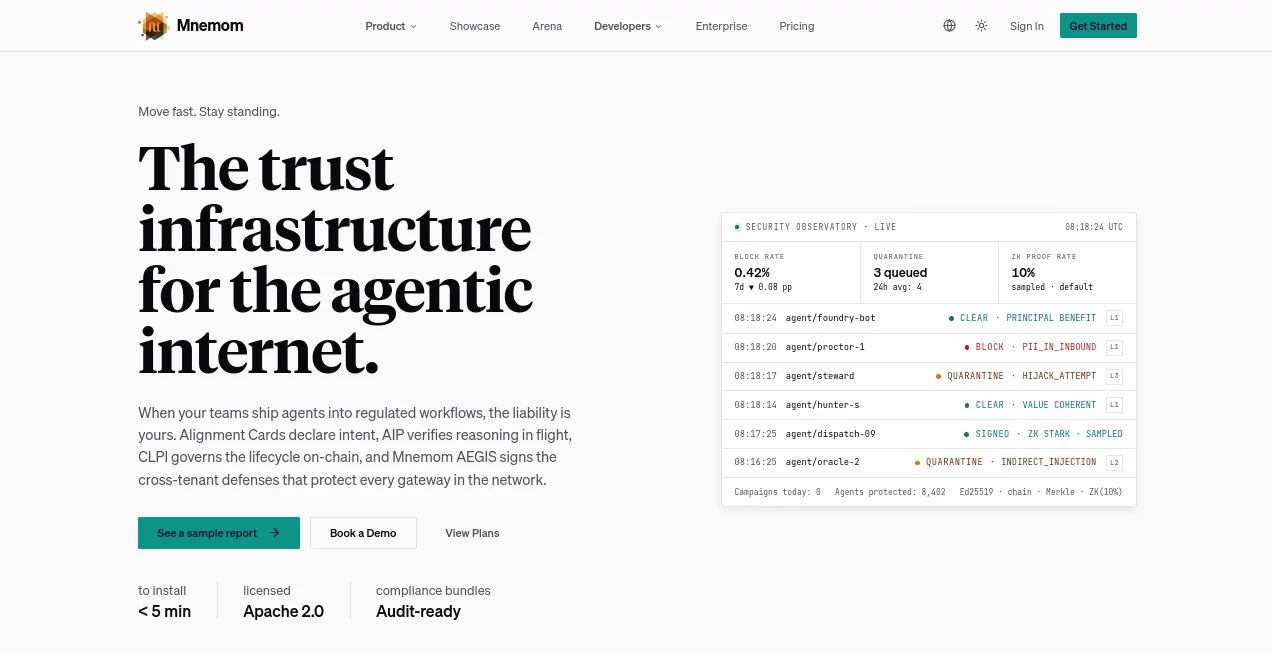
The shift to agentic systems is happening fast, but trust hasn’t kept pace. Traditional monitoring and logging fall short when agents can reason, use tools, and act autonomously across systems. Mnemom brings structure to that chaos with a coherent stack of protocols and protections designed specifically for AI agents. Alignment Cards declare intent upfront. The Agent Integrity Protocol checks reasoning before actions happen. On-chain governance and a cross-tenant defense network called AEGIS add layers that protect everyone. It’s not about slowing innovation down — it’s about giving teams the confidence to move fast while staying standing when regulators, auditors, or customers come asking.
Key Features
User Interface
The dashboard strikes a nice balance between power and clarity. You see live agent activity, trust ratings, and security events in one place without drowning in noise. Setting up Alignment Cards feels straightforward, and the observability views make it easy to understand what your agents are actually thinking and doing. Even during high-pressure moments, the interface stays calm and actionable rather than overwhelming you with alerts.
Accuracy & Performance
The system checks every thinking step before action with impressive precision. Alignment verification, behavioral drift detection, and cross-tenant threat propagation all happen with low overhead. In practice, teams report catching subtle issues early rather than after incidents. The combination of Ed25519 signatures, Merkle trees, and sampled ZK proofs gives strong guarantees without making everything feel slow or expensive.
Capabilities
It offers a full stack: Agent Alignment Protocol for declaring intent, Agent Integrity Protocol for in-flight verification, Card Lifecycle & Policy Intelligence for governance, and the AEGIS protection network that shares defenses across customers. You get cryptographic trust ratings, supply-chain detection beyond traditional tools, and audit-ready records that satisfy regulators. It works with major model providers and supports both individual agents and large fleets.
Security & Privacy
Everything is built with enterprise-grade concerns in mind — end-to-end encryption, tamper-evident records, and clear separation of customer data. The cross-tenant protection network strengthens everyone without exposing sensitive details between organizations. For companies operating in regulated spaces, that combination of transparency and strong controls is particularly valuable.
Use Cases
A fintech team deploys agents that handle loan decisions and uses Alignment Cards plus real-time integrity checks to satisfy auditors. A healthcare provider runs patient-triage agents with full governance trails that meet compliance requirements. An enterprise running dozens of internal agents gets early warnings about behavioral drift before small issues become big problems. Even smaller teams building customer-facing agents gain confidence from the public trust ratings and verifiable decision logs. It fits anywhere autonomy meets accountability.
Pros and Cons
Pros:
- Comprehensive trust layer purpose-built for agents rather than adapted from traditional security tools.
- Strong cryptographic guarantees with practical performance.
- Cross-tenant defense network provides protection that single-tenant systems can’t match.
- Audit-ready records that actually help during reviews instead of creating more work.
- Clear focus on regulated and high-stakes workflows.
Cons:
- Still relatively new, so the ecosystem and integrations are growing.
- Best value comes for teams already working with autonomous agents or planning to.
Pricing Plans
It offers developer-friendly pay-as-you-go options starting at very accessible rates per check, with team plans that include generous included usage. Enterprise customers get custom volumes, dedicated support, and advanced compliance features. The model rewards usage rather than punishing growth, which feels right for teams scaling agent deployments.
How to Use Mnemom
Start by defining Alignment Cards for your agents — what they’re allowed to do and why. Integrate the Agent Integrity Protocol to check reasoning before actions. Deploy with the provided SDKs or connect existing agents. Monitor live through the dashboard and review audit trails as needed. For larger deployments, enable the AEGIS protection network to benefit from cross-tenant intelligence. The onboarding is designed to feel natural rather than like another heavy security project.
Comparison with Similar Tools
Traditional monitoring and logging tools weren’t built for reasoning agents. General security platforms often lack the agent-specific primitives like Alignment Cards and in-flight integrity checks. This platform stands out by treating trust as a first-class concern from the beginning rather than bolting it on later. It gives teams in regulated spaces a more complete and coherent answer than piecing together multiple point solutions.
Conclusion
As agents move from experiments into real workflows that affect money, health, and operations, trust infrastructure stops being optional. This platform delivers that infrastructure in a way that feels coherent and practical rather than bolted together. It lets teams innovate quickly while giving stakeholders — from engineers to regulators — the verifiable confidence they need. In the agentic future that’s arriving faster than most expected, solutions like this may well become table stakes for responsible deployment.
Frequently Asked Questions (FAQ)
Is this only for large enterprises?
No — developers and smaller teams can start with the pay-as-you-go model and grow naturally.
Do I need to change my existing agents much?
Integration is designed to be lightweight, with SDKs for major providers.
How does the cross-tenant protection work without sharing sensitive data?
It uses anonymized behavioral signals and substrate fingerprints rather than raw customer data.
Can I export audit records for compliance reviews?
Yes — everything is designed to produce clean, append-only audit bundles.
AI Developer Tools , AI Research Tool , Other .
These classifications represent its core capabilities and areas of application. For related tools, explore the linked categories above.

Mnemom Alternatives Product

Chrome Sidek…

KaneAI
HostFinder

DeepSeek V4

URL to Any

Hugging Face

Patches Answ…

Sound Level …

PrompTessor
