

















The Atelier
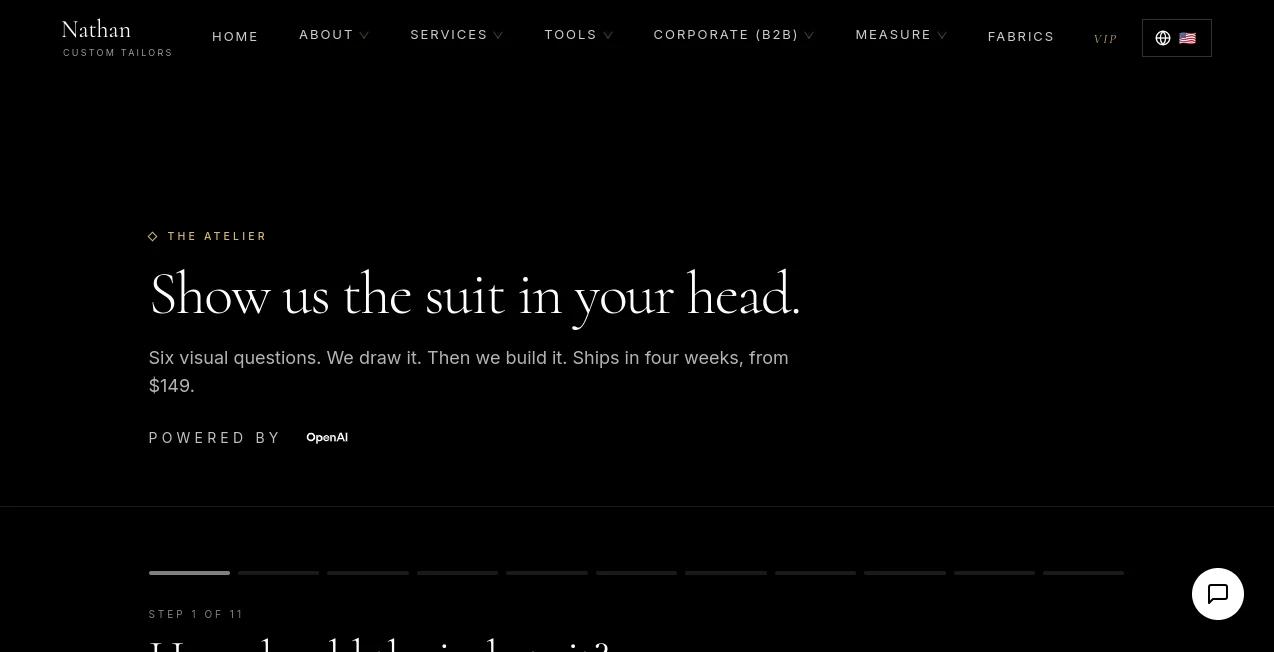
What is The Atelier?
Designing a suit usually starts with a vague idea: a certain cut, a particular lapel, a favorite color, or perhaps a look inspired by a classic film. Turning that idea into something a tailor can actually work with is another matter. This AI-powered suit design experience makes that first step much easier by letting you visualize the suit before deciding whether to have it made.
The experience is built around a simple idea: show the system the suit you have in mind, answer a handful of visual questions, and receive a rendered version of your design. You can choose details such as the jacket silhouette, lapel style, trouser shape, cloth, color, and finish. If you already know exactly what you want, you can also describe the look in your own words.
What makes the concept particularly interesting is what happens after the image is generated. The design is not intended to be just an inspirational picture. The selected details can become a working brief for human tailors in Hoi An, where the finished garment can be made to the customer's measurements and shipped internationally. The design itself is free, while custom suits start at $149.
Key Features
- AI-generated visual previews of custom suit designs.
- Multiple jacket silhouettes, including slim, classic, relaxed, and drape styles.
- Natural-language input for describing a preferred look.
- Ready-made style archetypes for users who want a faster starting point.
- Style references inspired by recognizable fashion eras and personalities.
- Detailed choices covering lapels, trouser rise, cloth, color, pattern, and finish.
- Design generations that can be carried forward as a tailor's working brief.
- Free suit design and rendering without requiring payment for the design itself.
- Worldwide delivery for customers who decide to order their finished garment.
- Integration with a remote fitting and measurement process.
User Interface
The interface takes a visual approach rather than throwing a long technical form at the user. Instead of requiring detailed knowledge of tailoring terminology, it presents visual choices and lets you compare different silhouettes. For someone who knows they want a modern suit but has no idea what distinguishes a Neapolitan shoulder from a traditional cut, this makes the process considerably less intimidating.
There is also a free-form option for people who prefer to explain an idea in ordinary language. A description such as a boxy, oversized 1990s-inspired suit can be used as a starting point. Users who would rather skip the decision-making can select an existing archetype and generate a design from there.
Accuracy & Performance
The rendering process is designed to be quick, with the website stating that a custom suit can be visualized in roughly 45 seconds. That speed is useful because it encourages experimentation. You can try a more conservative business cut, switch to a relaxed silhouette, or explore a completely different era without committing to a purchase.
It is important to understand that the generated image is a visual preview rather than a literal photograph of the final garment. Real fabric can behave differently from a digital rendering, and details such as color, drape, sheen, and proportions may vary in the finished suit. The service itself makes this distinction clear in its terms, which is a sensible limitation for any AI-generated fashion visualization.
Capabilities
The strongest part of the experience is the connection between visual design and actual tailoring. Users can make decisions about the overall silhouette as well as smaller details such as lapel width, trouser rise, cloth weight, and finish. This gives the generated image considerably more practical value than a generic fashion image generator.
There are also several curated starting points. Users can explore looks influenced by styles ranging from classic British tailoring and 1960s American fashion to Italian elegance, 1970s silhouettes, cinematic formalwear, and contemporary red-carpet styling. These presets are especially useful when you have a general aesthetic in mind but do not know how to describe it.
Once a design is selected, the tailoring process can continue through a remote consultation. Customers can receive guidance on fabric selection and measurements, with the website describing a guided measurement process that can be completed from home.
Security & Privacy
Privacy is worth considering because the service can process reference images, generated images, and body measurements as part of the design and ordering workflow. The privacy policy explains that measurements are stored with the relevant order and that uploaded measurement photographs are used for fit checking and quality control.
Reference images uploaded for AI generation may also be processed by external cloud storage and AI image-generation providers. The terms further explain that generated images may be used for galleries, social media, marketing, and related purposes under the license granted when a rendering is created. Anyone planning to upload personal photographs should therefore review the privacy policy and terms before using the service.
Use Cases
- First-time custom suit buyers: Visualizing a suit before ordering can make the custom-tailoring process much easier to understand.
- Business professionals: Users can experiment with classic, modern, or understated office-friendly silhouettes.
- Wedding planning: A groom can explore formal looks and create a visual reference before discussing the final garment.
- Fashion experimentation: People interested in different decades or tailoring traditions can test several aesthetics without buying anything.
- Remote tailoring: Customers who do not live near a tailor can create a design online and continue with a remote measurement and consultation process.
- Style discovery: Beginners can use the curated archetypes to discover cuts and proportions they may not have considered themselves.
- Custom clothing inspiration: Even users who are still deciding what they want can generate visual references to help communicate their preferences.
Pros and Cons
Pros
- Free to experiment with suit designs.
- Fast AI-generated visual previews.
- Useful visual approach for people unfamiliar with tailoring terminology.
- Supports both guided selections and natural-language descriptions.
- Offers a wide range of style references and archetypes.
- Connects digital design with a real custom-tailoring workflow.
- Custom suits start at a relatively accessible $149 price point.
- Worldwide shipping is available.
Cons
- A digital rendering cannot perfectly reproduce the appearance or behavior of real fabric.
- Customers still need to provide accurate measurements for the finished garment.
- The visual result should be treated as a design preview rather than an exact guarantee of the final suit.
- Users uploading personal or reference images should understand the applicable image-use terms.
Pricing Plans
The design and rendering experience is free to use. There are no design credits or upfront charges simply for creating a visual concept. Payment is required only if the customer decides to have the design turned into a physical garment.
Custom tailored suits start at $149, with the published range extending to $309 for merino wool. The final cost depends on the selected material and garment configuration. Customers can also arrange a free video consultation to confirm details, fabric, and measurements before production.
The website describes an approximate four-week turnaround for the full process, although delivery times can vary by destination and shipping method. Express options are also available for customers who need their garments sooner.
How to Use the AI Suit Design Tool
- Open the suit design experience and begin with the guided questions.
- Choose the jacket silhouette that best matches the look you want.
- Select additional design characteristics such as lapel shape, trouser proportions, cloth, color, and finish.
- If you already have a specific concept, describe it using your own words instead of selecting every option manually.
- Alternatively, start with one of the available style archetypes for a quicker result.
- Generate the visual preview and review the resulting suit.
- Experiment with different combinations until you find a design you genuinely like.
- If you want to order the garment, arrange a consultation and confirm the fabric and design.
- Complete the guided measurement process so the workshop has the information required for production.
- Review the final details with the tailoring team before the suit is made and shipped.
Comparison with Similar Tools
Many AI fashion applications are designed primarily for visual experimentation. They can create an attractive outfit image, but the result often remains on the screen. This experience takes a more practical approach by connecting visualization with a physical tailoring service.
That distinction matters if your goal is to actually own the suit you have designed. A conventional image generator may be better suited to creating fashion concepts, mood boards, or experimental artwork, while this platform is more focused on moving from an idea to a measurable garment.
It is also more approachable than traditional bespoke tailoring for someone who does not already speak the language of tailoring. Instead of walking into a workshop with a collection of unfamiliar terms, you can begin visually and refine the design step by step. The result can then be discussed with a real tailor before production.
Conclusion
This is an appealing example of AI being used for something more tangible than generating another image for a screen. The interesting part is not simply that artificial intelligence can produce a convincing suit rendering. It is that the rendering can serve as the starting point for a real custom garment.
The free design process makes experimentation easy, while the visual questions remove much of the guesswork for people who are new to tailoring. Experienced fashion enthusiasts can also use the more flexible description option to explore specific cuts and eras.
There are still sensible limitations: digital fabric is not physical fabric, generated proportions are not a substitute for measurements, and customers should understand how uploaded images may be handled. With those points in mind, the experience offers a genuinely useful bridge between fashion inspiration and custom clothing. For anyone who has ever imagined a particular suit but struggled to explain it to a tailor, this is a particularly enjoyable place to start.
Frequently Asked Questions (FAQ)
Is the AI suit design experience free?
Yes. Creating and rendering suit designs is free. You only pay if you decide to have the design produced as a real custom garment.
Can I describe my own suit instead of choosing preset options?
Yes. The interface includes an option to describe the desired style in your own words, which is useful when you already have a specific silhouette or fashion reference in mind.
Can the generated suit actually be made?
Yes. Designs can be converted into working tailoring briefs, with details from the design carried into the workshop for production. The finished garment is made according to the customer's measurements.
How much does a custom suit cost?
Custom suits start at $149, while the published pricing reaches $309 for merino wool. The final price depends on the selected fabric and configuration.
How long does delivery take?
The standard process is advertised at around four weeks from design to delivery, although the exact shipping time depends on the destination. Express delivery options are also available.
Do I need to visit a tailor in person?
No. The service supports remote consultations and a guided measurement process, allowing customers to provide their measurements from home and communicate with the tailoring team remotely.
Are the AI images an exact representation of the finished suit?
No. They are visual previews intended to communicate the design. Actual fabric color, drape, sheen, and proportions can differ from a digital rendering, so the final garment should be understood as a tailored physical interpretation of the design.
AI Design Generator , AI Clothing Generator .
These classifications represent its core capabilities and areas of application. For related tools, explore the linked categories above.

The Atelier Alternatives Product

Banana Pro

Nano Banana …

AI Slop Canv…
Seedream 5.0
BootstrapKing

Image to STL

Image to Thr…

Logo Animati…

Undertale Te…
